 Bug FAQ
Anoplodesmus saussurii
Anoplodesmus saussurii · Order: Polydesmida · Family: Paradoxosomatidae
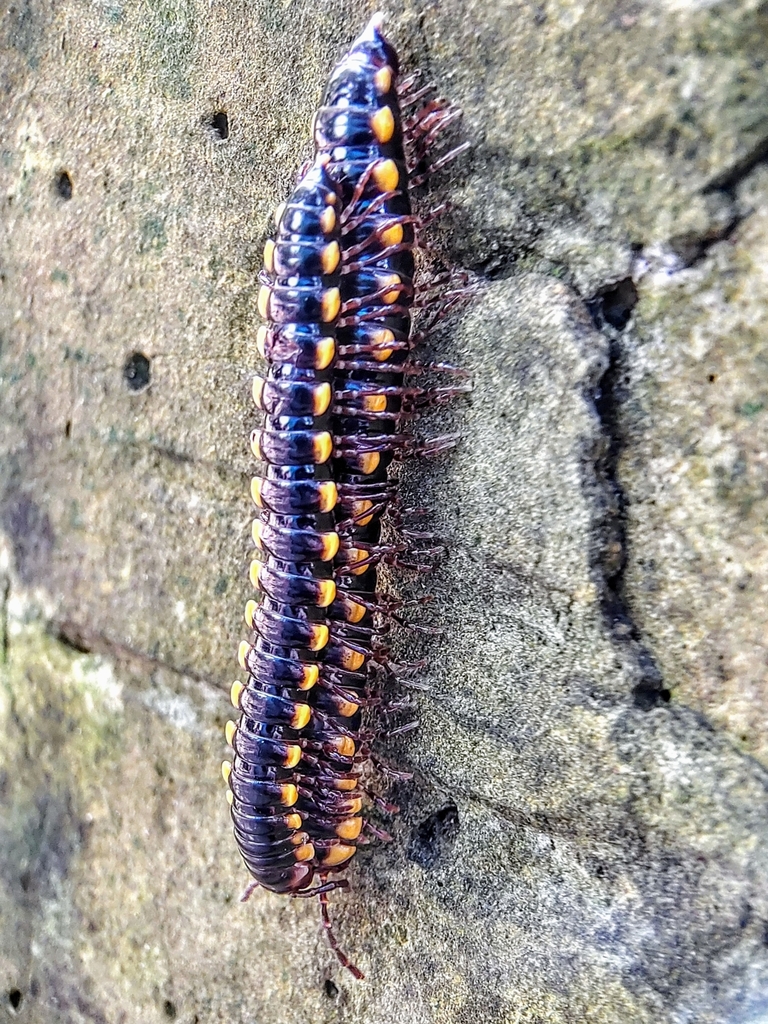
Adults are shiny dark brown to black and measure about 21 to 33 mm long. They live in large groups under decaying litter in humid agricultural, horticultural, and forest soils. They feed on decaying leaves, vegetable parts, wood, rotting fish and cow dung.
Source: Wikipedia
Size
They are about 21 to 33 mm long.
Source: Wikipedia
Where it lives
They are found in large groups under decaying litter in agricultural, horticultural, and forest soils that are humid.
Source: Wikipedia
What it eats
They eat decaying leaves, vegetable parts, wood, rotting fish, and cow dung.
Source: Wikipedia
Life cycle
Females lay 200 to 400 eggs in earthen nests after 20 to 25 days of mating and may repeat this 2 to 4 times; after seven molts the young emerge with the rainy season.
Source: Wikipedia
When you see it
Young emerge after seven molts when the rainy season begins.
Source: Wikipedia
Where it comes from
Originally thought to be South Asian only, they are also recorded in Southeast Asia, Fiji, and Mauritius.
Source: Wikipedia
Questions people ask
What do Anoplodesmus saussurii eat?
They feed on decaying leaves, vegetable parts, wood, rotting fish, and cow dung.
Source: Wikipedia
Where are they usually found?
They live in large groups under decaying litter in humid agricultural, horticultural, and forest soils.
Source: Wikipedia
What is their life cycle like?
Females lay 200 to 400 eggs in earthen nests after 20 to 25 days of mating and may do this 2 to 4 times; the young undergo seven molts and emerge with the rainy season.
Source: Wikipedia
Same family (Paradoxosomatidae)


Sources
- Wikipedia: https://en.wikipedia.org/wiki/Anoplodesmus_saussurii
Look it up elsewhere: GBIF · iNaturalist · BugGuide · Wikipedia
Text written 2026-10-22 from the sources above and checked sentence by sentence against them. Data fetched 2026-10-22.