 Bug FAQ
Black Soldier Fly
Hermetia illucens · Order: Diptera · Family: Stratiomyidae
Also called: Window-waisted Fly
Source: Wikipedia

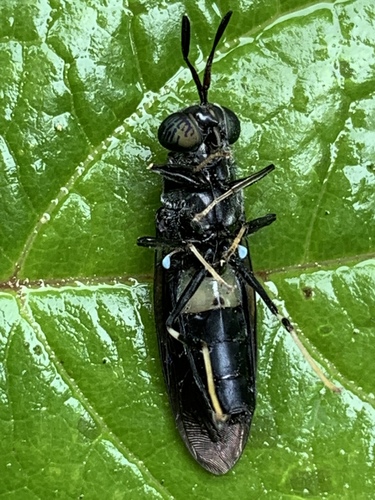
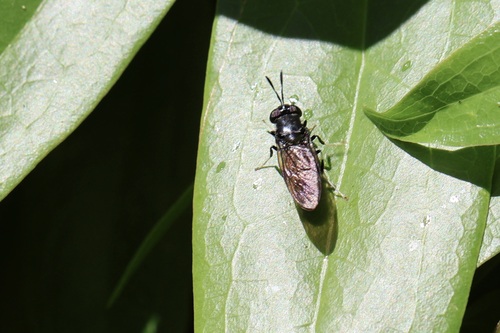
Adult black soldier flies are about 16 mm long and look like wasps with metallic blue-green reflections on the thorax. The larvae feed on many organic wastes and are used to up-cycle food scraps, while adults do not bite, sting, or spread disease.
Source: Wikipedia, Purdue Extension
How to recognize it
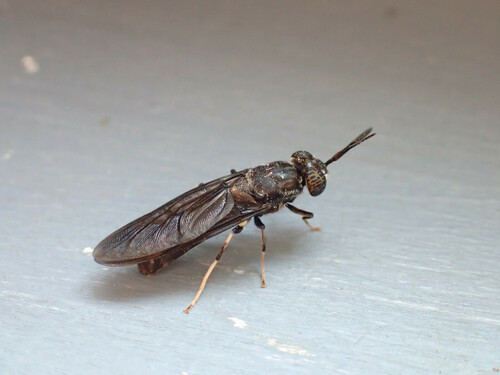
The fly has a black body with metallic blue-green reflections on the thorax and a reddish tip on the abdomen. Transparent spots on the second abdominal segment give the species its name. Clear cells on the abdomen make the fly look like a wasp.
Source: Wikipedia, Purdue Extension
Size
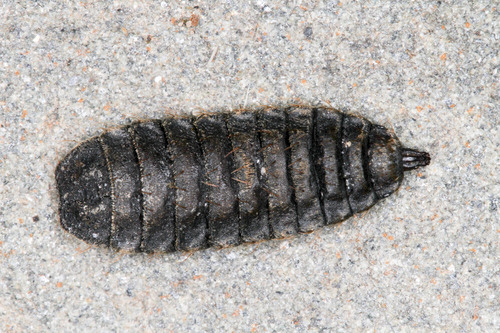
Adults are about 16 mm (5⁄8 in) long. Larvae can be told apart from housefly maggots by a thin gray-black stripe on the rear end.
Source: Wikipedia
Is it a pest in the house?
They are not considered agricultural pests or disease vectors and do not damage homes. Adults are harmless and do not feed, though they mimic wasps. The species is useful for up-cycling organic waste.
Source: Wikipedia, Purdue Extension
Does it bite or sting?
They neither bite nor sting.
Source: Wikipedia, Purdue Extension
How to get rid of it
Killing pupae in a wet grub bin reduces the adult population. Freezing, drying, feeding to animals or birds, or placing the bin in a chicken coop can also kill them. Providing an egg-laying substrate like suspended cardboard encourages adults to stay in the bin. If the bin gets too wet, drain excess water and dry it by opening the lid or adding dry material such as shredded cardboard or flour.
Source: Wikipedia, Purdue Extension
What it eats
Larvae can eat a wide range of organic material, adapting to different nutrient contents. Adults have reduced mouthparts and only sip liquids like nectar, though they usually do not feed at all.
Source: Wikipedia
Life cycle
A female lays about 200 to 600 eggs at a time. The larval stage lasts 18 to 36 days, followed by a prepupal stage of about 7 days.
Source: Wikipedia
When you see it
Adults can live 47 to 73 days with water and food, or survive 8 to 10 days on stored fat when only water is available.
Source: Wikipedia
Where it comes from
The species is native to the Neotropical realm and also occurs in Afrotropical, Australasian, east Palaearctic, Nearctic, North and Southern Africa, and Indomalayan regions such as India and Pakistan.
Source: Wikipedia
Lookalikes
They closely resemble organ-pipe mud-dauber wasps in size, color and shape. Mimicry is enhanced by elongated antennae, pale hind tarsi and two transparent windows that give a narrow waist appearance.
Source: Wikipedia
Where it is found in the US
Recorded in 47 of 51 states and DC. Most records: California, Texas, Florida, North Carolina, Virginia, Oregon, Georgia, New York.
Darker = more records. Counts are museum and citizen-science records, not population size.
Source: GBIF
Status: introduced in Canada. Source: iNaturalist
Months it is reported in the US
Source: GBIF
More photos
Questions people ask
Do black soldier flies bite or sting?
No, they neither bite nor sting.
Source: Wikipedia, Purdue Extension
How can I get rid of them in my compost bin?
Kill the pupae in the bin, keep it dry, or feed the larvae to animals or birds.
Source: Wikipedia
Why do they look like wasps?
They mimic wasps with clear abdominal windows, metallic reflections and a narrow waist shape.
Source: Purdue Extension, Wikipedia
Same family (Stratiomyidae)



Sources
- Wikipedia: https://en.wikipedia.org/wiki/Hermetia_illucens
- Purdue Extension: https://extension.entm.purdue.edu/publications/E-276/E-276.html
Look it up elsewhere: GBIF · iNaturalist · BugGuide · ITIS · Wikipedia
Text written 2026-10-23 from the sources above and checked sentence by sentence against them. Data fetched 2026-10-23.