 Bug FAQ
Common Shiny Woodlouse
Oniscus asellus · Order: Isopoda · Family: Oniscidae
Also called: Common Woodlouse, Grey Garden Woodlouse
Source: entomology.ca.uky.edu

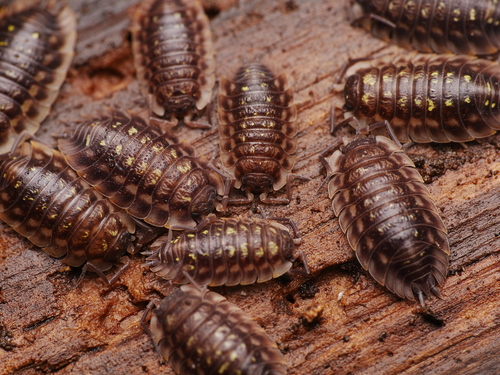
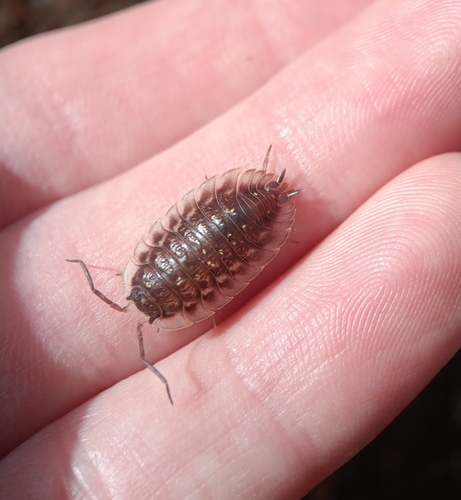
The common woodlouse grows to about 16 mm long and 6 mm wide and is shiny brown-grey in colour, sometimes paler. It prefers damp places such as under rotting wood, in gardens, walls and even inside houses, and its presence indoors can indicate excess moisture.
Source: Wikipedia, entomology.ca.uky.edu
How to recognize it
Adults are relatively flat and have a glossy brown-grey shell, while juveniles show rough bumps and orange spots. Sowbugs can be told apart by the two visible tail-like uropods and their inability to roll into a ball.
Source: Wikipedia, entomology.ca.uky.edu
Size
They can reach up to 16 mm (0.63 in) in length and about 6 mm (0.24 in) in width.
Source: Wikipedia
Is it a pest in the house?
They are common indoor visitors but do not harm people or pets. Finding many of them inside may point to a moisture problem or gaps in seals around doors, windows or foundations. Historically they have been noted in houses, rotting wood, hibernacula and walls.
Source: entomology.ca.uky.edu, Wikipedia
Does it bite or sting?
Pill bugs and sowbugs cannot bite or sting and are harmless to humans.
Source: entomology.ca.uky.edu, yardandgarden.extension.iastate.edu
How to get rid of it
Reducing moisture makes it very hard for them to survive indoors. Applying pyrethroid around the foundation in spring or fall can limit entry. Sealing cracks and gaps in foundations, doors and windows often stops them from getting inside. Residual insecticide treatments can be used both inside and outside to control them.
Source: entomology.ca.uky.edu, yardandgarden.extension.iastate.edu
Where it lives
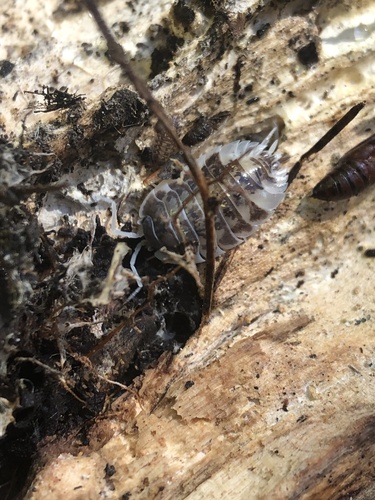
They live in many damp habitats, especially under decaying wood. They also thrive in human-made environments like gardens, walls and houses.
Source: Wikipedia
What it eats
They have a sweet, crab-like taste with a strong umami flavour.
Source: Wikipedia
Life cycle
When moulting, the rear half sheds before the front half. After shedding, they often eat the discarded exoskeleton.
Source: Wikipedia
Where it comes from
Its range extends from Portugal to Sweden and east to Ukraine, including the Azores and Madeira, but it is rarer in the Mediterranean.
Source: Wikipedia
Lookalikes
Juvenile woodlice may be confused with Porcellio scaber because of their bumpy orange markings. Pill bugs can roll into a ball and lack visible tail appendages, a trait that gives them the nickname “roly-polies”.
Source: Wikipedia, entomology.ca.uky.edu, yardandgarden.extension.iastate.edu
Where it is found in the US
Recorded in 33 of 51 states and DC. Most records: New York, Massachusetts, Pennsylvania, Washington, Michigan, Ohio, Vermont, Oregon.
Darker = more records. Counts are museum and citizen-science records, not population size.
Source: GBIF
Status: introduced in North America; introduced in United States; introduced in Canada. Source: iNaturalist
Months it is reported in the US
Source: GBIF
More photos

Questions people ask
Do they bite or sting?
No, they cannot bite or sting and are harmless to people.
Source: entomology.ca.uky.edu
Why are they inside my house?
Their presence indoors usually signals excess moisture or gaps that let them enter.
Source: entomology.ca.uky.edu
How can I get rid of them?
Lower indoor humidity, seal entry points, and consider perimeter pyrethroid or residual insecticide treatments.
Source: entomology.ca.uky.edu, yardandgarden.extension.iastate.edu
What do they look like?
Adults are flat, shiny brown-grey; juveniles have rough bumps and orange spots, and sowbugs have two tail-like uropods.
Source: Wikipedia, entomology.ca.uky.edu
Sources
- entomology.ca.uky.edu: https://entomology.ca.uky.edu/ef439
- Wikipedia: https://en.wikipedia.org/wiki/Oniscus_asellus
- yardandgarden.extension.iastate.edu: https://yardandgarden.extension.iastate.edu/encyclopedia/sowbugs-and-pillbugs
Look it up elsewhere: GBIF · iNaturalist · BugGuide · ITIS · Wikipedia
Text written 2026-10-23 from the sources above and checked sentence by sentence against them. Data fetched 2026-10-23.