 Bug FAQ
Copper Demoiselle
Calopteryx haemorrhoidalis · Order: Odonata · Family: Calopterygidae
Also called: Mediterranean Demoiselle
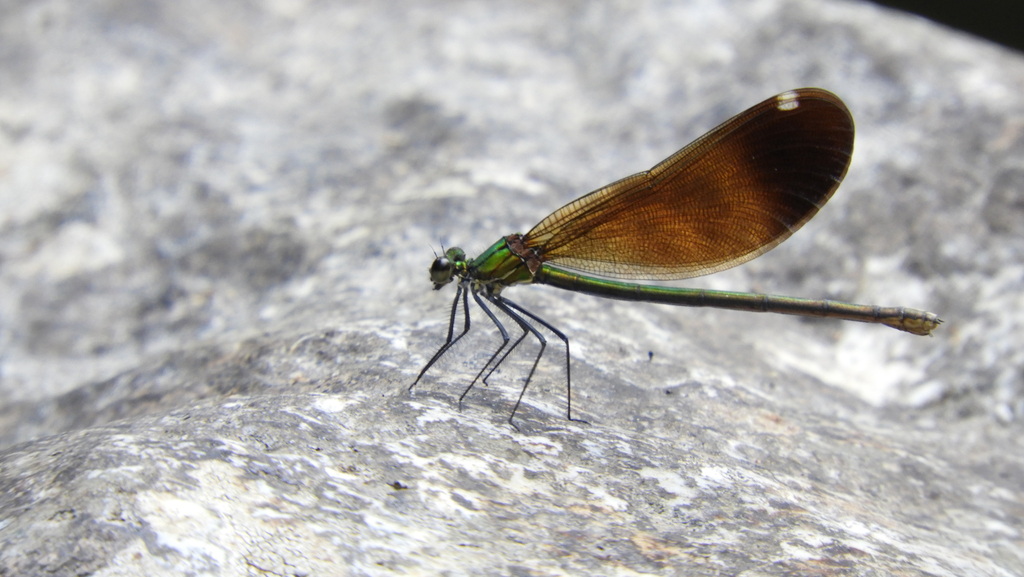
It lives beside rivers, streams and sunny larger waters in the western Mediterranean region, flying from May through September, and may be affected by water pollution. Males and females differ in wing length, with males having 23 to 32 mm and females 25 to 37 mm wings, and the whole insect measures about 45 to 48 mm in body length.
Source: Wikipedia
Size
Body length is about 45 to 48 mm (1.8 to 1.9 in). Male wing length ranges 23 to 32 mm (0.91 to 1.26 in) and female wing length 25 to 37 mm (0.98 to 1.46 in).
Source: Wikipedia
Where it lives
It lives along rivers, streams, and sunny larger water bodies. Water pollution can affect its populations.
Source: Wikipedia
When you see it
Adults are on the wing from May to September.
Source: Wikipedia
Where it comes from
Native to the western Mediterranean Basin, including Iberia, southern France, Italy, Monaco, and North African countries such as Algeria, Morocco, and Tunisia.
Source: Wikipedia
Lookalikes
It can hybridize with the banded demoiselle, Calopteryx splendens.
Source: Wikipedia
Questions people ask
When can I see copper demoiselles?
Adults are active from May through September, usually near rivers, streams, and sunny water bodies.
Source: Wikipedia
Same family (Calopterygidae)


Sources
- Wikipedia: https://en.wikipedia.org/wiki/Calopteryx_haemorrhoidalis
Look it up elsewhere: GBIF · iNaturalist · BugGuide · Wikipedia
Text written 2026-10-22 from the sources above and checked sentence by sentence against them. Data fetched 2026-10-22.