 Bug FAQ
Dark-footed Yellow Loosestrife Bee
Macropis nuda · Order: Hymenoptera · Family: Melittidae
Also called: Dark-legged Yellow Loosestrife Bee
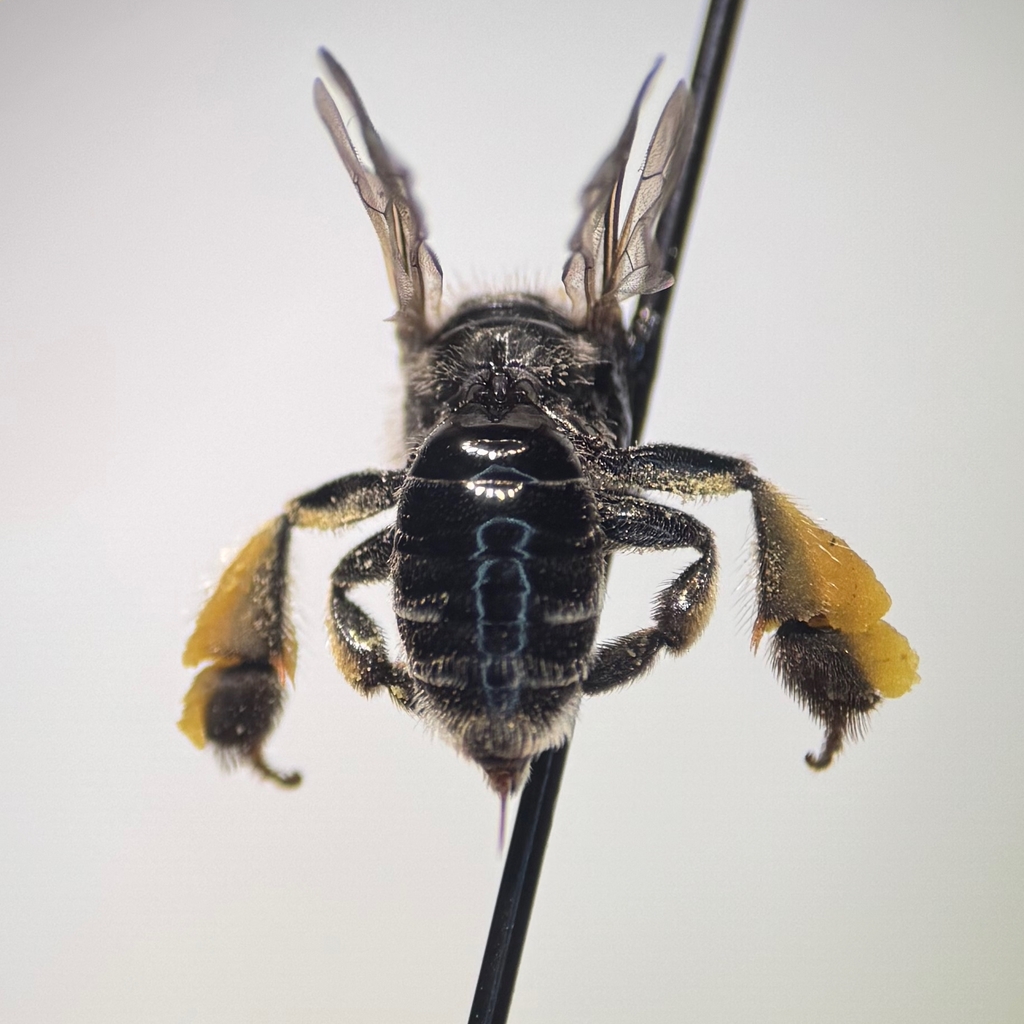
The dark-footed yellow loosestrife bee is about 7 to 7.5 mm long and females are entirely dark-black while males have a completely yellow front head plate. It lives in northern North America, nesting in shady, dry, sandy-loam soils, and feeds exclusively on oil and pollen from the plant Lysimachia ciliata, though it also drinks nectar from other flowers. The species is solitary, produces one brood per year, overwinters as mature pupae in cocoons, and females become sexually mature soon after emerging to build nests.
Source: Wikipedia
How to recognize it
Females have a completely dark black head, thorax and abdomen. Males show yellow markings on the head, with the front plate entirely yellow.
Source: Wikipedia
Size
Both sexes measure roughly 7 to 7.5 mm in length.
Source: Wikipedia
Where it lives
It is native to northern North America and females nest in shady areas of dry, sandy-loam soil.
Source: Wikipedia
What it eats
It is an oligolectic bee that collects floral oils and pollen only from Lysimachia ciliata. Females also drink nectar from a variety of flowers but use only Lysimachia ciliata for oil and pollen provisioning.
Source: Wikipedia
Life cycle
The bee is solitary; females dig their own ground nests and produce a single brood each season, with offspring hibernating in the nest until the next year. Both males and females overwinter as mature pupae in cocoons and resume development in spring as temperatures rise.
Source: Wikipedia
When you see it
There are no distinct mating rituals reported for this species. Females reach sexual maturity shortly after emerging and begin constructing nests.
Source: Wikipedia
Where it comes from
Its range extends from British Columbia, Idaho and Utah eastward to Newfoundland and New Jersey. It is native to northern North America.
Source: Wikipedia
Lookalikes
It can be parasitized by the cuckoo bee Epeoloides pilosulus.
Source: Wikipedia
Where it is found in the US
Recorded in 22 of 51 states and DC. Most records: New York, Illinois, North Dakota, Massachusetts, Vermont, Utah, Maine, Connecticut.
Darker = more records. Counts are museum and citizen-science records, not population size.
Source: GBIF
Status: native in North America; native in Canada; native in United States. Source: iNaturalist
Months it is reported in the US
Source: GBIF
More photos
Questions people ask
What plants does this bee rely on for food?
It gathers oil and pollen only from the plant Lysimachia ciliata, though it also drinks nectar from other flowers.
Source: Wikipedia
How can I recognize a male versus a female?
Males have yellow markings on the head with a completely yellow front plate, while females are entirely dark black on head, thorax and abdomen.
Source: Wikipedia
When are the adults active?
Adults emerge in spring after overwintering as mature pupae; females become sexually mature soon after emergence and start building nests.
Source: Wikipedia
Same family (Melittidae)


Sources
- Wikipedia: https://en.wikipedia.org/wiki/Macropis_nuda
Look it up elsewhere: GBIF · iNaturalist · BugGuide · ITIS · Wikipedia
Text written 2026-10-24 from the sources above and checked sentence by sentence against them. Data fetched 2026-10-24.