 Bug FAQ
Hairy Chinch Bug
Blissus leucopterus · Order: Hemiptera · Family: Blissidae
Source: Wikipedia
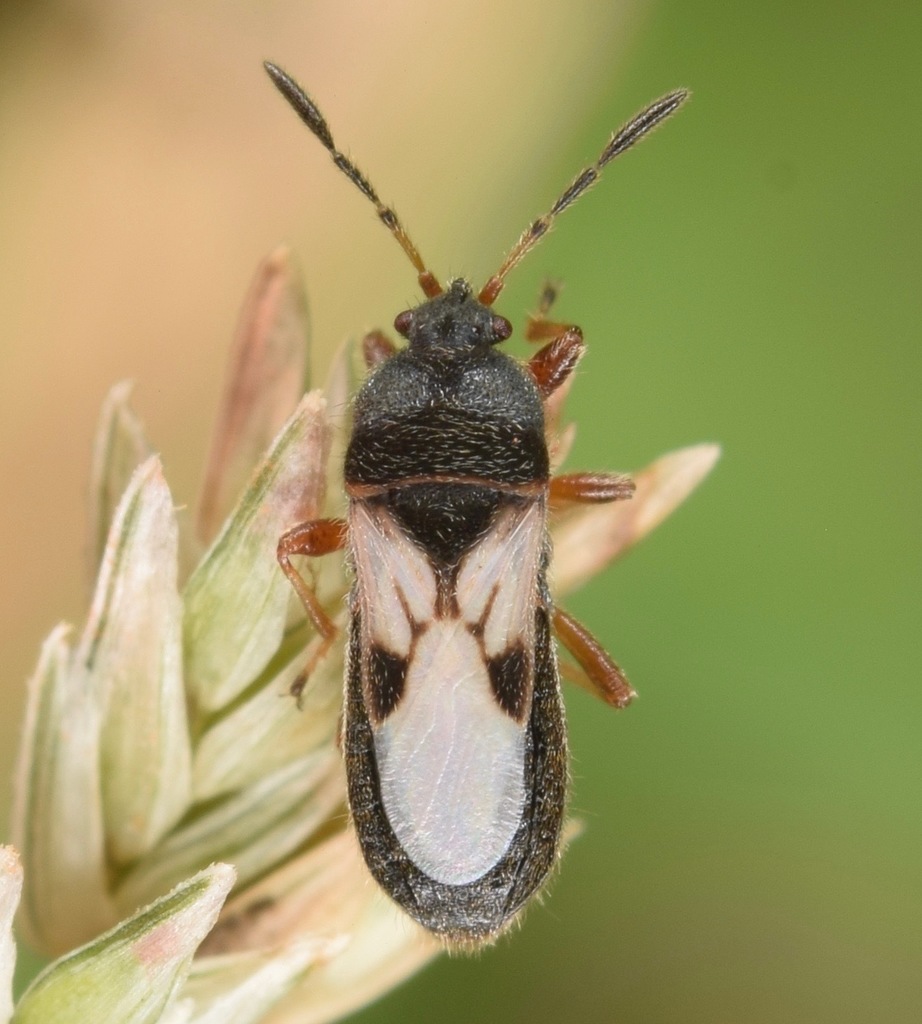
How to recognize it
Adults vary from dark red to brown, have white wings and red legs. Nymphs are bright red, about half the adult size, and show a white band on the abdomen.
Source: Wikipedia
Size
Fully grown bugs are about 4 mm (0.16 in) long.
Source: Wikipedia
Is it a pest in the house?
They are a common lawn pest and can become problematic by feeding on turfgrass stems and grain crops.
Source: Wikipedia
How to get rid of it
Control methods include pesticide applications and planting pest-resistant grasses. Farmers may rotate to soybeans, which are not a host for the chinch bug.
Source: Wikipedia
Where it lives
They are found on sunny, open turfgrass patches. Adults overwinter in various shelters such as hedgerows, fence rows, woodland edges, soybean stubble, under bark, in bunch grass, and even inside field-mouse nests.
Source: Wikipedia
What it eats
They feed on grasses, both wild and cultivated, sucking the sap from plants like wheat, rye, barley, oats and corn.
Source: Wikipedia
Life cycle
The bug lives less than a year, with two generations of eggs laid from spring to summer that develop into adults.
Source: Wikipedia
When you see it
In April to May adults move to small-grain fields and begin feeding on sap. From July to October they continue feeding, breeding and produce a second generation.
Source: Wikipedia
Where it comes from
The species is native to North America, occurring throughout the United States, southern Canada, Mexico and Central America.
Source: Wikipedia
Lookalikes
A closely related species is the southern chinch bug (Blissus insularis).
Source: Wikipedia
Where it is found in the US
Recorded in 29 of 51 states and DC. Most records: Mississippi, Illinois, Iowa, Texas, Kansas, Ohio, Oklahoma, Florida.
Darker = more records. Counts are museum and citizen-science records, not population size.
Source: GBIF
Status: native in North America; native in Canada. Source: iNaturalist
Months it is reported in the US
Source: GBIF
More photos

Questions people ask
What damage do they cause?
They feed on the sap of turfgrass and grain crops, damaging lawns and reducing yields of wheat, rye, barley, oats and corn.
Source: Wikipedia
When are they most active?
Adults are active in April to May on small-grain fields, and a second generation feeds and breeds from July to October.
Source: Wikipedia
How can I control them?
Use pesticides and plant pest-resistant grasses, or switch crops to soybeans, which they do not feed on.
Source: Wikipedia
Sources
- Wikipedia: https://en.wikipedia.org/wiki/Blissus_leucopterus
Look it up elsewhere: GBIF · iNaturalist · BugGuide · ITIS · Wikipedia
Text written 2026-10-23 from the sources above and checked sentence by sentence against them. Data fetched 2026-10-23.