 Bug FAQ
Malabar torrent dart
Euphaea fraseri · Order: Odonata · Family: Euphaeidae
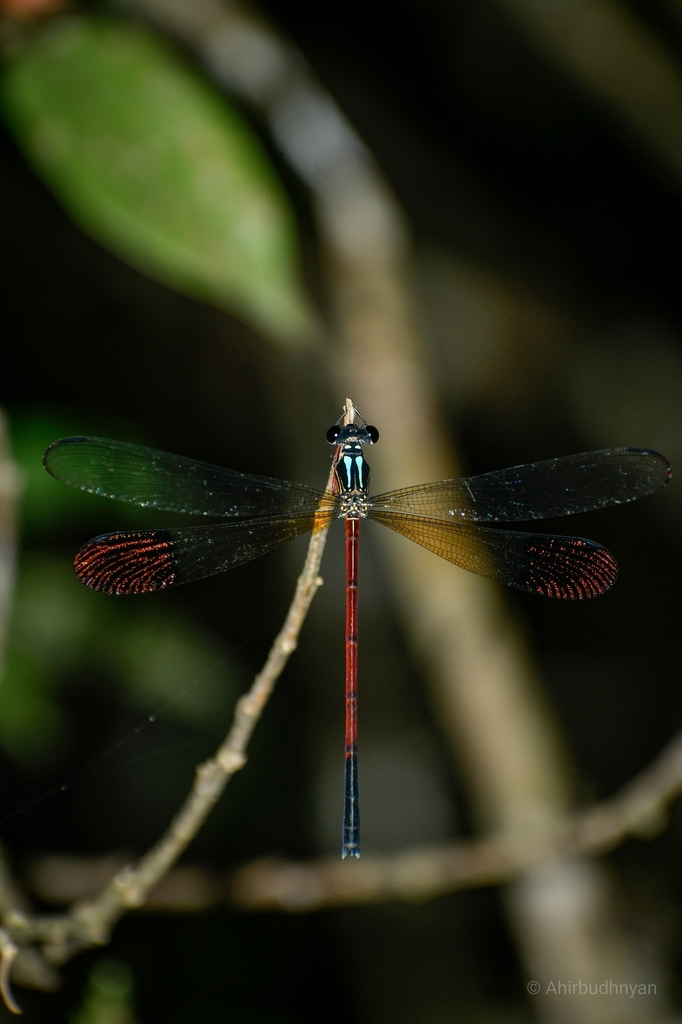
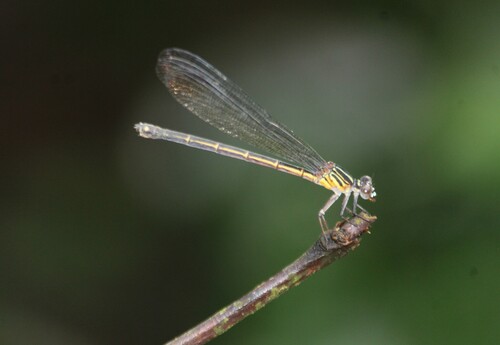
The Malabar torrent dart is a medium-sized damselfly with a black head, brown-capped pale grey eyes, a black thorax marked by sky-blue and reddish-yellow stripes, and a bright red abdomen that turns black at the tip. It breeds in lower-elevation hill streams, where males sit on low vegetation along the banks or in the middle of the water, and it is endemic to the Western and Eastern Ghats of India, extending to coastal Maharashtra.
Source: Wikipedia
How to recognize it
The thorax is black with a sky-blue stripe near the shoulder and a reddish-yellow stripe on the humeral area. The abdomen is bright red up to segment 7, after which the tip becomes black.
Source: Wikipedia
Where it lives
It breeds in hill streams at lower elevations. Males are usually seen on low herbage along the banks or in the middle of the streams.
Source: Wikipedia
Lookalikes
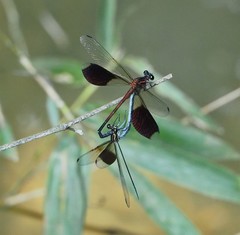
Its wings are narrower than those of Euphaea cardinalis, and the hind-wings are shorter than the fore-wings. The legs are red like E. cardinalis, but the first pair of legs is dark.
Source: Wikipedia
More photos
Questions people ask
Where can I find the Malabar torrent dart?
It lives in hill streams at lower elevations, with males perching on low plants along the banks or in the middle of the water, and it is native to the Western and Eastern Ghats of India, reaching coastal Maharashtra.
Source: Wikipedia
How can I tell this damselfly apart from similar species?
Its wings are narrower than those of Euphaea cardinalis and the hind-wings are shorter than the fore-wings; the legs are red but the first pair is dark.
Source: Wikipedia
Same family (Euphaeidae)
Sources
- Wikipedia: https://en.wikipedia.org/wiki/Euphaea_fraseri
Look it up elsewhere: GBIF · iNaturalist · BugGuide · Wikipedia
Text written 2026-10-24 from the sources above and checked sentence by sentence against them. Data fetched 2026-10-23.