 Bug FAQ
Hide beetle (Omorgus suberosus)
Omorgus suberosus · Order: Coleoptera · Family: Trogidae
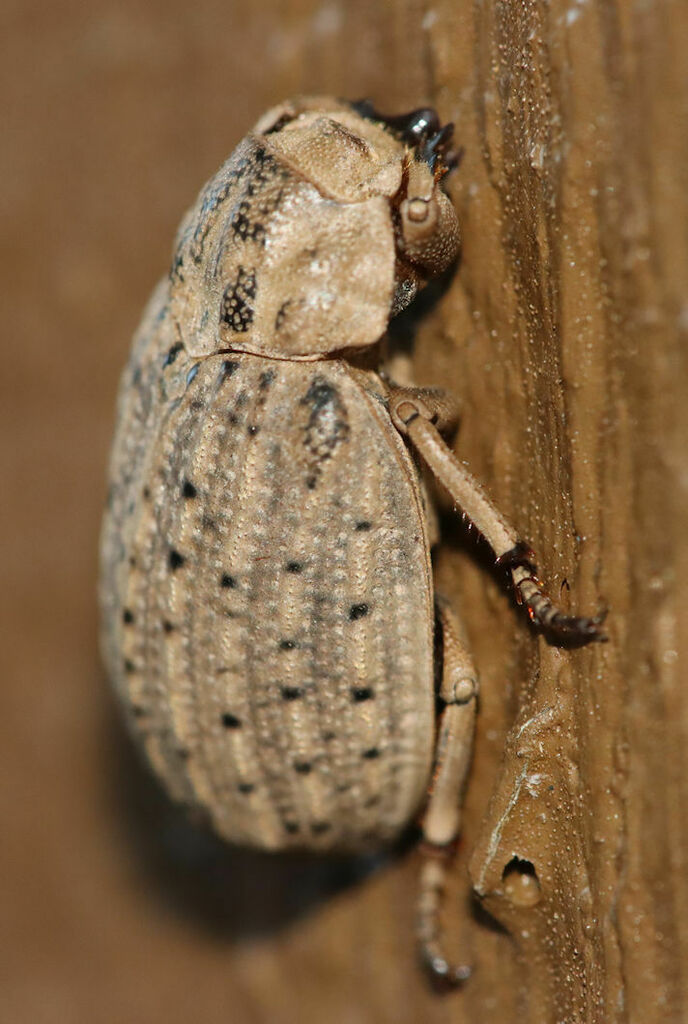
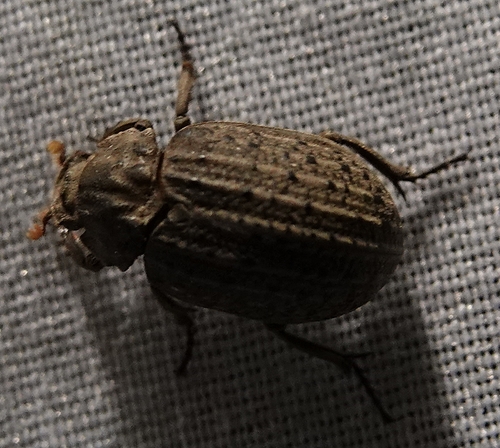
The hide beetle is a small, rough-shelled beetle about 11 to 14 mm long with a pale brown, convex back and fine hairs on its pronotum. It lives in many parts of the world, from Central and South America through parts of Europe to several Australian states, and feeds on dead animal material.
Source: Wikipedia
How to recognize it
Its back is convex, very rough with ridges and bumps, and is pale brown in color. The pronotum carries long, fine hairs.
Source: Wikipedia
Size
Adults measure between 11 and 14 mm in length.
Source: Wikipedia
Where it lives
Adults survive the winter months in a dormant state.
Source: Wikipedia
What it eats
The species feeds on carrion.
Source: Wikipedia
Life cycle
Adults overwinter and resume activity when conditions improve.
Source: Wikipedia
Where it comes from
It is also found in the Czech Republic, Hungary, Spain, and several Australian states.
Source: Wikipedia
Where it is found in the US
Recorded in 33 of 51 states and DC. Most records: Arizona, Texas, New Mexico, Kentucky, Florida, California, Michigan, Alabama.
Darker = more records. Counts are museum and citizen-science records, not population size.
Source: GBIF
Months it is reported in the US
Source: GBIF
More photos
Questions people ask
Where are hide beetles found?
They live from the southern United States through South America, as well as parts of Europe and Australia.
Source: Wikipedia
Sources
- Wikipedia: https://en.wikipedia.org/wiki/Omorgus_suberosus
Look it up elsewhere: GBIF · iNaturalist · BugGuide · ITIS · Wikipedia
Text written 2026-10-24 from the sources above and checked sentence by sentence against them. Data fetched 2026-10-24.