 Bug FAQ
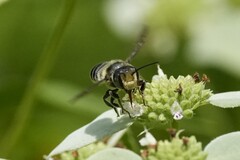
Patchwork Leafcutter Bee
Megachile centuncularis · Order: Hymenoptera · Family: Megachilidae
Also called: Megachile leaf-cutter bee, Patchwork Leaf-Cutter Bee

The patchwork leafcutter bee is about two centimetres long and is common in gardens across both rural and urban areas. It lives in eastern Ireland and southern Britain, and its native range stretches across northern Europe from Scandinavia to Spain and Italy, as well as North America. Adults feed on nectar from thistles and brambles and collect pollen from many flowers, including asters, legumes and St. John’s-wort, while the species overwinters as a pupa or mature larva.
Source: Wikipedia
Size
It measures roughly two centimetres (about 0.8 in) in length.
Source: Wikipedia
Where it lives
It is found in eastern Ireland and especially in the southern part of Britain.
Source: Wikipedia
What it eats
Adults sip nectar from a variety of flowers, notably thistles and brambles. They gather pollen from many plant families such as Asteraceae, Fabaceae and Hypericaceae to provision their nests.
Source: Wikipedia
Life cycle
In temperate zones the bee overwinters, emerging later as either a pupa or a fully developed larva.
Source: Wikipedia
When you see it
It is a common species that visits both rural and urban gardens throughout the season.
Source: Wikipedia
Where it comes from
The species is native to the northern hemisphere, occurring in both North America and Eurasia. In western Europe its range runs from Norway, Sweden and Finland down to Spain and Italy.
Source: Wikipedia
Where it is found in the US
Recorded in 32 of 51 states and DC. Most records: New York, North Dakota, Illinois, Michigan, New Jersey, Massachusetts, Oregon, Utah.
Darker = more records. Counts are museum and citizen-science records, not population size.
Source: GBIF
Status: native in North America; native in United States; native in Canada. Source: iNaturalist
Months it is reported in the US
Source: GBIF
More photos
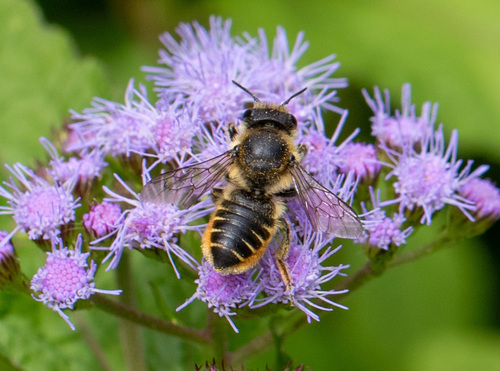
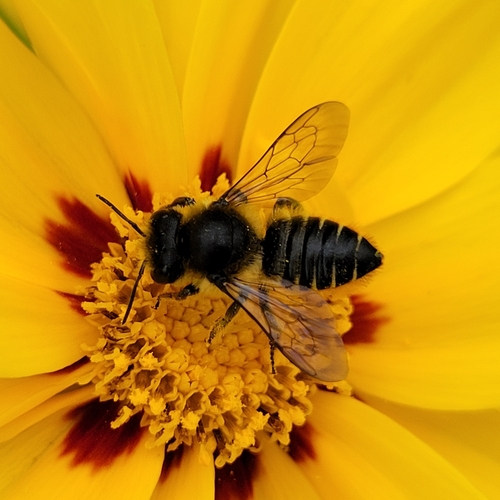
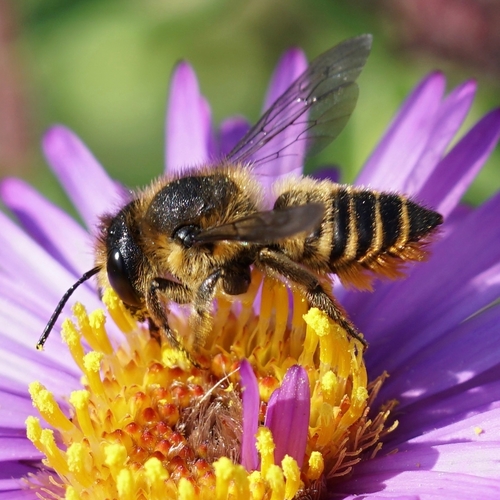
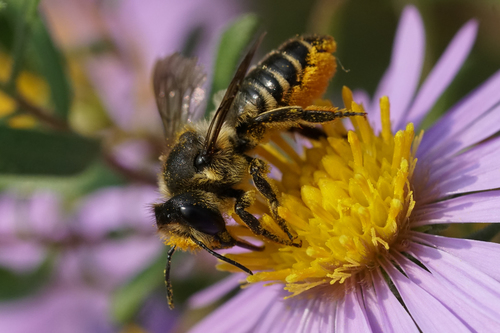
Same family (Megachilidae)

Sources
- Wikipedia: https://en.wikipedia.org/wiki/Megachile_centuncularis
Look it up elsewhere: GBIF · iNaturalist · BugGuide · ITIS · Wikipedia
Text written 2026-10-24 from the sources above and checked sentence by sentence against them. Data fetched 2026-10-24.