 Bug FAQ
River Clubtail
Stylurus flavipes · Order: Odonata · Family: Gomphidae
Also called: Yellow-legged Clubtail, Yellow-Legged Dragonfly, Yellow-legged Club-tail, Yellow-legged Club-tailed Dragonfly

The River Clubtail is a medium-sized dragonfly about 5 to 5.5 cm long with a wingspan of 7 to 8 cm. Adults are predators that catch smaller insects in flight.
Source: Wikipedia
How to recognize it
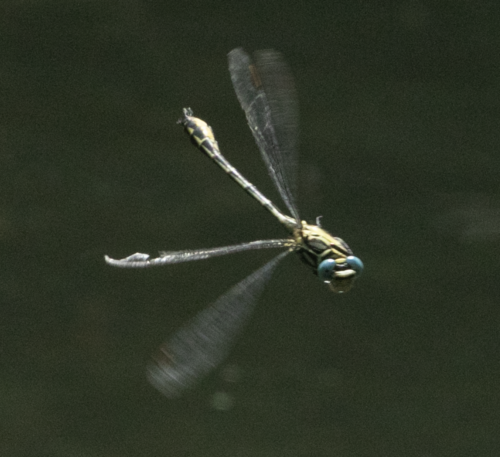
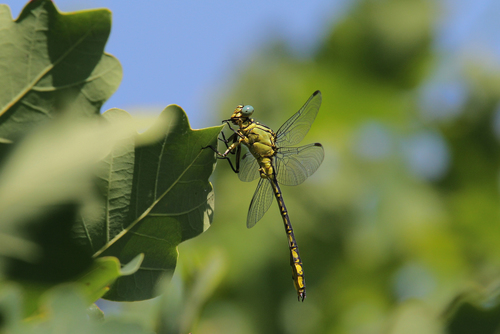
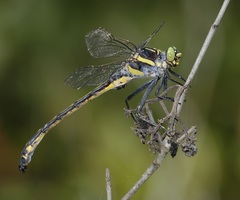
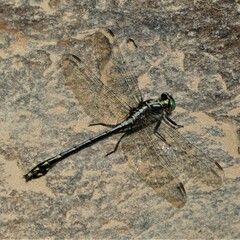
Both sexes have mainly yellow legs; males have thin angled appendages and a completely black dorsal 10th abdominal segment. Males have blue eyes while females have green eyes.
Source: Wikipedia
Size
Adults measure 50 to 55 mm in length with a wingspan of 70 to 80 mm.
Source: Wikipedia
Where it lives
They are found along the middle and lower parts of slow-flowing medium-sized to large rivers. The species prefers riverbeds with mud, clay, loam or fine sand, where the larvae live buried in the soil.
Source: Wikipedia
What it eats
Adults are aerial predators that capture smaller insects while flying. Both larvae and adults use a specialized labium (“mask”) to seize small invertebrates.
Source: Wikipedia
Life cycle
Larvae develop for about three years buried in the fine river-bed soil. Adult emergence usually occurs at the end of May or June, depending on location and conditions.
Source: Wikipedia
When you see it
Adults are on the wing from June through September, varying with locality. Mating typically takes place in June or July.
Source: Wikipedia
Where it comes from
The River Clubtail is a European species. Its range stretches from France eastward to Siberia, making it the most widely distributed European gomphid.
Source: Wikipedia
More photos
Questions people ask
When can I expect to see adult River Clubtails?
Adults usually emerge at the end of May or June and are active from June to September, depending on the region.
Source: Wikipedia
What do River Clubtails eat?
Both the larvae and the flying adults are predators that catch small insects and other invertebrates.
Source: Wikipedia
How can I tell male and female River Clubtails apart?
Males have blue eyes, thin angled appendages, and a completely black dorsal 10th abdominal segment, while females have green eyes.
Source: Wikipedia
Same family (Gomphidae)



Sources
- Wikipedia: https://en.wikipedia.org/wiki/Gomphus_flavipes
Look it up elsewhere: GBIF · iNaturalist · BugGuide · Wikipedia
Text written 2026-10-24 from the sources above and checked sentence by sentence against them. Data fetched 2026-10-23.