 Bug FAQ
Sunburst Diving Beetle
Thermonectus marmoratus · Order: Coleoptera · Family: Dytiscidae
Also called: Yellow-spotted Diving Beetle

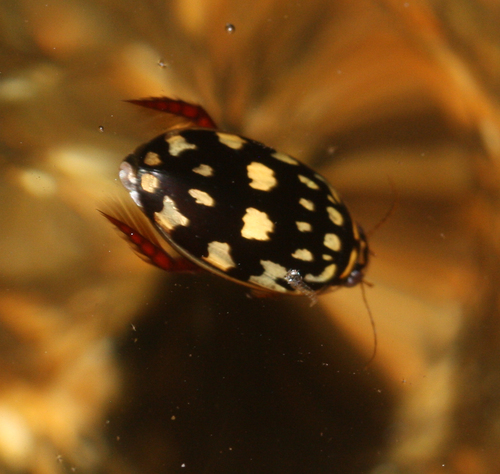
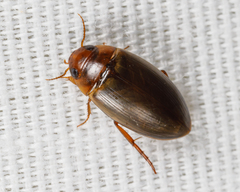
The sunburst diving beetle is a small aquatic beetle about 0.8 to 1.5 cm long, with females a bit larger than males. It has a black, streamlined carapace marked with bright yellow or golden spots, and males carry a suction disk on each foreleg. It lives in shallow, slow-moving freshwater pools and creeks in the southwestern United States and Mexico, and will fly to a new water source when its habitat dries up.
Source: Wikipedia
How to recognize it
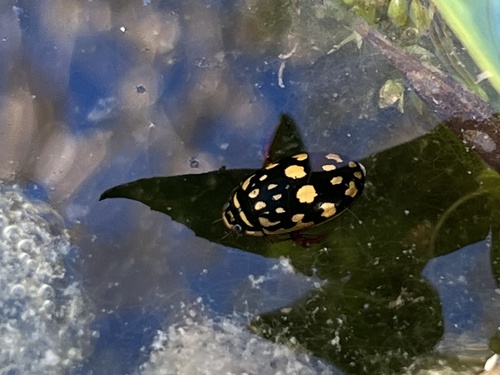
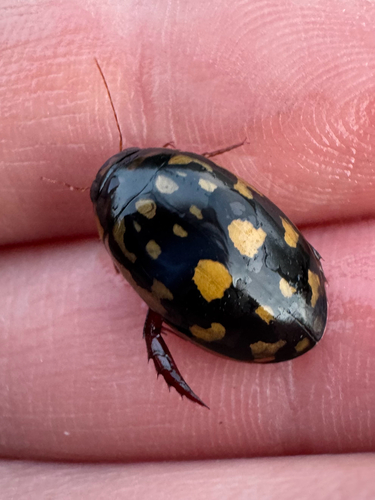
The beetle’s carapace is black and smooth, dotted with bright yellow or golden spots. Males have a suction disk on each foreleg, which helps them cling to surfaces.
Source: Wikipedia
Size
Adults measure between 0.8 and 1.5 cm in length, with females slightly larger than males.
Source: Wikipedia
Where it lives
They prefer slow-moving, shallow freshwater habitats such as temporary pools and arroyos that have little or no aquatic vegetation. When the water dries up, the beetles will fly to locate a new suitable habitat.
Source: Wikipedia
What it eats
In the wild they are predators and scavengers, feeding on small aquatic invertebrates, snails, other insects, and even tiny fish or tadpoles. In captivity they will accept fish flakes and live crickets as food.
Source: Wikipedia
Life cycle
Females lay white, opaque eggs that are 3.5 to 4 mm long.
Source: Wikipedia
Where it comes from
They are native to extreme southern California, southern Utah, Arizona, New Mexico, Texas, and Mexico.
Source: Wikipedia
Where it is found in the US
Recorded in 6 of 51 states and DC. Most records: Arizona, Texas, California, New Mexico, Utah, Nevada.
Darker = more records. Counts are museum and citizen-science records, not population size.
Source: GBIF
Months it is reported in the US
Source: GBIF
More photos

Questions people ask
How can I recognize a sunburst diving beetle?
Look for a small black beetle about 1 cm long with bright yellow or golden spots on its smooth carapace; males have a suction disk on each foreleg.
Source: Wikipedia
Where does this beetle live?
It lives in shallow, slow-moving freshwater pools and creeks in southern California, Utah, Arizona, New Mexico, Texas, and Mexico, and will fly to new water when its habitat dries up.
Source: Wikipedia
What does the sunburst diving beetle eat?
In nature it preys on small aquatic insects, snails, and even tiny fish or tadpoles; in captivity it will eat fish flakes and live crickets.
Source: Wikipedia
How fast does it develop from egg to adult?
The beetle develops from egg to adult in about 28 days, pupating on land after the eggs hatch.
Source: Wikipedia
Same family (Dytiscidae)




Sources
- Wikipedia: https://en.wikipedia.org/wiki/Thermonectus_marmoratus
Look it up elsewhere: GBIF · iNaturalist · BugGuide · ITIS · Wikipedia
Text written 2026-10-24 from the sources above and checked sentence by sentence against them. Data fetched 2026-10-24.