 Bug FAQ
Turkey Brown
Paraleptophlebia submarginata · Order: Ephemeroptera · Family: Leptophlebiidae

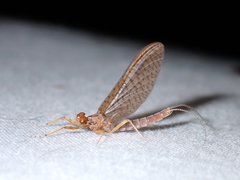
Turkey Brown mayflies are 9 to 12 mm long, have dark brown bodies with a darker dorsal pattern, and transparent wings about 12 to 14 mm long that show clear veins. They live in stony upper- and middle-course rivers across most of Europe, where larvae hide among moss on stones and feed on tiny organic particles, while adults do not feed at all. The insect spends most of its life as a nymph, the subimago stage lasts about 20 hours and the adult (imago) lives up to three days, appearing from early April to mid-September.
Source: Wikipedia
How to recognize it
The body is very dark brown with a distinct darker marking on the back, and the wings are clear with visible ribs. Males have three long tail-like cerci up to 15 mm, while females have shorter cerci up to 12 mm.
Source: Wikipedia
Size
Adults reach 9 to 12 mm in body length. Front wings are long and triangular; hind wings are about one-third the size of the front wings and more rounded.
Source: Wikipedia
Where it lives
They are abundant in stony upper- and middle-course rivers and streams throughout most of Europe. Larvae live among moss on the surfaces of stones.
Source: Wikipedia
What it eats
Larvae eat small organic particles such as algae, plant residues, and decaying plant material. Adult mayflies do not feed.
Source: Wikipedia
Life cycle
Most of the life is spent as a nymph in the water. The subimago stage lasts about 20 hours, and the adult (imago) lives up to three days.
Source: Wikipedia
When you see it
Adults can be seen from early April through mid-September.
Source: Wikipedia
Where it comes from
The species is native to and very common in European rivers and streams with stony bottoms.
Source: Wikipedia
More photos

Same family (Leptophlebiidae)


Sources
- Wikipedia: https://en.wikipedia.org/wiki/Paraleptophlebia_submarginata
Look it up elsewhere: GBIF · iNaturalist · BugGuide · Wikipedia
Text written 2026-10-23 from the sources above and checked sentence by sentence against them. Data fetched 2026-10-23.