 Bug FAQ
22-spot Ladybird
Psyllobora vigintiduopunctata · Order: Coleoptera · Family: Coccinellidae
Also called: 22-spot Ladybird Beetle, 22-spotted Lady Beetle, 22-spotted Ladybug
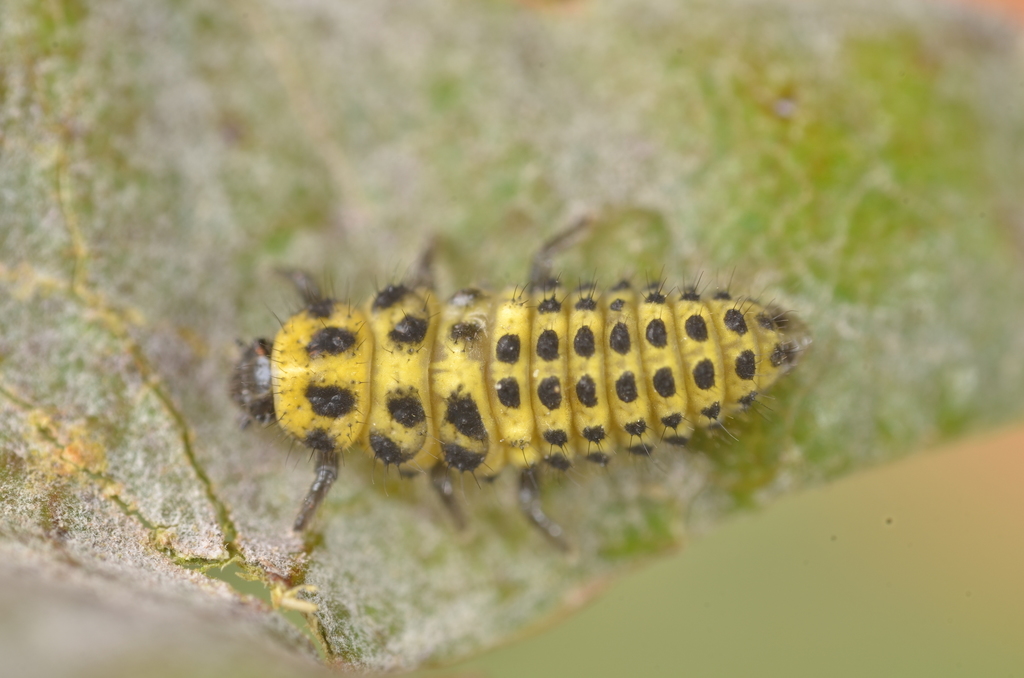
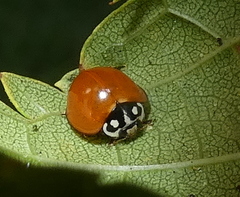
The 22-spot ladybird is a tiny 3 to 5 mm beetle with yellow wing covers marked by 22 black spots and a similarly spotted pronotum. It lives low in grassy and semi-open areas such as meadows, gardens and forest edges, and can be found on low vegetation and young tree branches. Both adults and larvae feed on mildew on plants rather than aphids, and the larvae begin eating the fungus a few hours after hatching.
Source: Wikipedia
Size
Adults measure about 3 to 5 mm in length.
Source: Wikipedia
Where it lives
Often searched for among low vegetation and sometimes seen on lower branches of young trees or in coastal areas.
Source: Wikipedia
What it eats
Unlike most ladybirds, it eats mildew, especially on umbellifers and low-growing shrubs.
Source: Wikipedia
Life cycle
The larva, pupa and adult all share a similar gray-khaki colour with dark tubercles and hairs, making them easy to recognize at any stage.
Source: Wikipedia
When you see it
Adults become active in April and can be collected then. Individuals have also been found active during winter under dock leaves in a UK park.
Source: Wikipedia
Lookalikes
Its eggs are slightly more yellowish and larger than those of the similar Psyllobora vigintimaculata, whose eggs are pale to translucent white.
Source: Wikipedia
Status: introduced in United States. Source: iNaturalist
More photos
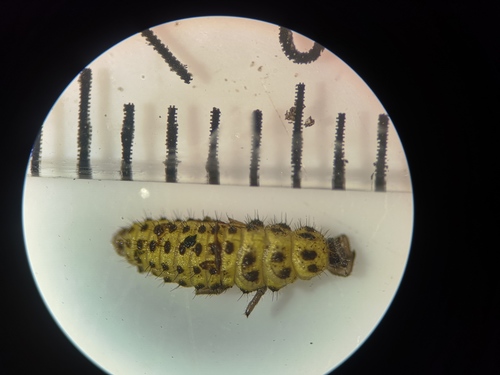
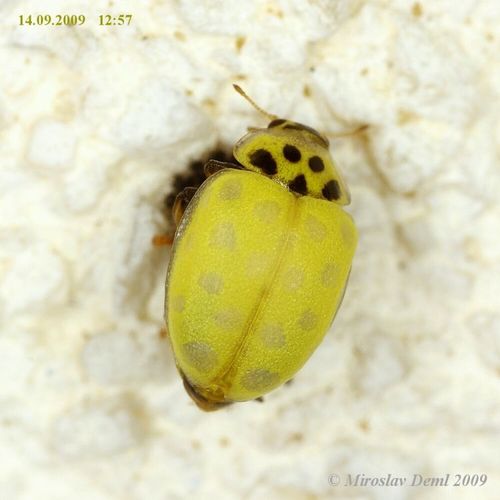
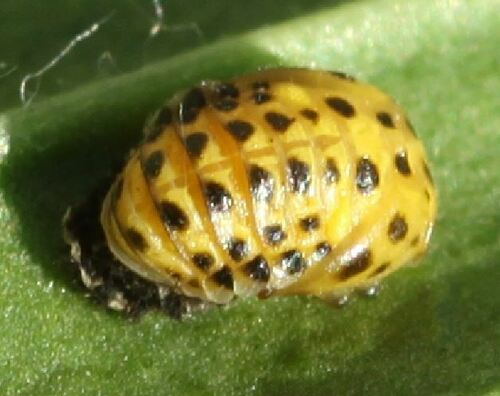
Same family (Coccinellidae)

Sources
- Wikipedia: https://en.wikipedia.org/wiki/Psyllobora_vigintiduopunctata
Look it up elsewhere: GBIF · iNaturalist · BugGuide · Wikipedia
Text written 2026-10-22 from the sources above and checked sentence by sentence against them. Data fetched 2026-10-22.