 Bug FAQ
Amazon Sapphirewing
Zenithoptera fasciata · Order: Odonata · Family: Libellulidae
Also called: Rainforest Bluewing

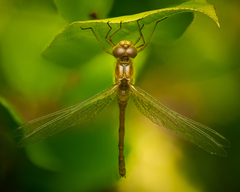
The rainforest bluewing has striking iridescent blue wings that are mostly uniform, sometimes showing a light band near the tip. It lives in tropical and subtropical forest canopies and wetlands across the northern half of South America and the southern part of Central America.
Source: Wikipedia
How to recognize it
Its wings are a vivid iridescent blue, and the side of its thorax is dark brown with narrow, irregular yellowish bands.
Source: Wikipedia
Size
The wings are almost uniform in color, though a lighter band may appear just short of the apex.
Source: Wikipedia
Where it lives
It inhabits tropical and subtropical forests, rainforests, and wetlands, spending most of its time in the forest canopy.
Source: Wikipedia
What it eats
The larval diet has not been described.
Source: Wikipedia
Life cycle
The larval stage has not been described.
Source: Wikipedia
When you see it
Adults stay mainly in the canopy and descend only briefly in midday sun for quick breeding encounters.
Source: Wikipedia
Lookalikes
A closely related species, Z. lanei, more commonly shows the light band near the wing tip, which can help tell them apart.
Source: Wikipedia
More photos


Questions people ask
When are these dragonflies most likely to be seen?
Adults usually descend from the canopy for short periods in the midday sun, often for brief breeding encounters.
Source: Wikipedia
Same family (Libellulidae)


Sources
- Wikipedia: https://en.wikipedia.org/wiki/Zenithoptera_fasciata
Look it up elsewhere: GBIF · iNaturalist · BugGuide · ITIS · Wikipedia
Text written 2026-10-23 from the sources above and checked sentence by sentence against them. Data fetched 2026-10-23.