 Bug FAQ
Aromatic Cherry Millipede
Apheloria corrugata · Order: Polydesmida · Family: Xystodesmidae
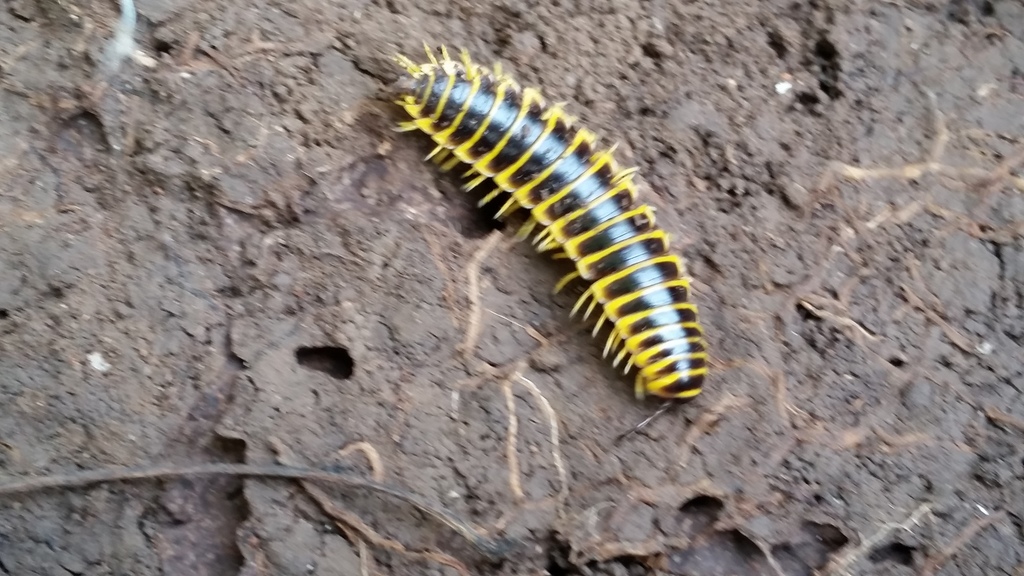
Adult aromatic cherry millipedes are large, reaching about 40 to 70 mm in length and are known for a pleasant scent. They live in moist deciduous or mixed forests across the northeastern United States and southern Canada, often under leaf litter, logs, or stones.
Source: Wikipedia
How to recognize it
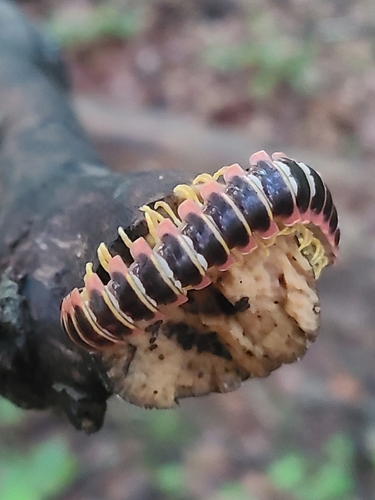
A second common form has yellow stripes along the side margins of the side extensions instead of red or pink spots.
Source: Wikipedia
Size
Adults usually measure 40 to 60 mm, and some can grow up to 70 mm (over 2 inches).
Source: Wikipedia
Life cycle
Adults have 20 body segments, counting the first collum and the last telson. Adult females have 31 pairs of legs, while adult males have 30 pairs because the eighth pair is modified into gonopods.
Source: Wikipedia
Where it comes from
Their range covers northeastern North America, from Virginia north to western Connecticut and Montreal.
Source: Wikipedia
Lookalikes
They can be distinguished from other Apheloria species by the shape of the male gonopods, though they may be confused with A. virginiensis where their ranges overlap in southern Virginia.
Source: Wikipedia
Where it is found in the US
Recorded in 24 of 51 states and DC. Most records: Pennsylvania, Virginia, New York, Ohio, Maryland, West Virginia, New Jersey, Kentucky.
Darker = more records. Counts are museum and citizen-science records, not population size.
Source: GBIF
Status: native in North America; native in Canada. Source: iNaturalist
Months it is reported in the US
Source: GBIF
More photos
Questions people ask
How can I identify this millipede?
Look for a dark black body with yellow edge stripes, red or pink spots (or yellow side stripes) on the side extensions, and yellow legs.
Source: Wikipedia
Where might I find them?
In moist deciduous or mixed forests of the northeastern US and southern Canada, often under leaf litter, logs, or stones.
Source: Wikipedia
Same family (Xystodesmidae)


Sources
- Wikipedia: https://en.wikipedia.org/wiki/Apheloria_corrugata
Look it up elsewhere: GBIF · iNaturalist · BugGuide · Wikipedia
Text written 2026-10-22 from the sources above and checked sentence by sentence against them. Data fetched 2026-10-22.