 Bug FAQ
Black-and-gold Flat Millipede
Apheloria virginiensis · Order: Polydesmida · Family: Xystodesmidae
Also called: Kentucky Flat Millipede, Virginia Apheloria
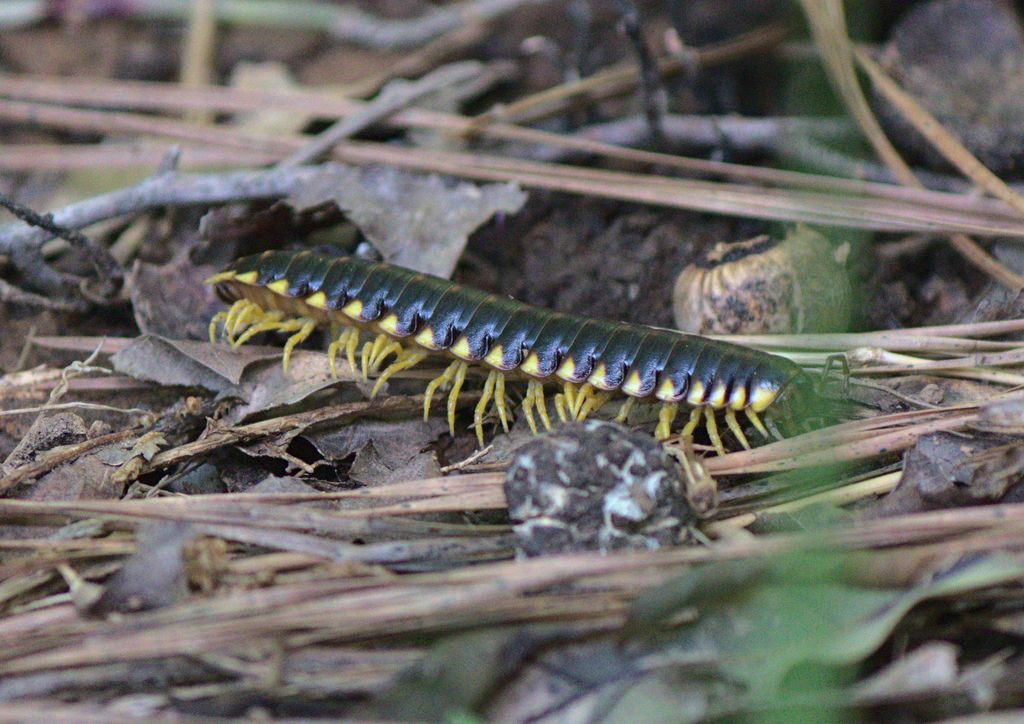
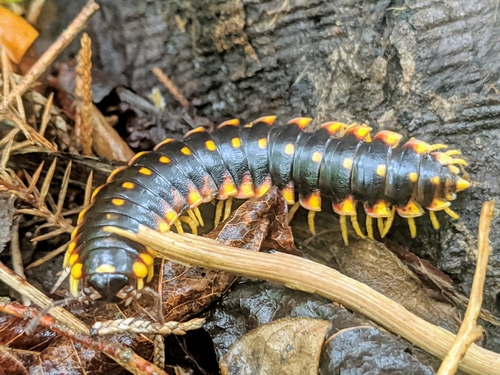
The black-and-gold flat millipede can grow up to about two inches long and is usually black with yellow spots on its sides and legs. It lives in moist deciduous or mixed forests, often on sandy soil, in Virginia and North Carolina, and feeds on leaf litter, rotting wood and humus. When handled it may release a small amount of cyanide-smelling chemicals, so washing your hands afterward is advised.
Source: Wikipedia
How to recognize it
The most common colour pattern is a black back with yellow spots on the side plates and yellow legs. Some individuals also have an extra yellow spot in the middle of each body segment and on the first segment.
Source: Wikipedia
Size
Adults can reach about two inches (approximately 50 mm) in length.
Source: Wikipedia
Does it bite or sting?
It releases a small amount of hydrogen cyanide and benzaldehyde as a defense, which is not hazardous but can smell like cherries or almonds; washing hands after handling is recommended.
Source: Wikipedia
What it eats
Adults eat leaf litter and rotting wood from both coniferous and deciduous trees, while juveniles feed on humus.
Source: Wikipedia
Life cycle
Eggs hatch after three weeks or more into pale juveniles with fewer body segments and legs. The species lives for two to three years.
Source: Wikipedia
Where it comes from
Its range includes the Piedmont and coastal plain of North Carolina and extends into southern Virginia.
Source: Wikipedia
Lookalikes
It can be told apart from other Apheloria species by the shape of the male gonopods, which have a distinct elbow-like bend.
Source: Wikipedia
Where it is found in the US
Recorded in 24 of 51 states and DC. Most records: Pennsylvania, Virginia, New York, Ohio, Maryland, West Virginia, New Jersey, Kentucky.
Darker = more records. Counts are museum and citizen-science records, not population size.
Source: GBIF
Months it is reported in the US
Source: GBIF
More photos
Questions people ask
Are these millipedes dangerous to handle?
They may spray a tiny amount of cyanide-smelling chemicals, but it is not hazardous; just wash your hands afterward.
Source: Wikipedia
What do they look like?
They are black with yellow spots on the side plates and legs, sometimes with extra yellow spots on each body segment.
Source: Wikipedia
Where are they found?
In moist deciduous or mixed forests, often on sandy soil, in Virginia and North Carolina.
Source: Wikipedia
Same family (Xystodesmidae)


Sources
- Wikipedia: https://en.wikipedia.org/wiki/Apheloria_virginiensis
Look it up elsewhere: GBIF · iNaturalist · BugGuide · ITIS · Wikipedia
Text written 2026-10-23 from the sources above and checked sentence by sentence against them. Data fetched 2026-10-22.