 Bug FAQ
Black-banded Spider Wasp
Anoplius viaticus · Order: Hymenoptera · Family: Pompilidae
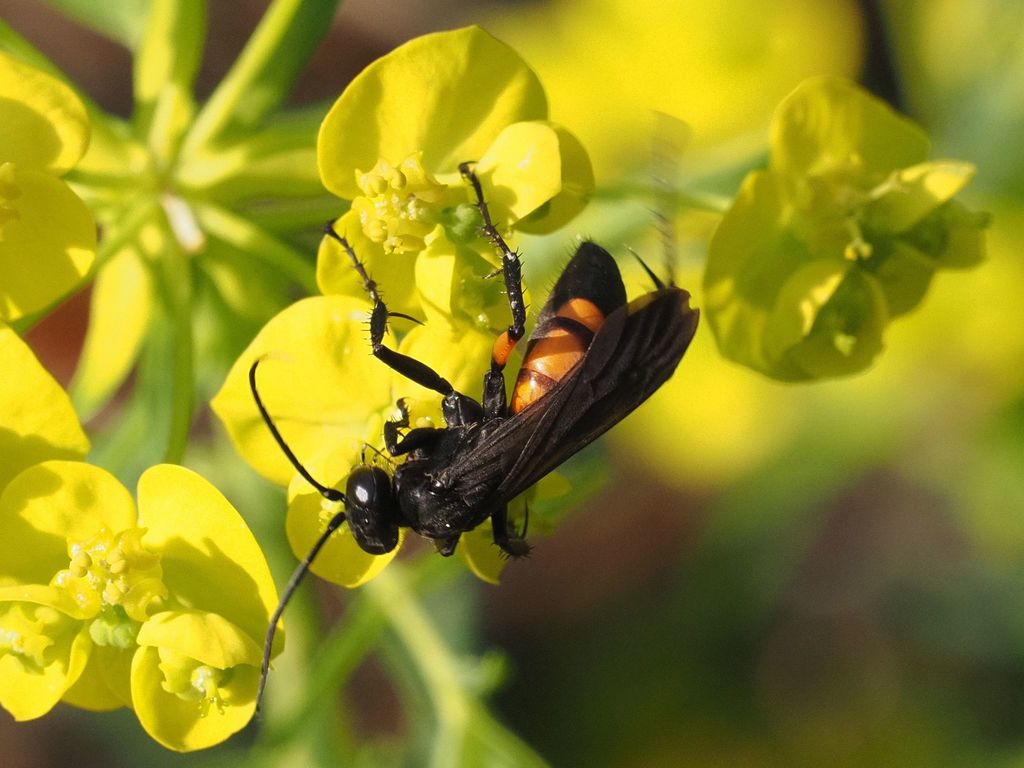
The black-banded spider wasp is a large wasp about 14 mm long (0.55 in). It has a black head and thorax, a red abdomen with black margins on the first three segments, and the rest of the abdomen is black; African specimens may show more extensive red or orange on those segments. Adults drink nectar, while females hunt spiders such as wolf spiders, ground spiders, grass spiders, crab spiders and jumping spiders to provision their nests.
Source: Wikipedia
How to recognize it
In Africa the amount of red on the abdomen varies, with some individuals having the first two or three segments entirely red or orange.
Source: Wikipedia
Size
It measures about 14 mm (0.55 in) in length.
Source: Wikipedia
What it eats
Adults feed on flower nectar. Females hunt spiders, mainly wolf spiders, but also ground spiders, grass spiders, crab spiders and jumping spiders.
Source: Wikipedia
When you see it
In southern England it is active from March onward.
Source: Wikipedia
Where it comes from
Its range includes European sandy heathlands and the mountainous and temperate regions of eastern and southern Africa.
Source: Wikipedia
Questions people ask
What does this wasp look like?
It has a black head and thorax, a red abdomen with black margins on the first three segments, and the rest of the abdomen is black; African forms may show more red or orange.
Source: Wikipedia
What does it eat?
Adults sip nectar from flowers, and females hunt various spiders to feed their larvae.
Source: Wikipedia
Same family (Pompilidae)

Sources
- Wikipedia: https://en.wikipedia.org/wiki/Anoplius_viaticus
Look it up elsewhere: GBIF · iNaturalist · BugGuide · Wikipedia
Text written 2026-10-23 from the sources above and checked sentence by sentence against them. Data fetched 2026-10-22.