 Bug FAQ
Priocnemis monachus
Priocnemis monachus · Order: Hymenoptera · Family: Pompilidae
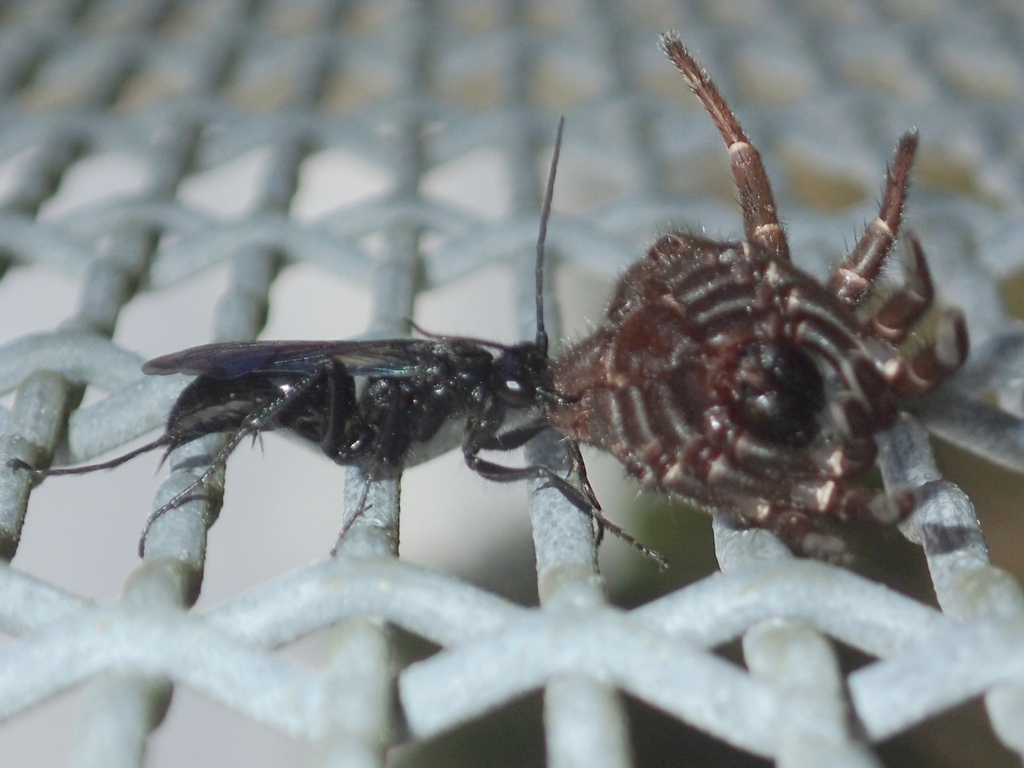
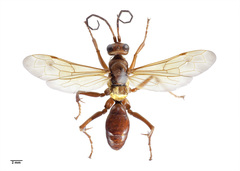
The large black hunting wasp is metallic bluish-black and covered in black hairs. Females grow up to about 26 mm and males to about 19 mm. It nests on exposed banks, in sand or gardens where its spider prey are plentiful.
Source: Wikipedia
How to recognize it
Adults have a metallic bluish-black colour with a covering of black hairs.
Source: Wikipedia
Size
Females can reach up to 26 mm, while males may grow to about 19 mm.
Source: Wikipedia
Is it a pest in the house?
The wasp hunts large tunnelweb or trapdoor spiders, paralyzing them with its sting for its larvae.
Source: Wikipedia
Does it bite or sting?
It uses its sting to immobilise spiders for its offspring.
Source: Wikipedia
Where it lives
They usually nest on exposed forest banks, but also use sand and garden sites. The wasp lives where large spiders are abundant.
Source: Wikipedia
What it eats
Adults sip nectar and fruit from plants such as Leptospermum scoparium and Pennantia corymbosa. They capture and paralyze large mygalomorph spiders to feed their larvae.
Source: Wikipedia
Life cycle
It is the biggest pompilid wasp in New Zealand. The female paralyzes large spiders and brings them to the nest for the developing larvae.
Source: Wikipedia
Lookalikes
The Māori word ngaro means fly or wasp, and wīwī suggests walking far.
Source: Wikipedia
Questions people ask
How big does Priocnemis monachus get?
Females can reach about 26 mm and males about 19 mm in length.
Source: Wikipedia
What does this wasp look like?
It is metallic bluish-black and covered in black hairs.
Source: Wikipedia
Where does it build its nest?
It nests on exposed forest banks, in sand or garden areas where large spiders are present.
Source: Wikipedia
What does it eat?
Adults feed on nectar and fruit, and they capture large mygalomorph spiders to feed their larvae.
Source: Wikipedia
Same family (Pompilidae)
Sources
- Wikipedia: https://en.wikipedia.org/wiki/Priocnemis_monachus
Look it up elsewhere: GBIF · iNaturalist · BugGuide · Wikipedia
Text written 2026-10-23 from the sources above and checked sentence by sentence against them. Data fetched 2026-10-23.