 Bug FAQ
Buff Ermine
Spilosoma lutea · Order: Lepidoptera · Family: Erebidae
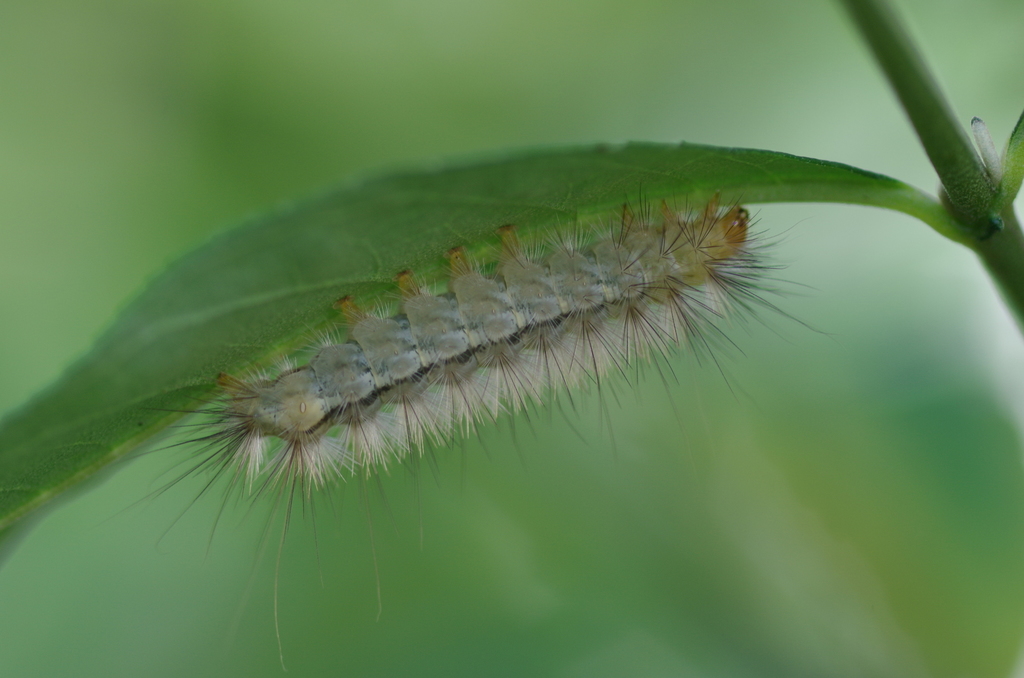
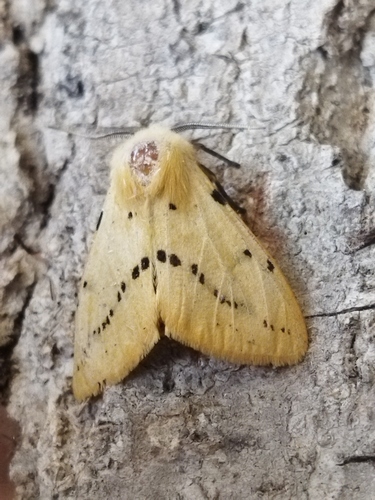
Buff Ermine moths have buff-yellow wings with variable dark spotting, and a wingspan of roughly 34 to 42 mm. The species overwinters as a pupa and is sometimes classified in the genus Spilosoma.
Source: Wikipedia
How to recognize it
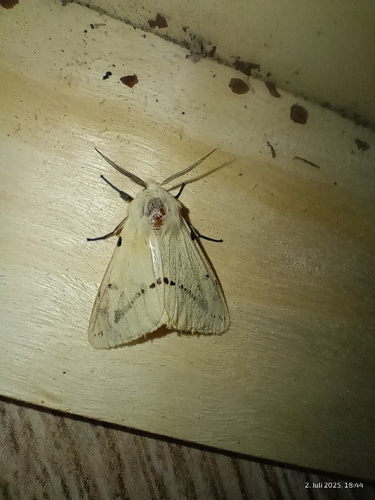
The wings are a buff-yellow colour, often with a diagonal line of dark spots on each forewing and a few scattered spots on both fore- and hindwings; the amount of black can vary from almost none to heavily melanic.
Source: Wikipedia
Size
Adults have a wingspan of about 34 to 42 mm.
Source: Wikipedia
Where it lives
It lives across the temperate part of the Palearctic and is attracted to lights at night.
Source: Wikipedia
Life cycle
The species spends the winter as a pupa.
Source: Wikipedia
When you see it
In the British Isles it flies from May through July; timing may differ elsewhere.
Source: Wikipedia
Where it comes from
Its range extends through the temperate Palearctic, reaching southern Turkey, the Caucasus, Kazakhstan, southern Siberia, Mongolia, the Amur region, China, Korea and Japan.
Source: Wikipedia
More photos
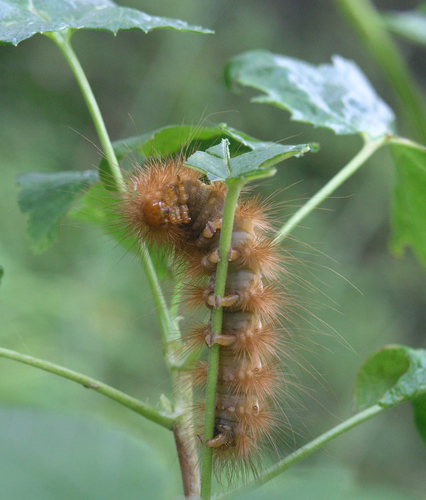
Questions people ask
When are Buff Ermine moths active?
In the British Isles they are on the wing from May to July, though the period can vary in other regions.
Source: Wikipedia
Same family (Erebidae)
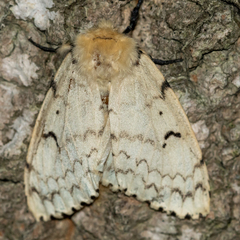 Spongy MothLymantria disparDamages trees, gardens or crops
 Fall Webworm MothHyphantria cuneaDamages trees, gardens or crops
 Brown-tail MothEuproctis chrysorrhoeaCan irritate skin
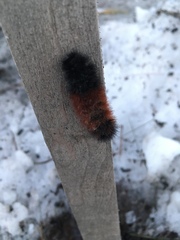 Isabella Tiger MothPyrrharctia isabella
 Virginian Tiger MothSpilosoma virginicaCan irritate skin
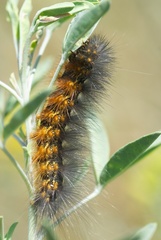 Salt Marsh MothEstigmene acrea
Sources
- Wikipedia: https://en.wikipedia.org/wiki/Buff_ermine
Look it up elsewhere: GBIF · iNaturalist · BugGuide · Wikipedia
Text written 2026-10-24 from the sources above and checked sentence by sentence against them. Data fetched 2026-10-22.