 Bug FAQ
Common Rough Woodlouse
Porcellio scaber · Order: Isopoda · Family: Porcellionidae
Also called: Garden Woodlouse, Rough Sowbug, Scabby Sow Bug
Source: UC IPM

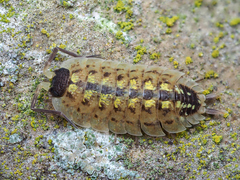
Common Rough Woodlouse is a grey, oval-shaped crustacean up to 20 mm long with a bumpy back. It lives in damp places, feeds on decaying plant matter, and may occasionally chew seedlings or vegetables touching the soil.
How to recognize it
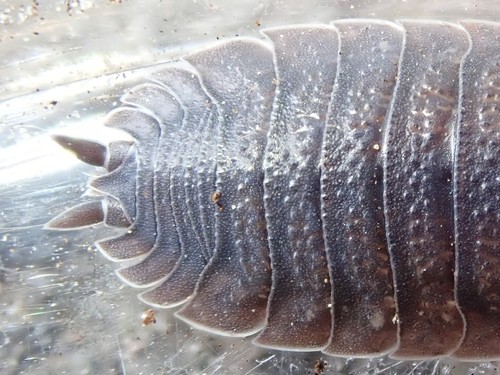
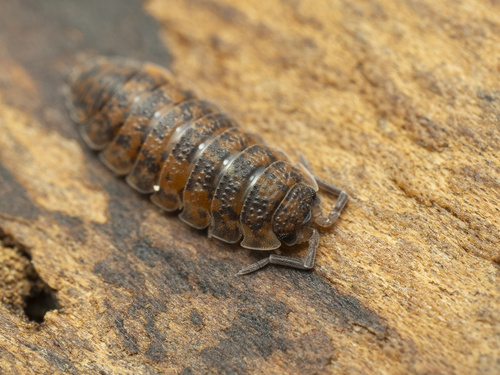
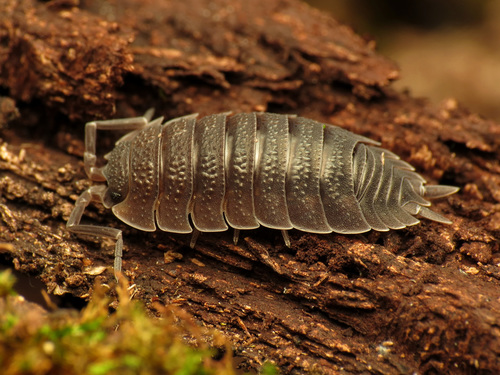
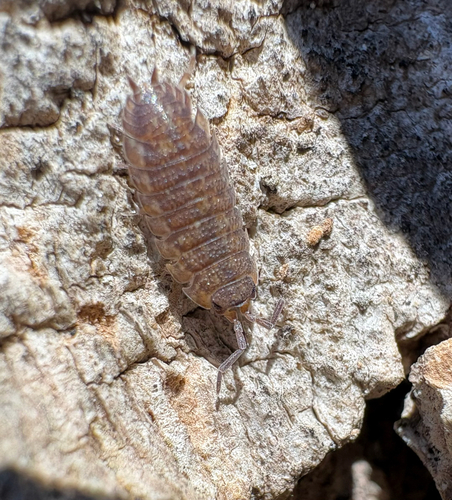
Its back is covered with tiny bumps that give it the name “rough woodlouse”. Adults have seven pairs of legs, unlike insects which have three pairs. The body is convex, giving it an arched, half-domed shape.
Size
It can grow up to about 20 mm (0.79 in) long.
Source: Wikipedia
Is it a pest in the house?
They sometimes wander indoors, which can be a nuisance.
Source: UC IPM
How to get rid of it
Reduce decaying organic matter and keep soil surface drier to discourage them. Seal entry points with weather stripping and door sweeps to keep them out of the house.
Source: UC IPM
Where it lives
It needs damp habitats but can tolerate lower humidity than some other woodlice.
Source: Wikipedia
What it eats
It is a detritivore that mainly eats decaying leaf litter and rotting plant material.
Source: Wikipedia
Life cycle
Females carry 25 to 90 eggs in a fluid sac for about 40 to 50 days before they hatch. Young become mature in three months and adults live about two years.
Source: Wikipedia
Where it comes from
It is native to central and western Europe.
Source: Wikipedia
Lookalikes
Unlike roll-up woodlice, this species cannot curl into a ball; it clings to surfaces instead.
Source: Wikipedia
Where it is found in the US
Recorded in 48 of 51 states and DC. Most records: Virginia, California, Massachusetts, Washington, Oregon, New York, Maryland, North Carolina.
Darker = more records. Counts are museum and citizen-science records, not population size.
Source: GBIF
Status: introduced in North America; introduced in United States; introduced in Canada. Source: iNaturalist
Months it is reported in the US
Source: GBIF
More photos
Questions people ask
Can they damage my garden?
Yes, they may chew seedlings, young roots, lower leaves, and fruits or vegetables that touch the soil.
Source: UC IPM
How can I keep them out of my home?
Seal cracks with weather stripping and door sweeps, and reduce damp, decaying material near entryways.
Source: UC IPM
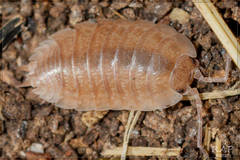
Same family (Porcellionidae)
Sources
- UC IPM: https://ipm.ucanr.edu/home-and-landscape/pillbugs-and-sowbugs/
- Wikipedia: https://en.wikipedia.org/wiki/Porcellio_scaber
Look it up elsewhere: GBIF · iNaturalist · BugGuide · ITIS · Wikipedia
Text written 2026-10-22 from the sources above and checked sentence by sentence against them. Data fetched 2026-10-22.