 Bug FAQ
Common Small Flat
Sarangesa dasahara · Order: Lepidoptera · Family: Hesperiidae
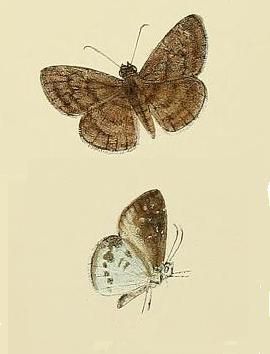
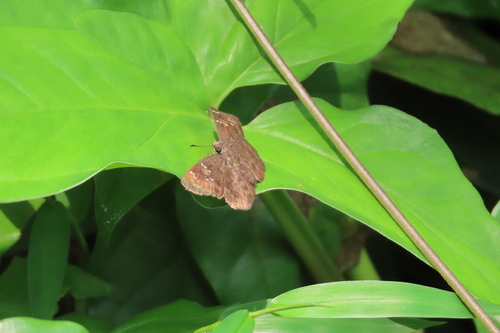
The common small flat is a small, dull-coloured butterfly with a wingspan of about 30 to 35 mm and semi-transparent spots on its wings. It lives in forest edges, openings and savannah grasslands across the Deccan plains and lower hills of the Indomalayan realm, appearing mainly after the rainy season.
Source: Wikipedia
How to recognize it
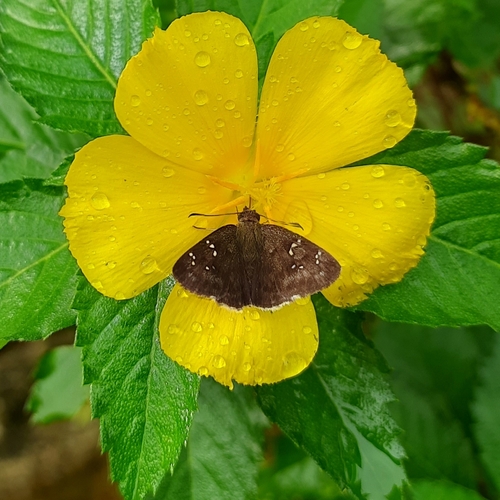
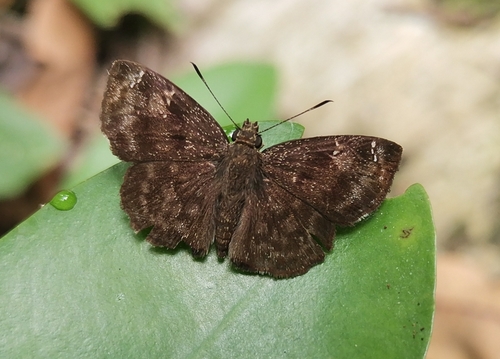
The upper side is dull black or brown with a semi-transparent spot, sometimes with no visible spots. The underside is grey-brown with diffused dark spots.
Source: Wikipedia
Size
Its wingspan measures roughly 30 to 35 mm.
Source: Wikipedia
Where it lives
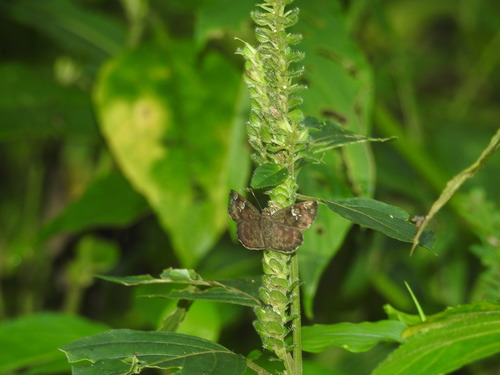
It is found in openings and edges of evergreen, semi-evergreen, deciduous forests, as well as scrub and short-grass savannahs. It occurs on the Deccan plains and nearby hills, preferring lower elevations.
Source: Wikipedia
What it eats
Caterpillars feed on Acanthaceae herbs and small shrubs such as Asystasia species and Blepharis asperrima.
Source: Wikipedia
Life cycle
The butterfly flies very fast in an erratic, jerky manner.
Source: Wikipedia
When you see it
Adults are most commonly seen at the end of the rainy season and are scarce in the post-monsoon months.
Source: Wikipedia
Where it comes from
It is native to the Indomalayan realm.
Source: Wikipedia
Lookalikes
Males look similar to Sarangesa purendra but are a little darker on the upper side. Males and females are alike in shape and colour with little differentiation.
Source: Wikipedia
More photos
Questions people ask
When can I see this butterfly?
You will most often see it at the end of the rainy season, and it becomes scarce after the monsoon.
Source: Wikipedia
What plants do the caterpillars eat?
The larvae feed on herbs and small shrubs in the Acanthaceae family, such as Asystasia species and Blepharis asperrima.
Source: Wikipedia
How can I tell it apart from similar species?
Males are a bit darker than the similar Sarangesa purendra, and both sexes look alike with little colour difference.
Source: Wikipedia
Same family (Hesperiidae)




Sources
- Wikipedia: https://en.wikipedia.org/wiki/Sarangesa_dasahara
Look it up elsewhere: GBIF · iNaturalist · BugGuide · Wikipedia
Text written 2026-10-24 from the sources above and checked sentence by sentence against them. Data fetched 2026-10-22.