 Bug FAQ
Constrictotermes cavifrons
Constrictotermes cavifrons · Order: Blattodea · Family: Termitidae

The imago is 17 to 19 mm long with wings and 8 to 10 mm long without them, showing a dark head and abdomen against a yellowish thorax. It builds arboreal nests high in trees and forages in large, daytime trails to feed on lichens and other micro-epiphytes.
Source: Wikipedia
How to recognize it
The head and abdomen are darkly pigmented while the thorax is conspicuously yellowish, matching the workers. The adult’s head is brown-black, broadly oval, and sparsely covered with long hairs.
Source: Wikipedia
Size
Winged adults measure 17 to 19 mm in total length; the body alone is 8 to 10 mm long.
Source: Wikipedia
How to get rid of it
Nests are found high (about 10 m) in host trees and have an elongate shape with a central runway flanked by gallery walls or sloping ridges.
Source: Wikipedia
Where it lives
They form large, diurnal, open-foraging trails to lichens and other micro-epiphytes.
Source: Wikipedia
What it eats
Their diet consists mainly of lichens and other micro-epiphytes collected along their foraging trails.
Source: Wikipedia
Life cycle
Soldiers molt from smaller, sclerotized presoldier forms that look like workers. Presoldier heads measure 0.839 to 0.887 mm, while worker heads are 0.936 to 1.036 mm.
Source: Wikipedia
When you see it
Foraging trails are active during the day throughout the season.
Source: Wikipedia
Where it comes from
Constrictotermes cavifrons is an Amazonian nasute termite native to the Amazon region.
Source: Wikipedia
More photos


Questions people ask
How can I identify Constrictotermes cavifrons?
Look for a dark head and abdomen with a yellowish thorax, a brown-black oval head with sparse long hairs, and a total length of 17 to 19 mm including wings.
Source: Wikipedia
Where does this termite live?
It is native to the Amazon region and builds nests high in trees, often about 10 m above ground.
Source: Wikipedia
What does it eat?
It feeds mainly on lichens and other micro-epiphytes collected along its foraging trails.
Source: Wikipedia
How can I control it?
Since nests are high in trees and have a characteristic elongate shape with a central runway, removal usually requires treating the host tree or the nest directly.
Source: Wikipedia
Same family (Termitidae)
 Conehead TermiteNasutitermes corniger
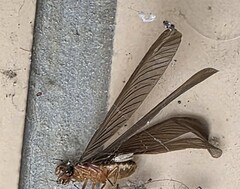 Black-winged Subterranean TermiteOdontotermes formosanusDamages trees, gardens or crops
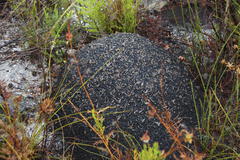 Blackmound TermiteAmitermes hastatus
 Macrotermes carbonariusMacrotermes carbonariusCan bite
 Spinifex TermiteNasutitermes triodiaeCan irritate skin
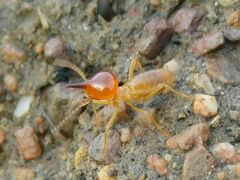 Snouted Harvester TermiteTrinervitermes trinervoides
Sources
- Wikipedia: https://en.wikipedia.org/wiki/Constrictotermes_cavifrons
Look it up elsewhere: GBIF · iNaturalist · BugGuide · Wikipedia
Text written 2026-10-23 from the sources above and checked sentence by sentence against them. Data fetched 2026-10-23.