 Bug FAQ
Dark Fishing Spider
Dolomedes tenebrosus · Order: Araneae · Family: Pisauridae
Source: Wikipedia, Penn State Extension

Females are 15 to 26 mm long and males 7 to 13 mm; leg spans reach 50 to 90 mm. They live in wooded areas, often on trees, and may wander into homes near forests.
Source: Wikipedia
How to recognize it
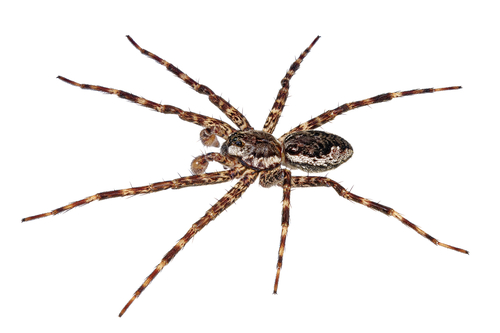
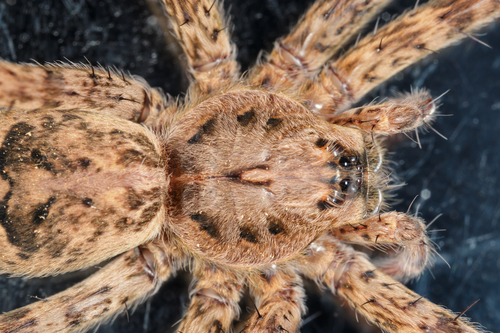
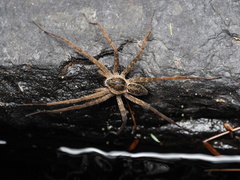
The spider is brownish-gray with chevron patterns and lighter leg stripes, and its legs have dark and reddish-brown banding.
Source: Wikipedia, Penn State Extension
Size
Females measure 15 to 26 mm (excluding legs) and males 7 to 13 mm; leg lengths range from 50 to 90 mm.
Source: Wikipedia
Is it a pest in the house?
It is a common invader of homes located in wooded areas.
Source: Wikipedia, Penn State Extension
Does it bite or sting?
It can bite humans, but it usually flees at the slightest movement and the bite is comparable to a bee or wasp sting. People who are sensitive to spider venom may have stronger reactions.
Source: Wikipedia, Penn State Extension
How to get rid of it
These spiders are shy and will usually run away when disturbed. Even if handled, they rarely bite.
Source: Penn State Extension
Where it lives
It is found in wooded areas and dwells on trees. It often enters homes that are near wooded locations.
Source: Wikipedia
Life cycle
During mating, females may eat the male, which can increase the survival chances of their offspring.
Source: Wikipedia
Lookalikes
It resembles the related D. scriptus, which has white “W” markings on the abdomen, and can be confused with larger wolf spiders.
Source: Wikipedia, Penn State Extension
Where it is found in the US
Recorded in 41 of 51 states and DC. Most records: Ohio, Virginia, Pennsylvania, Maryland, New York, North Carolina, Minnesota, Michigan.
Darker = more records. Counts are museum and citizen-science records, not population size.
Source: GBIF
Status: native in North America; native in United States; native in Canada. Source: iNaturalist
Months it is reported in the US
Source: GBIF
More photos

Questions people ask
Do they bite people?
Yes, they can bite, but the bite is usually no more painful than a bee or wasp sting.
Source: Wikipedia, Penn State Extension
How can I keep them out of my house?
Since they are shy and tend to run away, sealing cracks and keeping doors closed around wooded areas reduces their entry.
Source: Penn State Extension, Wikipedia
What do they look like?
They are brownish-gray with chevron markings, lighter leg stripes, and dark banding on the legs.
Source: Wikipedia, Penn State Extension
Where are they found?
They live in wooded areas of the United States and Canada, from New England and Canada down to Florida and Texas.
Source: Wikipedia, Penn State Extension
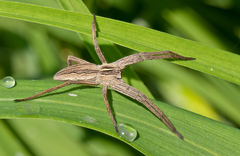
Same family (Pisauridae)



Sources
- Wikipedia: https://en.wikipedia.org/wiki/Dolomedes_tenebrosus
- Penn State Extension: https://extension.psu.edu/fishing-spider
Look it up elsewhere: GBIF · iNaturalist · BugGuide · ITIS · Wikipedia
Text written 2026-10-23 from the sources above and checked sentence by sentence against them. Data fetched 2026-10-23.