 Bug FAQ
Elephant Hawkmoth
Deilephila elpenor · Order: Lepidoptera · Family: Sphingidae
Also called: Elephant Hawk, Elephant Hawk-Moth
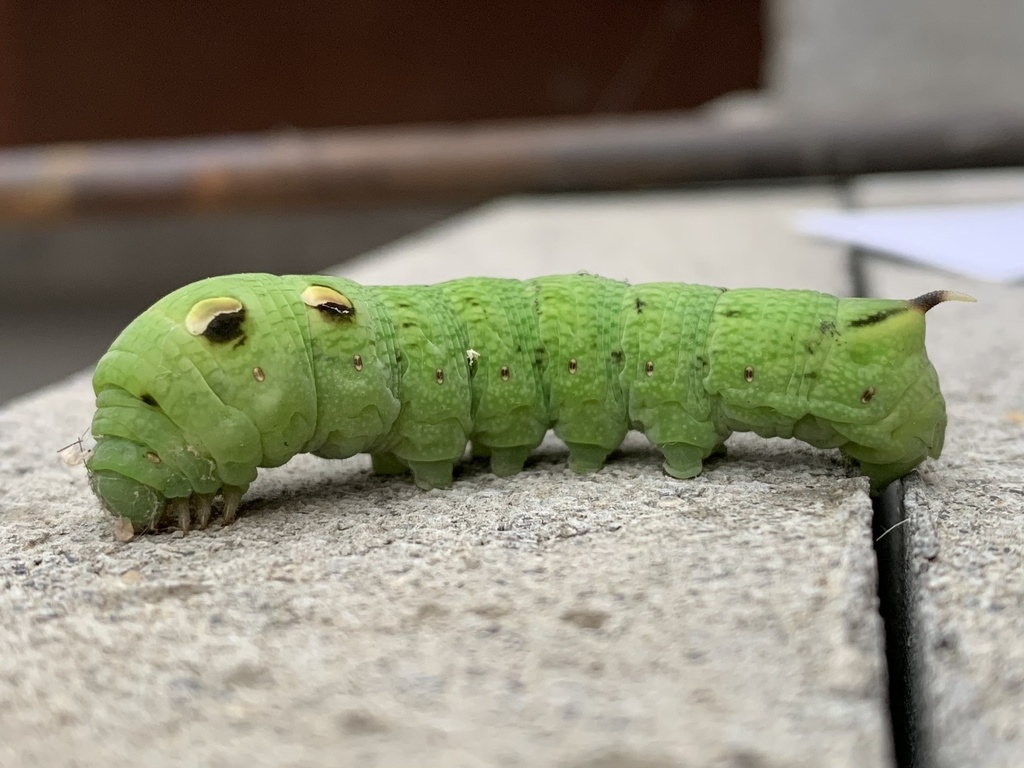
The elephant hawk moth has a wingspan of about 60 to 70 mm and its caterpillars can grow up to 3 inches long. Adults are active from May to early August, especially in June, and they feed on flower nectar. They live in many habitats such as grasslands, heath, dunes, woods, gardens and even urban areas across Central Europe, the Palearctic, and into Asia and Japan.
Source: Wikipedia
How to recognize it
The forewings are olive-brown with a pink outline, and a thick pink stripe runs down the abdomen.
Source: Wikipedia
Size
Wingspan ranges from 60 to 70 mm (about 2.4 to 2.8 inches). Fully grown caterpillars can reach up to 3 inches (7.6 cm) in length.
Source: Wikipedia
What it eats
Adults sip nectar from flowers. Females lay eggs on leaves of rosebay willowherb and bedstraws, which become food for the caterpillars.
Source: Wikipedia
Life cycle
Usually only one generation occurs each year. Pupae overwinter in cocoons and emerge as adults from May to early August.
Source: Wikipedia
When you see it
Adults are most active in June, but can be seen from May through early August.
Source: Wikipedia
Where it comes from
Common in Central Europe and throughout the Palearctic region. Its range also extends across Asia to Japan.
Source: Wikipedia
Lookalikes
It is often mistaken for the small elephant hawk moth, but differences in size and colour help tell them apart.
Source: Wikipedia
Where it is found in the US
Recorded in 2 of 51 states and DC. Most records: Washington, Oregon.
Darker = more records. Counts are museum and citizen-science records, not population size.
Source: GBIF
Status: introduced in United States; introduced in Canada. Source: iNaturalist
Months it is reported in the US
Source: GBIF
Questions people ask
When can I expect to see them?
Adults are most active in June and can be seen from May to early August.
Source: Wikipedia
How can I tell them apart from the small elephant hawk moth?
Look for the larger size and the thick pink stripe on the abdomen; the small species lacks this stripe.
Source: Wikipedia
Same family (Sphingidae)
 White-lined SphinxHyles lineataDamages trees, gardens or crops
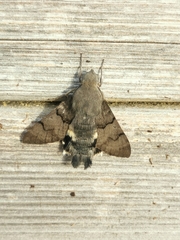 Eurasian Hummingbird HawkmothMacroglossum stellatarum
 Snowberry ClearwingHemaris diffinis
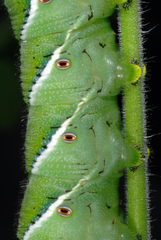 Carolina SphinxManduca sextaDamages trees, gardens or crops
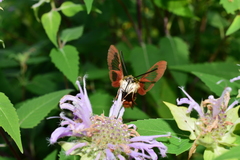 Hummingbird ClearwingHemaris thysbeDamages trees, gardens or crops
 Convolvulus HawkmothAgrius convolvuliDamages trees, gardens or crops
Sources
- Wikipedia: https://en.wikipedia.org/wiki/Deilephila_elpenor
Look it up elsewhere: GBIF · iNaturalist · BugGuide · ITIS · Wikipedia
Text written 2026-10-22 from the sources above and checked sentence by sentence against them. Data fetched 2026-10-22.