 Bug FAQ
European Peacock Butterfly
Aglais io · Order: Lepidoptera · Family: Nymphalidae
Also called: Peacock butterfly, The Peacock, European Peacock

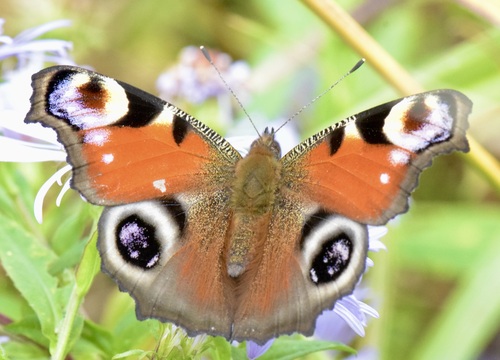
The European peacock butterfly has a rusty-red wing base with striking black, blue and yellow eyespots at each tip, while the underside looks like a dead leaf. Males have a wingspan of about 63 to 69 mm and females 67 to 75 mm. It lives in woods, fields, meadows, parks and gardens up to 2,500 m elevation and is common throughout Europe and temperate Asia to Japan.
Source: Wikipedia
How to recognize it
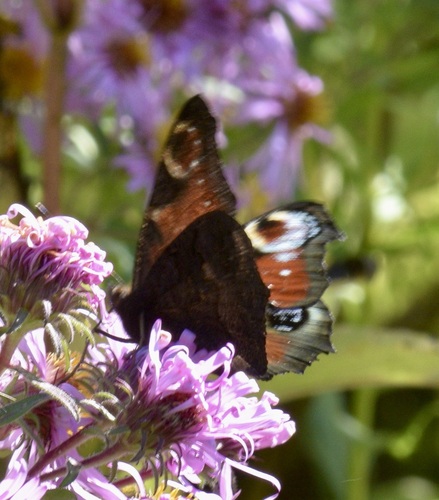
The upper side of the wings is rusty red with black, blue and yellow eyespots at each tip; the underside is dark brown or black, resembling a dead leaf.
Source: Wikipedia
Size
Wingspan ranges from 63 to 69 mm in males and 67 to 75 mm in females.
Source: Wikipedia
Where it lives
It is a relatively common butterfly in many European parks and gardens.
Source: Wikipedia
What it eats
Caterpillars feed on stinging nettle, hop and small nettle. Adults sip nectar from many flowering plants after emerging in early spring.
Source: Wikipedia
Life cycle
The butterfly hibernates over winter and lays up to 400 eggs in early spring. In most climates the first generation emerges late March to early April, with a second generation in late July.
Source: Wikipedia
When you see it
Flight peaks occur in early July and again from early August to early October.
Source: Wikipedia
Lookalikes
Two subspecies exist: A. io caucasica in Azerbaijan and A. io geisha in Japan and the Russian Far East.
Source: Wikipedia
Where it is found in the US
Recorded in 7 of 51 states and DC. Most records: Vermont, New York, Maine, Maryland, New Hampshire, South Carolina, California.
Darker = more records. Counts are museum and citizen-science records, not population size.
Source: GBIF
Status: introduced in Canada; introduced in United States. Source: iNaturalist
Months it is reported in the US
Source: GBIF
More photos
Same family (Nymphalidae)





Sources
- Wikipedia: https://en.wikipedia.org/wiki/Aglais_io
Look it up elsewhere: GBIF · iNaturalist · BugGuide · Wikipedia
Text written 2026-10-22 from the sources above and checked sentence by sentence against them. Data fetched 2026-10-22.