 Bug FAQ
Litchi Lantern Bug
Pyrops candelaria · Order: Hemiptera · Family: Fulgoridae
Source: Wikipedia
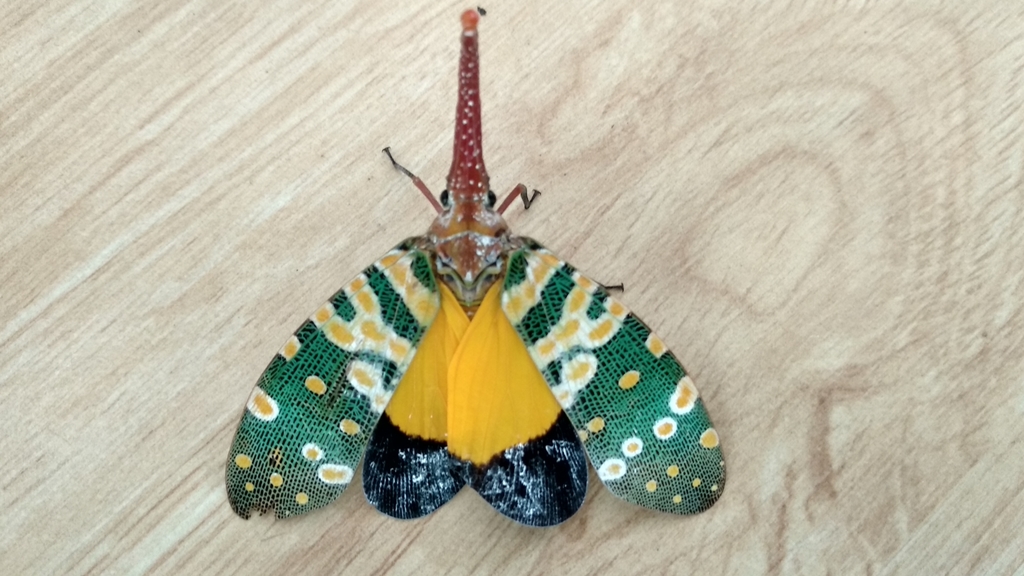
The Litchi Lantern Bug has yellow-orange hind wings with a dark border at the tips, a reddish head and a long cephalic process marked with white spots. It occurs in parts of southeast Asia such as Guangdong, Guangxi, Hong Kong, Cambodia, Vietnam, Laos and Thailand. Adults feed on plant sap, especially from longan and lychee trees, using their elongated proboscis.
Source: Wikipedia
How to recognize it
Yellow-orange hind wings with a black border near the tips, a reddish head and a long cephalic process that has white spots.
Source: Wikipedia
Where it lives
It is the type species of the genus Pyrops, a group erected by Spinola in 1839. Members of this genus are called lanternflies because of their prominent cephalic process, although they do not emit light.
Source: Wikipedia
What it eats
Feeds on plant sap, including that of longan and lychee trees (family Sapindaceae). Uses its long proboscis to tap tree sap and helps recycle nutrients in tropical forests.
Source: Wikipedia
Lookalikes
Like other Pyrops species, it is called a lanternfly because of its striking head process, not because it glows.
Source: Wikipedia
More photos

Questions people ask
What does the Litchi Lantern Bug eat?
It sucks sap from trees such as longan and lychee using its long proboscis.
Source: Wikipedia
Where can I find this bug?
It has been recorded in several southeast Asian regions, including Guangdong, Guangxi, Hong Kong, Cambodia, Vietnam, Laos and Thailand.
Source: Wikipedia
Why is it called a lanternfly?
The name comes from its prominent cephalic process, not from any light-producing ability.
Source: Wikipedia
Same family (Fulgoridae)
Sources
- Wikipedia: https://en.wikipedia.org/wiki/Pyrops_candelaria
Look it up elsewhere: GBIF · iNaturalist · BugGuide · Wikipedia
Text written 2026-10-22 from the sources above and checked sentence by sentence against them. Data fetched 2026-10-22.