 Bug FAQ
Long-bodied Cellar Spider
Pholcus phalangioides · Order: Araneae · Family: Pholcidae
Also called: Cobweb Spider, Longbodied cellar spider
Source: Wikipedia
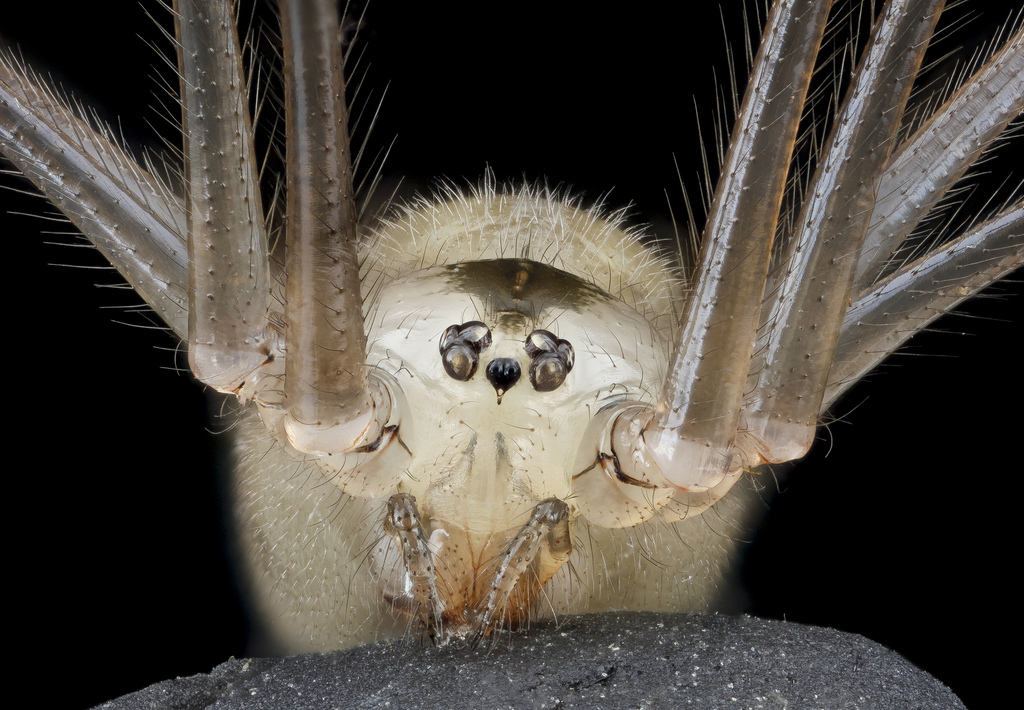
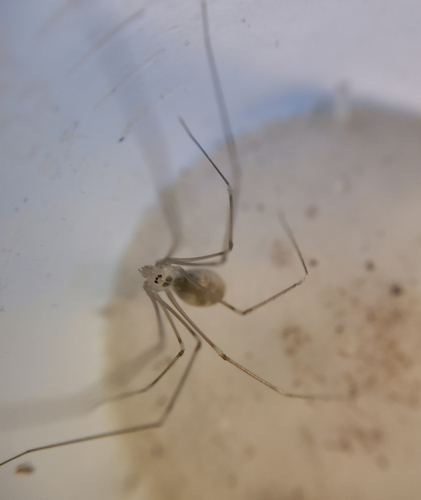
Long-bodied cellar spiders are pale yellow-brown with a large gray patch on the front body and fine gray hairs covering translucent legs. They live on ceilings and in dark, quiet corners of homes, caves, garages or cellars, preferring warm indoor spaces.
Source: Wikipedia, animaldiversity.org
How to recognize it
Their bodies have two parts, a prosoma and an opisthosoma, and the whole spider looks like a daddy-longlegs with very long legs. The body and legs are almost translucent and covered with fine gray hairs.
Source: Wikipedia, UC IPM, animaldiversity.org
Size
Females are about 8 mm long, while males are usually around 6 mm but can range up to 10 mm.
Source: Wikipedia
Is it a pest in the house?
They are harmless to humans and their silk has potential medicinal uses. As a synanthropic species, their worldwide spread is linked to human movement.
Source: Wikipedia
Does it bite or sting?
If they bite, the result is a mild stinging sensation with no long-term health effects. Their jaws are too small to bite humans in most cases.
How to get rid of it
Control is best done by removing webs and hiding places; pesticides are usually unnecessary. They help control other pest insects, so removal is optional.
Source: UC IPM, animaldiversity.org
Where it lives
They are commonly found on ceilings of rooms, in caves, garages, cellars and other indoor locations. They avoid cold environments and therefore stay inside heated buildings in cooler regions.
Source: Wikipedia
What it eats
They are carnivorous predators that eat insects, other spiders and small invertebrates. They help control pest spiders, including dangerous ones like redback spiders.
Source: Wikipedia, animaldiversity.org
Life cycle
It takes about one year for them to reach maturity, and they can live two years or more after that. Young spiders molt frequently, while older ones shed their exoskeleton less often.
Source: Wikipedia
When you see it
They prefer dimly lit, quiet, dark areas and are most often found indoors year-round.
Source: Wikipedia
Where it comes from
The species is considered native to Asia. It also occurs in subtropical parts of Afro-Eurasia.
Source: Wikipedia
Lookalikes
They are often called “daddy-long-legs” but should not be confused with harvestmen or crane flies. Like other spiders, they have a hard exoskeleton and are arachnids, not insects.
Source: Wikipedia, animaldiversity.org, UC IPM
Where it is found in the US
Recorded in 50 of 51 states and DC. Most records: California, Washington, North Carolina, Oregon, New York, Georgia, Pennsylvania, Massachusetts.
Darker = more records. Counts are museum and citizen-science records, not population size.
Source: GBIF
Status: introduced in North America; introduced in United States. Source: iNaturalist
Months it is reported in the US
Source: GBIF
More photos
Questions people ask
Do they bite people?
They can bite, but the bite only causes a mild sting and no lasting harm.
Are they dangerous to my home?
They are harmless to people and do not damage the house, though their webs can be messy.
Source: UC IPM, animaldiversity.org
How can I get rid of them?
Remove their webs and reduce clutter in dark corners; chemicals are usually not needed.
Source: UC IPM
Do they help control other pests?
Yes, they eat insects and other spiders, including some dangerous species.
Source: Wikipedia, animaldiversity.org
Same family (Pholcidae)

Sources
- Wikipedia: https://en.wikipedia.org/wiki/Pholcus_phalangioides
- animaldiversity.org: https://animaldiversity.org/accounts/Pholcus_phalangioides/
- UC IPM: https://ipm.ucanr.edu/PMG/PESTNOTES/pn7442.html
Look it up elsewhere: GBIF · iNaturalist · BugGuide · ITIS · Wikipedia
Text written 2026-10-23 from the sources above and checked sentence by sentence against them. Data fetched 2026-10-23.