 Bug FAQ
Mint Moth
Pyrausta aurata · Order: Lepidoptera · Family: Crambidae
Also called: Small Purple & Gold
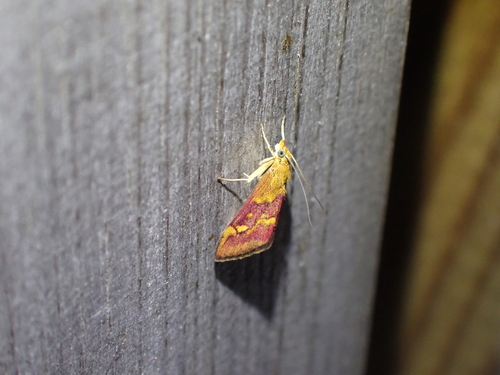
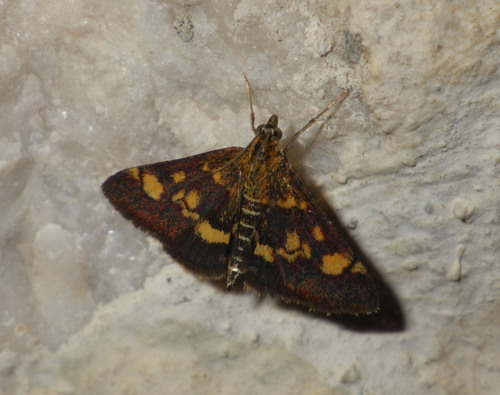
The mint moth has a wingspan of about 18 to 20 mm and shows purplish-brown forewings with golden yellow markings, while its hindwings are dark with a broad central yellow band. It lives in chalk and limestone grasslands, woodlands, marshes and gardens across most of Europe, North Africa, and a wide stretch of Asia from Siberia to Japan and down to the Middle East.
Source: Wikipedia
How to recognize it
Hindwings are dark brown or black with a broad yellow transverse band near the centre and no basal spot.
Source: Wikipedia
Size
Wingspan ranges from 18 to 20 mm (about 0.7 to 0.8 in).
Source: Wikipedia
What it eats
Larvae feed mainly on mint species such as spearmint and round-leaf mint, but also on marjoram, sage, lemon balm, catnip and Calamintha.
Source: Wikipedia
Life cycle
In the UK it produces two generations, one in May to June and another in July to August. Across north-west Europe adults are on the wing from April to the end of September and can have two broods per season.
Source: Wikipedia
When you see it
Adults fly both during the day and at night. In north-west Europe they are visible from April through September.
Source: Wikipedia
Where it comes from
Occurs throughout most of Europe and is widespread in North Africa and North Asia. In the east its range extends from Siberia to northern China, Korea and Japan, and south through Asia Minor, the Middle East, Iran, Afghanistan, Central Asia and Mongolia.
Source: Wikipedia
Lookalikes
It resembles the related Pyrausta purpuralis, which is slightly larger and has a post-median band usually broken into at least three yellow spots.
Source: Wikipedia
More photos
Questions people ask
When can I see mint moths?
In north-west Europe they are active from April until the end of September, flying both by day and night.
Source: Wikipedia
How many generations do they have?
They usually have two generations per year, one in late spring and another in midsummer.
Source: Wikipedia
What plants do the larvae feed on?
The caterpillars feed on mint species and also on marjoram, sage, lemon balm, catnip and Calamintha.
Source: Wikipedia
How can I tell it apart from similar moths?
It is smaller than Pyrausta purpuralis and its hindwing band is a single solid yellow stripe rather than a series of spots.
Source: Wikipedia
Same family (Crambidae)
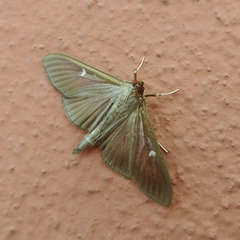 Box Tree MothCydalima perspectalisDamages trees, gardens or crops
 Celery Leaftier MothUdea rubigalisDamages trees, gardens or crops
 Elegant Grass-veneerMicrocrambus elegans
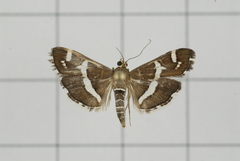 Hawaiian Beet Webworm MothSpoladea recurvalisDamages trees, gardens or crops
 Garden Grass-veneerChrysoteuchia culmellaDamages trees, gardens or crops
 Bluegrass Webworm MothParapediasia teterrellusDamages trees, gardens or crops
Sources
- Wikipedia: https://en.wikipedia.org/wiki/Mint_moth
Look it up elsewhere: GBIF · iNaturalist · BugGuide · Wikipedia
Text written 2026-10-24 from the sources above and checked sentence by sentence against them. Data fetched 2026-10-22.