 Bug FAQ
Polyphemus Moth
Antheraea polyphemus · Order: Lepidoptera · Family: Saturniidae
Also called: Polyphemus Silkmoth

The Polyphemus moth is a large tan moth with a wingspan between about 10 and 15 cm (4 to 6 in). It lives in deciduous forests, orchards, cities and wetlands across most of North America except Arizona and Nevada. Adults are active at night and there are typically two generations each year, one in spring and one in late summer.
Source: Wikipedia
How to recognize it
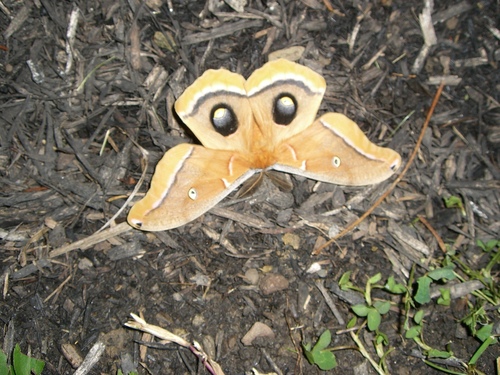
Each hindwing shows a big purplish eye-spot and a yellow patch edged with blue and black, plus a black-and-white stripe along the wing edge.
Source: Wikipedia
Size
The average wingspan is about 15 cm (6 in). Wingspan can range from roughly 10 to 15 cm (3.94 to 5.91 in).
Source: Wikipedia
Where it lives
It is found in hardwood forests, orchards, urban areas and wetlands.
Source: Wikipedia
What it eats
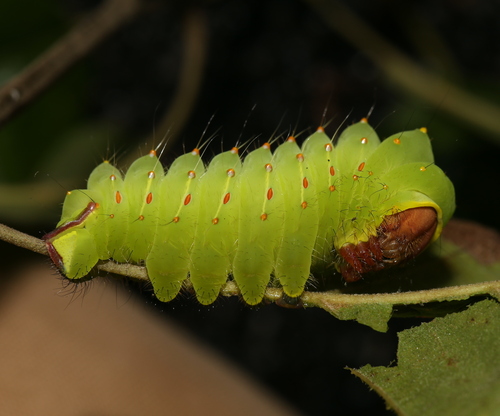
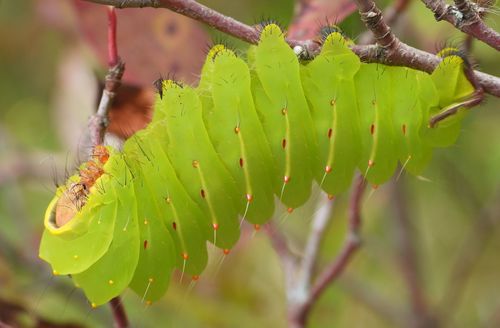
Caterpillars feed on many different plants and can consume up to 86,000 times their weight in the first eight weeks.
Source: Wikipedia
Life cycle
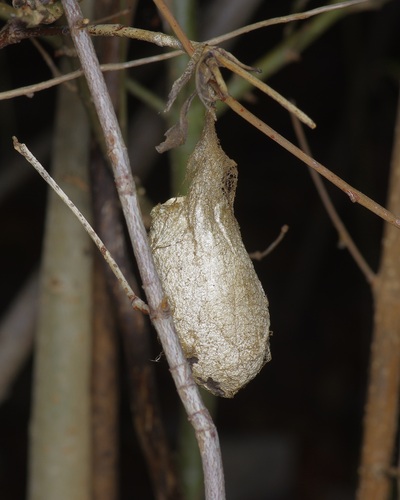
Its life cycle follows the typical pattern of Saturniidae moths. Two broods usually hatch each year, one in early spring and another in late summer.
Source: Wikipedia
When you see it
Adults are nocturnal, becoming active at dusk and throughout the night to find mates. Two generations appear each year, one in spring and one in late summer.
Source: Wikipedia
Where it comes from
The species occurs throughout continental North America, in subarctic Canada and every US state except Arizona and Nevada.
Source: Wikipedia
Lookalikes
The hindwing pattern resembles the head of a great horned owl.
Source: Wikipedia
Where it is found in the US
Recorded in 49 of 51 states and DC. Most records: Texas, Florida, North Carolina, Virginia, Ohio, Pennsylvania, New York, Georgia.
Darker = more records. Counts are museum and citizen-science records, not population size.
Source: GBIF
Status: native in North America; native in United States; native in Canada. Source: iNaturalist
Months it is reported in the US
Source: GBIF
More photos
Same family (Saturniidae)

Sources
- Wikipedia: https://en.wikipedia.org/wiki/Antheraea_polyphemus
Look it up elsewhere: GBIF · iNaturalist · BugGuide · ITIS · Wikipedia
Text written 2026-10-22 from the sources above and checked sentence by sentence against them. Data fetched 2026-10-22.