 Bug FAQ
Red-shouldered Bug
Jadera haematoloma · Order: Hemiptera · Family: Rhopalidae

Red-shouldered bugs are about 1 cm long and have a distinctive red patch on the shoulders of the pronotum. They live across the United States down to northern South America and have also been found in Taiwan. These bugs feed on seeds of soapberry-family plants and are often seen paired tail-to-tail for extended copulation.
Source: Wikipedia
How to recognize it
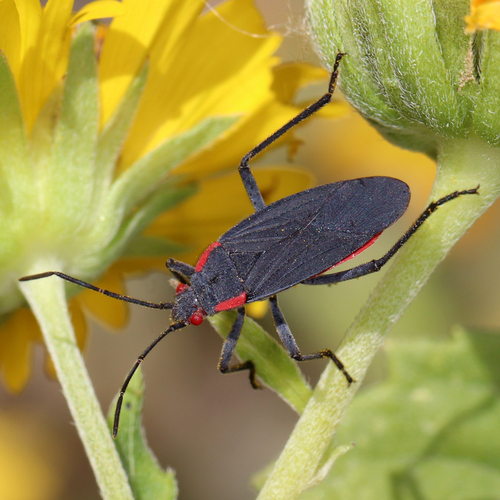
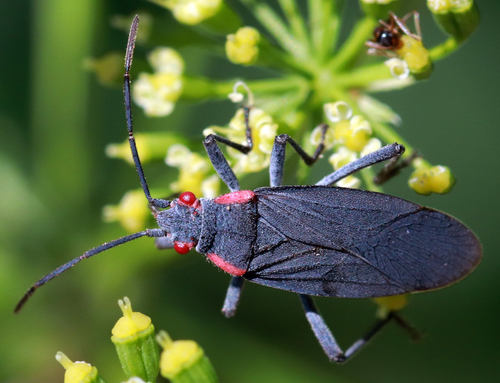
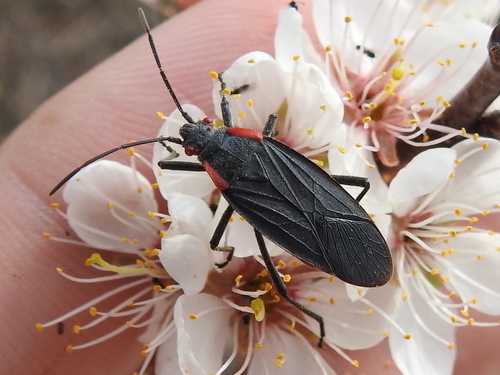
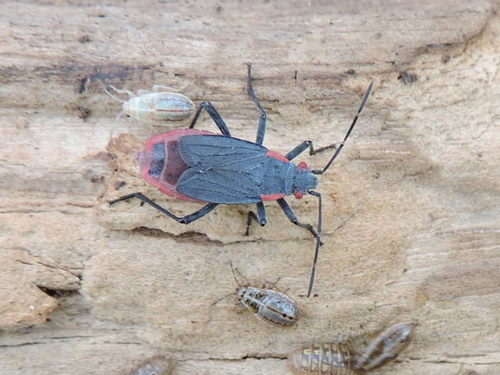
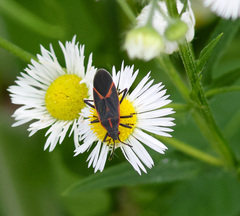
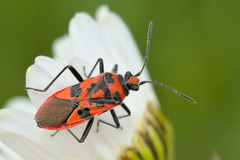
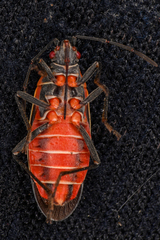
Adults are mostly blackish with red eyes, red “shoulders” on the pronotum, and red along the wing edges and abdomen; nymphs are mainly red with a black pronotum.
Source: Wikipedia
Size
Typical length is 9.5 to 13.5 mm and width 3 to 4 mm; short-winged forms are 7 to 8 mm long.
Source: Wikipedia
Where it lives
They occur throughout the United States and extend south to northern South America.
Source: Wikipedia
What it eats
They feed on seeds of plants in the soapberry family (Sapindaceae) and can quickly adapt to new host plants.
Source: Wikipedia
Life cycle
Males outnumber females about two to one, and they stay coupled tail-to-tail for up to two days to reduce sperm competition.
Source: Wikipedia
Where it comes from
Native to the New World, the species was first recorded in Asia (Taiwan) in 2012.
Source: Wikipedia
Lookalikes
They are often mistaken for boxelder bugs or lovebugs.
Source: Wikipedia
Where it is found in the US
Recorded in 39 of 51 states and DC. Most records: California, Texas, Virginia, Florida, New Mexico, Oklahoma, Colorado, Louisiana.
Darker = more records. Counts are museum and citizen-science records, not population size.
Source: GBIF
Months it is reported in the US
Source: GBIF
More photos
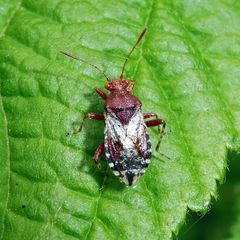
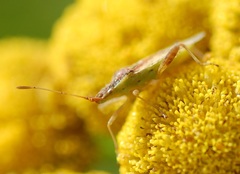
Same family (Rhopalidae)
Sources
- Wikipedia: https://en.wikipedia.org/wiki/Jadera_haematoloma
Look it up elsewhere: GBIF · iNaturalist · BugGuide · ITIS · Wikipedia
Text written 2026-10-22 from the sources above and checked sentence by sentence against them. Data fetched 2026-10-22.