 Bug FAQ
Tropical Checkered-Skipper
Pyrgus oileus · Order: Lepidoptera · Family: Hesperiidae
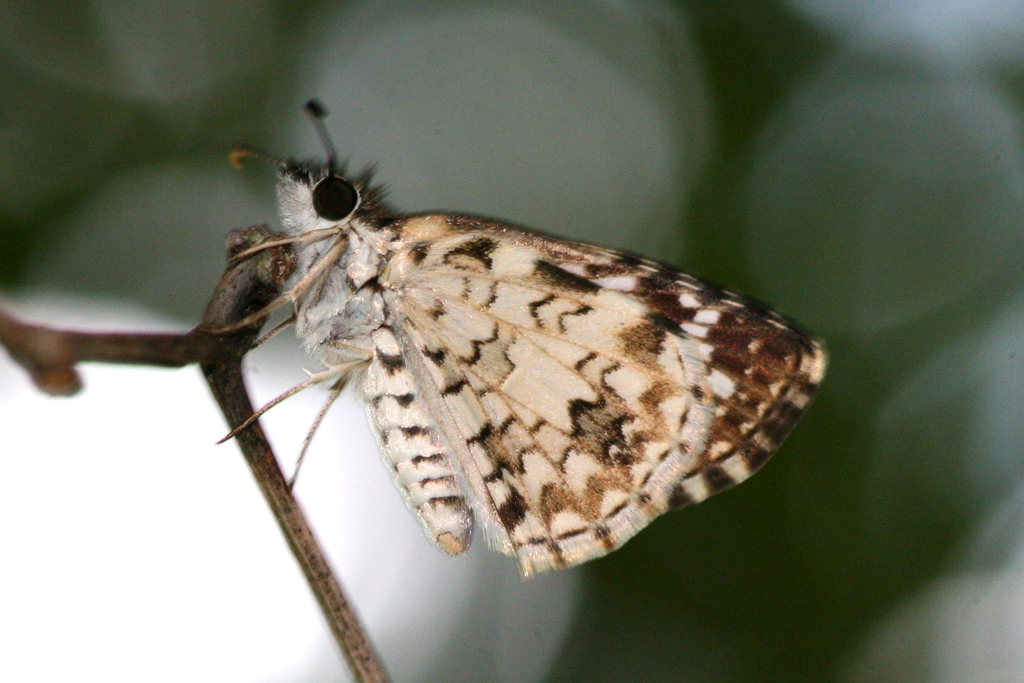
The tropical checkered-skipper has a wingspan of about 32 to 38 mm. Its caterpillars feed on several Malvaceae plants such as Sida rhombifolia and Malva, while adults sip nectar from Sida flowers and small composites. In southern Texas and Florida it can produce four to five generations each year.
Source: Wikipedia
How to recognize it
It belongs to the skipper family Hesperiidae and is known as Burnsius oileus.
Source: Wikipedia
Size
The wingspan ranges from 32 to 38 mm.
Source: Wikipedia
Where it lives
It lives in peninsular Florida, the Gulf Coast, southern Texas, the West Indies, Mexico, Central America and reaches Costa Rica.
Source: Wikipedia
Life cycle
Four to five generations occur each year in southern Texas and Florida.
Source: Wikipedia
When you see it
These multiple generations happen throughout the year in its southern range.
Source: Wikipedia
Where it comes from
It is native to the United States, especially Florida and Texas, and extends south through the Caribbean and Central America to Costa Rica.
Source: Wikipedia
Lookalikes
It was moved to the genus Burnsius in 2019; before that it was called Pyrgus oileus.
Source: Wikipedia
Where it is found in the US
Recorded in 18 of 51 states and DC. Most records: Texas, Florida, South Carolina, Louisiana, Georgia, Alabama, Arizona, Mississippi.
Darker = more records. Counts are museum and citizen-science records, not population size.
Source: GBIF
Months it is reported in the US
Source: GBIF
More photos


Questions people ask
What flowers do the adults visit?
Adults sip nectar from Sida species and small-flowered composites like shepherd's needles.
Source: Wikipedia
How many generations are there each year?
In southern Texas and Florida there are four to five generations per year.
Source: Wikipedia
Same family (Hesperiidae)




Sources
- Wikipedia: https://en.wikipedia.org/wiki/Burnsius_oileus
Look it up elsewhere: GBIF · iNaturalist · BugGuide · Wikipedia
Text written 2026-10-23 from the sources above and checked sentence by sentence against them. Data fetched 2026-10-23.