 Bug FAQ
Two-lined Spittlebug
Prosapia bicincta · Order: Hemiptera · Family: Cercopidae
Also called: Twolined spittlebug
Source: Wikipedia
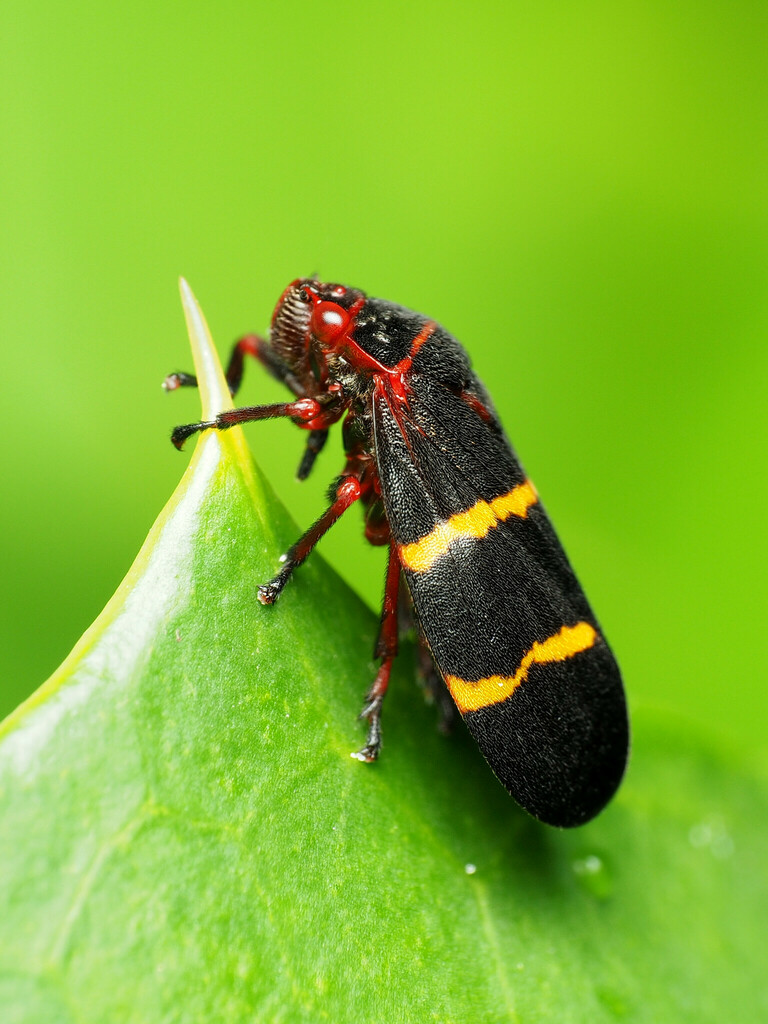
The two-lined spittlebug is 8 to 10 mm long and black with two red or orange wing stripes. Nymphs live in foamy spittle on grasses, while adults eat holly and redbud leaves. It is a known pest of lawns, forage grasses and pastures, causing economic damage in the southeastern US and Hawaii.
Source: Wikipedia
Size
They grow to about 8 to 10 mm in length.
Source: Wikipedia
Is it a pest in the house?
It damages forage and turf grasses, hurting lawns and pastures in the southeastern US. Since 2016 it has caused large-scale pasture loss on Hawaiʻi, affecting over 70,000 ha.
Source: Wikipedia
Where it lives
They are common throughout the eastern half of the United States.
Source: Wikipedia
What it eats
Nymphs feed on grasses such as centipedegrass, bermudagrass and corn while hidden in spittle. Adults feed on leaves of holly species and the eastern redbud tree.
Source: Wikipedia
Life cycle
Nymphs live inside protective foam made from plant juices while they feed on grasses.
Source: Wikipedia
Where it comes from
Their native range is the eastern half of the United States.
Source: Wikipedia
Lookalikes
A similar species, Prosapia simulans, occurs in Central America and is also an agricultural pest.
Source: Wikipedia
Where it is found in the US
Recorded in 35 of 51 states and DC. Most records: North Carolina, Texas, Florida, Alabama, Georgia, Virginia, Tennessee, South Carolina.
Darker = more records. Counts are museum and citizen-science records, not population size.
Source: GBIF
Status: native in North America; native in United States. Source: iNaturalist
Months it is reported in the US
Source: GBIF
More photos


Questions people ask
What plants do they damage?
They feed on and can damage grasses, holly, and eastern redbud leaves.
Source: Wikipedia
Where are they found?
They are widespread in the eastern United States and have become a problem in Hawaii pastures.
Source: Wikipedia
Same family (Cercopidae)
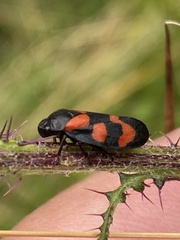
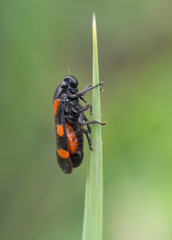
Sources
- Wikipedia: https://en.wikipedia.org/wiki/Prosapia_bicincta
Look it up elsewhere: GBIF · iNaturalist · BugGuide · ITIS · Wikipedia
Text written 2026-10-22 from the sources above and checked sentence by sentence against them. Data fetched 2026-10-22.