 Bug FAQ
Wetland Giant Wolf Spider
Tigrosa helluo · Order: Araneae · Family: Lycosidae
Source: Wikipedia, Penn State Extension

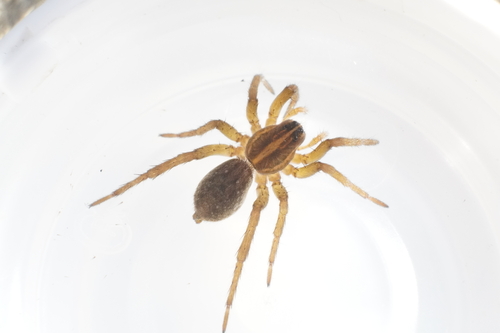
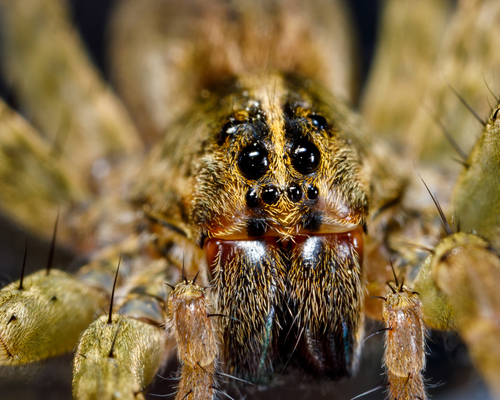
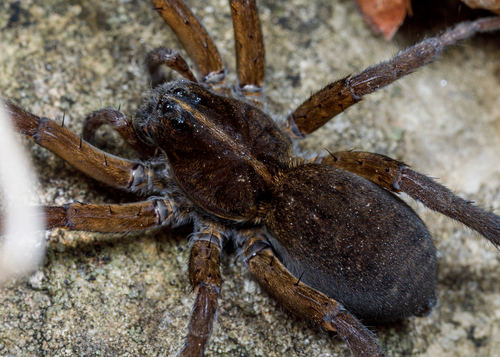
Wetland Giant Wolf Spiders are small (about 17 mm) with a brown carapace and a yellow stripe on the cephalothorax, plus black spots on the underside of the abdomen. They live in woods, marshes, fields and riparian zones across the United States, Canada and Mexico, hunt at night, and females build nests under stones or boards. If mishandled they will bite, delivering a bite that causes only temporary pain and swelling.
Source: Wikipedia, Penn State Extension
How to recognize it
The spider has a brown carapace with a distinct yellow stripe from the front eyes down the cephalothorax. Its abdomen’s underside shows black spots that help tell it apart from other wolf spiders.
Source: Wikipedia
Size
Adults average about 17 mm (0.67 in) in body length, placing them among the smaller wolf spiders.
Source: Wikipedia
Does it bite or sting?
They are not aggressive and will only bite if provoked or mishandled. Their bite injects venom that causes minor pain, redness and possibly some swelling, which usually resolves within 24 hours.
Source: Wikipedia, Penn State Extension
How to get rid of it
No serious medical consequences have been reported from their bites.
Source: Penn State Extension
Where it lives
It inhabits a range of moist environments such as woods, marshes, fields and riverbanks.
Source: Wikipedia
What it eats
It is nocturnal and hunts alone for prey during the night.
Source: Wikipedia
Life cycle
Males typically live about one year, while females can live close to two years. Mating usually occurs in May or June.
Source: Wikipedia
When you see it
Adults are active at night when they hunt for food. Mating takes place in late spring, around May and June.
Source: Wikipedia
Lookalikes
They can be confused with the nursery web spider Pisaurina mira because of similar appearance. They resemble H. carolinensis in color but have a narrow line of yellow hairs near the eyes.
Source: Wikipedia, Penn State Extension
Where it is found in the US
Recorded in 43 of 51 states and DC. Most records: Ohio, Pennsylvania, New York, Illinois, Maryland, Virginia, Texas, Indiana.
Darker = more records. Counts are museum and citizen-science records, not population size.
Source: GBIF
Status: native in North America; native in Canada. Source: iNaturalist
Months it is reported in the US
Source: GBIF
More photos

Questions people ask
Do they bite people?
Yes, they may bite if handled, causing pain and some swelling that usually fades within a day.
Source: Wikipedia, Penn State Extension
How can I tell this spider apart from similar species?
Look for a brown carapace with a yellow stripe from the eyes down the cephalothorax and black spots on the underside of the abdomen.
Source: Wikipedia
Same family (Lycosidae)

Sources
- Wikipedia: https://en.wikipedia.org/wiki/Tigrosa_helluo
- Penn State Extension: https://extension.psu.edu/wolf-spiders
Look it up elsewhere: GBIF · iNaturalist · BugGuide · ITIS · Wikipedia
Text written 2026-10-23 from the sources above and checked sentence by sentence against them. Data fetched 2026-10-23.