 Bug FAQ
Yellow-legged Mud-dauber Wasp
Sceliphron caementarium · Order: Hymenoptera · Family: Sphecidae
Also called: American Mud-dauber Wasp, Black-and-yellow Mud-dauber Wasp, mud dauber wasp
Source: Wikipedia, ask.ifas.ufl.edu, University of Minnesota Extension
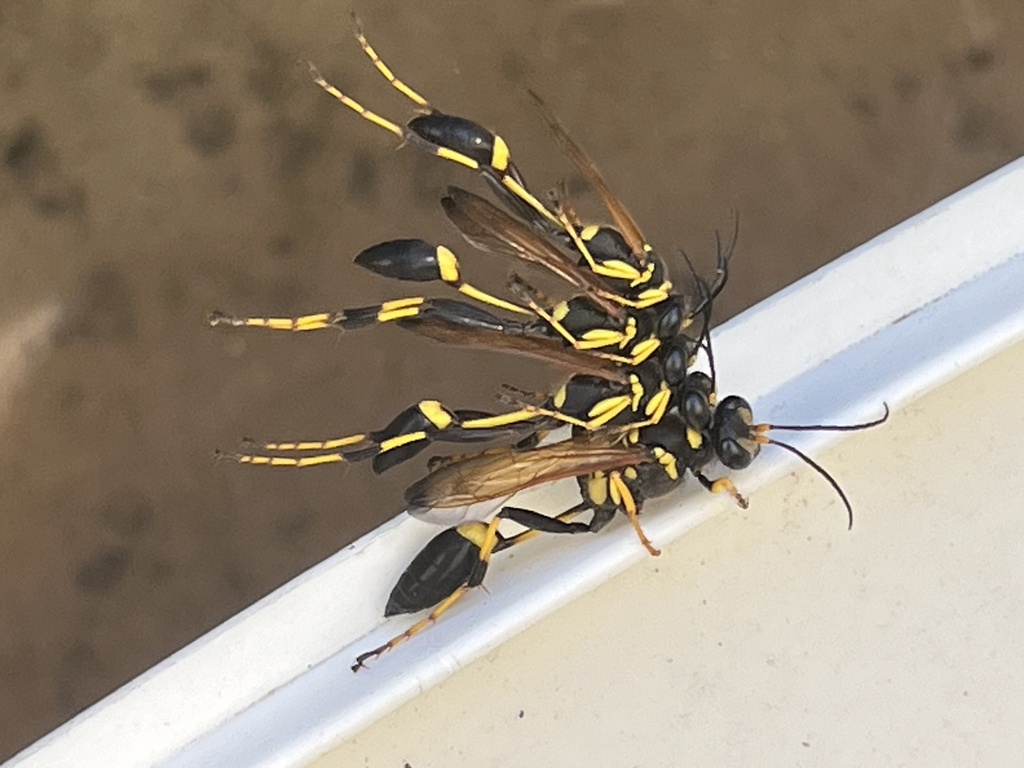
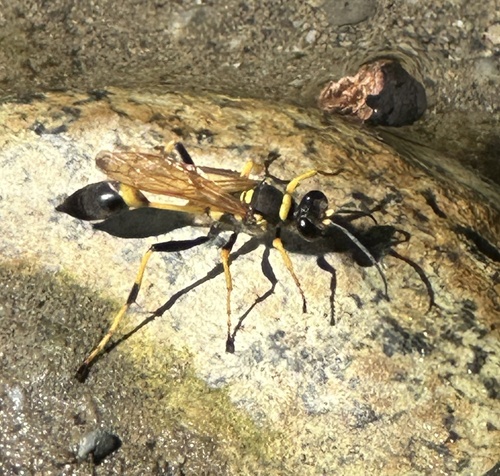
The yellow-legged mud-dauber is a black wasp about 24 to 28 mm long with yellow markings on its thorax, legs and antenna bases. It builds mud nests on shaded, sheltered surfaces such as rock ledges, eaves of homes and other man-made structures.
Source: Wikipedia, ask.ifas.ufl.edu, University of Minnesota Extension
How to recognize it
The wasp is black with yellow markings on the thorax, legs, and the base of the antennae, and has a very thin, long pedicel.
Source: Wikipedia, ask.ifas.ufl.edu, University of Minnesota Extension
Size
Adults reach 24 to 28 mm (about 1 inch) in length.
Is it a pest in the house?
Nests are often built on eaves, buildings and bridges, which some people consider a nuisance, but they do not damage the structures.
Does it bite or sting?
Stings are rare because the species is solitary and not aggressive. Their venom lacks common pain-inducing compounds and stings are not of medical importance.
Source: Wikipedia, University of Minnesota Extension, ask.ifas.ufl.edu
How to get rid of it
Nests may be removed if they become a nuisance, but there is no need for pest control because they do not sting or damage property.
Source: ask.ifas.ufl.edu
Where it lives
It occurs in many habitats, including rock ledges, water edges, pine and oak forests, and often nests in shaded, sheltered spots on natural or man-made structures.
Source: Wikipedia
What it eats
Adults feed on nectar from flowers such as Queen Anne’s lace and parsnip species in mid-summer. Females capture and paralyze spiders, placing 6 to 15 per nest cell as food for their larvae.
Source: Wikipedia
Life cycle
A single egg is laid on each paralyzed spider; the larva eats the spider, molts several times, pupates, and the adult emerges from the mud cell.
Source: Wikipedia
When you see it
Adults are most visible in mid-summer when they feed on flower nectar.
Source: Wikipedia
Lookalikes
There are many similar Sceliphron species worldwide; in the U.S. the only other native species is Sceliphron assimile, with the Asiatic mud-dauber occasionally observed.
Source: Wikipedia, ask.ifas.ufl.edu
Where it is found in the US
Recorded in 50 of 51 states and DC. Most records: Texas, California, Florida, Illinois, New York, Ohio, Virginia, Pennsylvania.
Darker = more records. Counts are museum and citizen-science records, not population size.
Source: GBIF
Months it is reported in the US
Source: GBIF
More photos
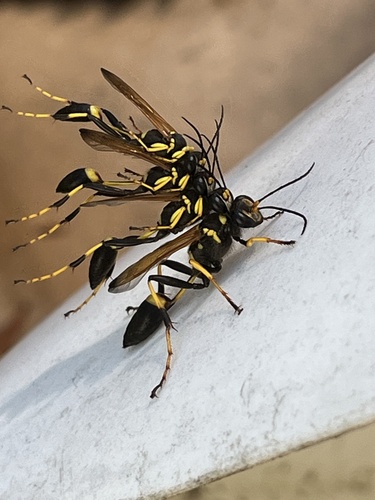
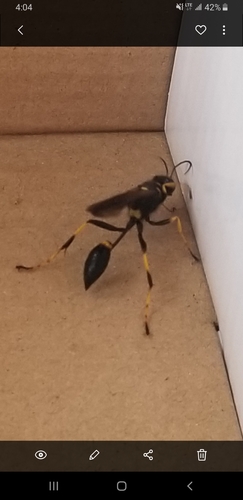
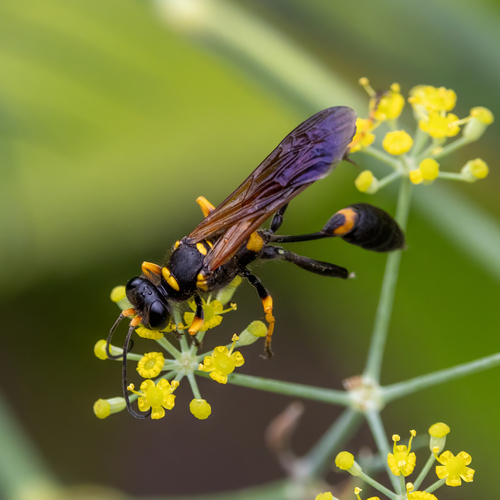
Questions people ask
Do they sting people?
Stings are rare and not medically important.
Source: Wikipedia, ask.ifas.ufl.edu, University of Minnesota Extension
How can I get rid of their nests?
Remove the mud nests from eaves or other structures if they are a nuisance; they do not damage the building.
What do they eat?
Adults sip nectar from flowers, while females hunt spiders to feed their larvae.
Source: Wikipedia
Same family (Sphecidae)

Sources
- Wikipedia: https://en.wikipedia.org/wiki/Sceliphron_caementarium
- ask.ifas.ufl.edu: https://ask.ifas.ufl.edu/publication/IN1478
- University of Minnesota Extension: https://apps.extension.umn.edu/garden/diagnose/insect/general-curiosity-insects/flies/medium/blackandyellowmuddauber.html
Look it up elsewhere: GBIF · iNaturalist · BugGuide · ITIS · Wikipedia
Text written 2026-10-23 from the sources above and checked sentence by sentence against them. Data fetched 2026-10-23.