 Bug FAQ
American Cockroach
Periplaneta americana · Order: Blattodea · Family: Blattidae
Also called: B-52 Cockroach, Common Cockroach, ship cockroach
Source: Wikipedia, Penn State Extension

The American cockroach is a large, reddish-brown pest that lives in moist, warm places and often enters homes through plumbing or cracks. It feeds on many household items and can contaminate food with harmful microbes, posing a health risk.
Source: Penn State Extension, Wikipedia
How to recognize it
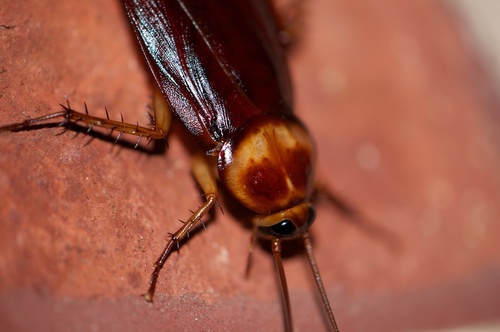
Adults are about 1½ inches long, reddish-brown with yellow-edged thorax and full-length wings. Egg cases are brown, purse-shaped, and about 0.9 cm long.
Source: Penn State Extension, Oklahoma State Extension, Wikipedia
Size
It is the largest cockroach species commonly found in homes.
Source: Wikipedia
Is it a pest in the house?
They are common in restaurants, grocery stores, bakeries, and other food-handling areas, and can infest yards and alleys in summer. They enter homes via wastewater pipes, door gaps, air ducts, or other openings.
Source: Oklahoma State Extension, Wikipedia
Does it bite or sting?
At least 22 pathogenic microbes and five helminth species have been isolated from them.
Source: Wikipedia
How to get rid of it
Inspect thoroughly, seal cracks, store food in insect-proof containers, and keep areas clean. Use glue traps, targeted insecticides, or pheromone-based methods as part of an IPM program. Contact your local county extension office for up-to-date advice.
Source: Wikipedia, US EPA, Penn State Extension, Oklahoma State Extension
Where it lives
They prefer warm, moist environments but can survive in dry areas if water is available.
Source: Wikipedia
What it eats
They are omnivorous, eating cheese, sweets, beer, leather, bakery goods, book glue, hair, dead animals, plant material, and starch-coated paper.
Source: Wikipedia, Penn State Extension
Life cycle
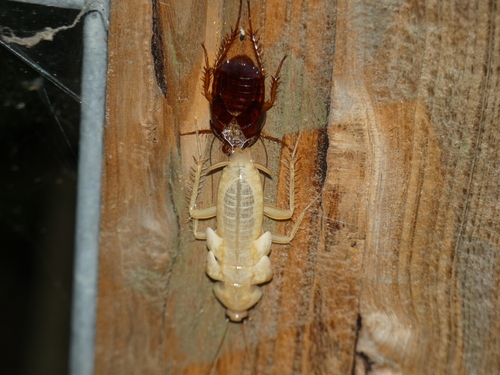
Their life cycle includes egg, nymph, and adult stages, with nymphs molting about 13 times.
Source: Wikipedia
When you see it
In cold climates they move indoors for warmth, but adults cannot survive several days at temperatures ≤10 °C.
Source: Wikipedia
Where it comes from
Despite the name, they originate from Africa and the Middle East.
Source: Wikipedia
Lookalikes
They are often mistaken for a palmetto bug.
Source: Wikipedia
Where it is found in the US
Recorded in 48 of 51 states and DC. Most records: Texas, California, Florida, North Carolina, Arizona, Hawaii, New York, Louisiana.
Darker = more records. Counts are museum and citizen-science records, not population size.
Source: GBIF
Status: introduced in North America. Source: iNaturalist
Months it is reported in the US
Source: GBIF
More photos
Questions people ask
Do American cockroaches bite?
The risk is what they carry: they pick up bacteria like Salmonella on their legs and leave it on food, which can cause food poisoning.
Source: Wikipedia, Penn State Extension
Where do they usually live?
They prefer warm, moist places like sewers, basements, and kitchens, and often enter homes through plumbing or cracks.
Source: Wikipedia
How can I get rid of them?
Seal entry points, keep food sealed, clean spills promptly, and use glue traps or targeted insecticides as part of an IPM plan.
Source: Wikipedia, Penn State Extension
Same family (Blattidae)
 Oriental CockroachBlatta orientalisCan spread germs or disease
 Smokybrown CockroachPeriplaneta fuliginosaNuisance, not dangerous
 Australian CockroachPeriplaneta australasiaeNuisance, not dangerous
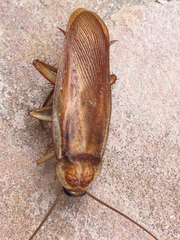 Turkestan CockroachPeriplaneta lateralis
 Florida Woods CockroachEurycotis floridana
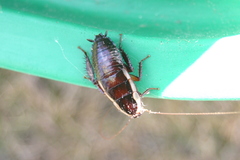 Gisborne CockroachDrymaplaneta semivittaHarmless
Sources
- Wikipedia: https://en.wikipedia.org/wiki/American_cockroach
- Penn State Extension: https://extension.psu.edu/american-cockroaches
- Oklahoma State Extension: https://extension.okstate.edu/programs/digital-diagnostics/insects-and-arthropods/american-cockroach-periplaneta-americana
- US EPA: https://www.epa.gov/ipm/cockroaches-and-schools
Look it up elsewhere: GBIF · iNaturalist · BugGuide · ITIS · Wikipedia
Text written 2026-10-22 from the sources above and checked sentence by sentence against them. Data fetched 2026-10-22.