 Bug FAQ
Florida Woods Cockroach
Eurycotis floridana · Order: Blattodea · Family: Blattidae
Also called: Florida cockroach, skunk cockroach, stinking cockroach

Adults are dark brown to reddish after molting and measure about 30 to 40 mm long. They live outdoors in leaf litter, tree holes, wood piles and other sheltered spots, and only occasionally wander indoors. The species is native to Florida and the West Indies, extending to coastal areas of several southeastern U.S. states.
Source: Wikipedia
How to recognize it
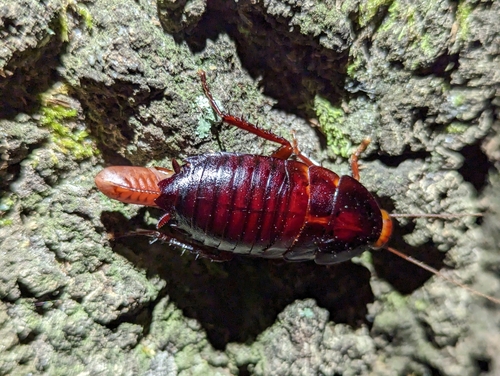
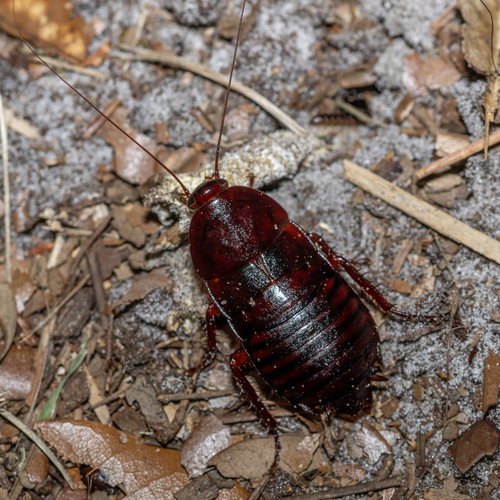
They are dark brown, turning reddish after a recent molt. Their fore-wings are very short, ending just past the mesonotum, and they have no hind wings.
Source: Wikipedia
Is it a pest in the house?
They sometimes wander indoors, especially into damp places like bathrooms, but they prefer the outdoors and are not a major indoor pest. Occasionally they establish in attics, leaving large droppings and dead body parts.
Source: Wikipedia
Does it bite or sting?
When alarmed, adults can spray a very foul-smelling fluid up to about 1 m (3.3 ft) from a sternal gland. The spray deters predators and acts as an alarm pheromone for other cockroaches.
Source: Wikipedia
How to get rid of it
They may wander indoors, especially into damp areas, but generally stay outdoors and are not a major household pest. When they do establish in attics, they leave large droppings and occasional dead parts.
Source: Wikipedia
Where it lives
They usually establish only in non-habitable parts of buildings.
Source: Wikipedia
What it eats
In nature they occupy holes in dead trees, stumps, woodpiles, bark cavities and sometimes leaf litter. When they get into attics they leave large droppings and occasional dead body parts.
Source: Wikipedia
Life cycle
Males can mate about 18 days after becoming adults, and females lay egg cases roughly every 8 days starting around 55 days after maturation.
Source: Wikipedia
When you see it
They cannot tolerate cold and need a warm, subtropical or tropical climate. They may become established in attics, leaving droppings and dead parts.
Source: Wikipedia
Where it comes from
Their native range includes Florida and the West Indies.
Source: Wikipedia
Lookalikes
They look very similar to female oriental cockroaches and can be mistaken for them. They are not the same as the American cockroach, another common Florida insect sometimes called a palmetto bug.
Source: Wikipedia
Where it is found in the US
Recorded in 10 of 51 states and DC. Most records: Florida, Texas, Georgia, Alabama, Louisiana, Virginia, South Carolina, Mississippi.
Darker = more records. Counts are museum and citizen-science records, not population size.
Source: GBIF
Status: introduced in Canada; native in North America; native in United States. Source: iNaturalist
Months it is reported in the US
Source: GBIF
More photos
Questions people ask
How can I tell a Florida woods cockroach from a similar species?
Look for very short fore-wings that end just past the mesonotum and the absence of hind wings; the color is dark brown, turning reddish after a molt.
Source: Wikipedia
Where are they likely to be found in my home?
They may wander into damp places like bathrooms or attics, but they usually stay outdoors in leaf litter, wood piles and similar shelters.
Source: Wikipedia
Are they a problem for my garden or trees?
The evidence only mentions them living in dead wood, leaf litter and tree holes; it does not state they damage living plants.
Source: Wikipedia
Same family (Blattidae)
 American CockroachPeriplaneta americanaCan spread germs or disease
 Oriental CockroachBlatta orientalisCan spread germs or disease
 Smokybrown CockroachPeriplaneta fuliginosaNuisance, not dangerous
 Australian CockroachPeriplaneta australasiaeNuisance, not dangerous
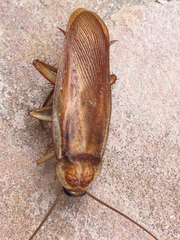 Turkestan CockroachPeriplaneta lateralis
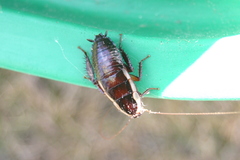 Gisborne CockroachDrymaplaneta semivittaHarmless
Sources
- Wikipedia: https://en.wikipedia.org/wiki/Florida_woods_cockroach
Look it up elsewhere: GBIF · iNaturalist · BugGuide · ITIS · Wikipedia
Text written 2026-10-23 from the sources above and checked sentence by sentence against them. Data fetched 2026-10-22.