 Bug FAQ
Brown Widow
Latrodectus geometricus · Order: Araneae · Family: Theridiidae
Also called: Brown Button, Brown Buttonspider, Brown Widow Spider, cobweb spiders
Source: lsuagcenter.com, Wikipedia

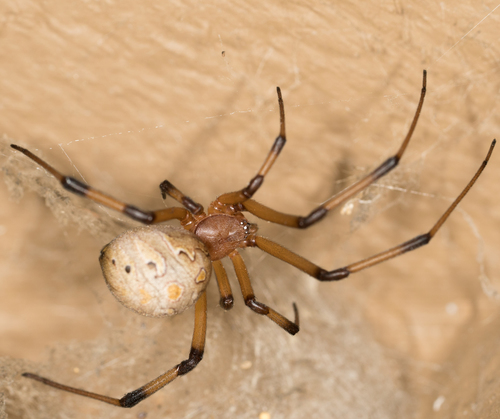
Females are medium-large (8 to 12 mm) with a tan to dark brown, mottled abdomen that shows a black-and-white geometric pattern and an orange-yellow hourglass on the underside. They build three-dimensional webs in dark corners around houses and can become numerous in tropical homes, but isolated individuals are usually harmless.
Source: lsuagcenter.com, faculty.ucr.edu, Wikipedia
How to recognize it
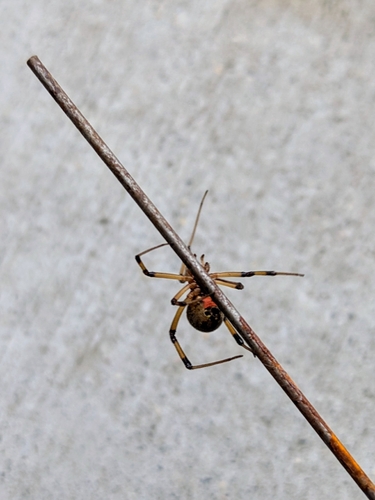
The abdomen has black-and-white geometric markings on the top and an orange-yellow hourglass on the underside. Females often have a dorsal longitudinal stripe and three diagonal stripes on each side of the abdomen. Males are small (2 to 5 mm), brown, and lack the bold patterns of females.
Source: Wikipedia, faculty.ucr.edu, lsuagcenter.com
Is it a pest in the house?
Brown widows are common around houses, especially in tropical areas, and can form large populations near buildings. They are less of a medical threat than black widows but may share the same niche, potentially altering local spider communities.
Source: Wikipedia, lsuagcenter.com, faculty.ucr.edu
Does it bite or sting?
Bites are painful, cause a red mark, and are generally mild compared with black widow bites. Anyone who thinks they have been bitten should consult a physician.
Source: faculty.ucr.edu, Wikipedia, lsuagcenter.com
How to get rid of it
Isolated individuals are usually not a concern, but large infestations should be handled by pest-control professionals. They breed prolifically, producing many egg sacs over their lifespan.
Source: lsuagcenter.com, faculty.ucr.edu
Where it lives
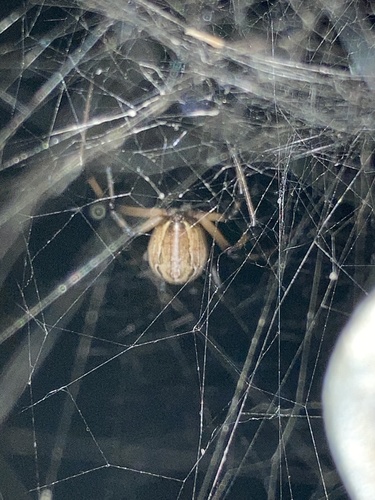
They spin three-dimensional webs in dark, protected corners of homes and nearby vegetation.
Source: Wikipedia, faculty.ucr.edu
What it eats
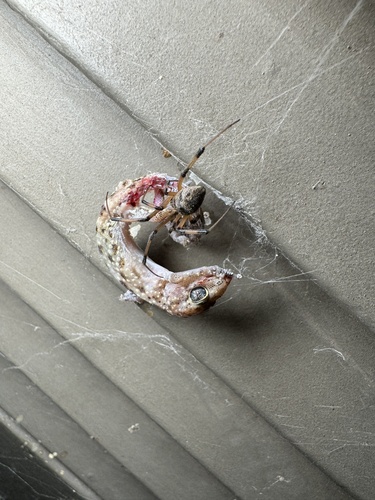
Like other Latrodectus species, they possess neurotoxic venom used to subdue prey. They are preyed upon by various wasps such as blue mud-dauber and digger wasps.
Source: Wikipedia
Life cycle
Eggs hatch in roughly 20 days.
Source: Wikipedia
Where it comes from
The brown widow is native to Africa and has been introduced to many regions worldwide, including the Americas and parts of Asia and Oceania.
Source: Wikipedia
Lookalikes
Brown widows are cousins of the black widow and share the hourglass marking, though theirs is orange-yellow rather than red. Immature brown widows can look similar to juvenile black widows, making identification tricky.
Source: Wikipedia, faculty.ucr.edu
Where it is found in the US
Recorded in 32 of 51 states and DC. Most records: California, Florida, Texas, Georgia, South Carolina, North Carolina, Alabama, Louisiana.
Darker = more records. Counts are museum and citizen-science records, not population size.
Source: GBIF
Status: introduced in North America; introduced in United States; introduced in Canada. Source: iNaturalist
Months it is reported in the US
Source: GBIF
More photos
Questions people ask
How can I tell a brown widow from a black widow?
Look for the orange-yellow hourglass and the black-and-white geometric pattern on the abdomen; black widows have a red hourglass and a solid black body.
Source: Wikipedia
Do brown widows bite humans?
Yes. Their bites hurt and leave a red mark, but they are much less dangerous than a black widow's.
Source: Wikipedia
Where are brown widows likely to build webs in my house?
They prefer dark, secluded corners such as behind furniture, in closets, or in woody vegetation near the home.
Source: Wikipedia, faculty.ucr.edu
Should I call pest control for a few brown widows?
A few isolated spiders are not usually a problem, but large numbers should be treated by a professional.
Source: lsuagcenter.com
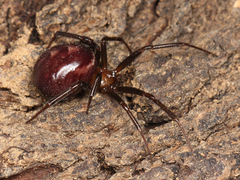
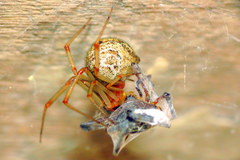
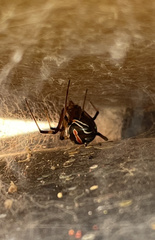
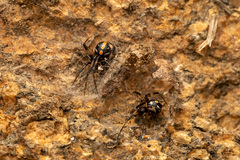
Same family (Theridiidae)


Sources
- lsuagcenter.com: https://www.lsuagcenter.com/articles/page1636498277801
- Wikipedia: https://en.wikipedia.org/wiki/Latrodectus_geometricus
- faculty.ucr.edu: https://faculty.ucr.edu/~legneref/biotact/invade/brownwidowspider.htm
Look it up elsewhere: GBIF · iNaturalist · BugGuide · ITIS · Wikipedia
Text written 2026-10-23 from the sources above and checked sentence by sentence against them. Data fetched 2026-10-23.