 Bug FAQ
Southern Black Widow
Latrodectus mactans · Order: Araneae · Family: Theridiidae
Also called: Black widow spider, cobweb spiders
Source: Wikipedia, UF/IFAS, Penn State Extension
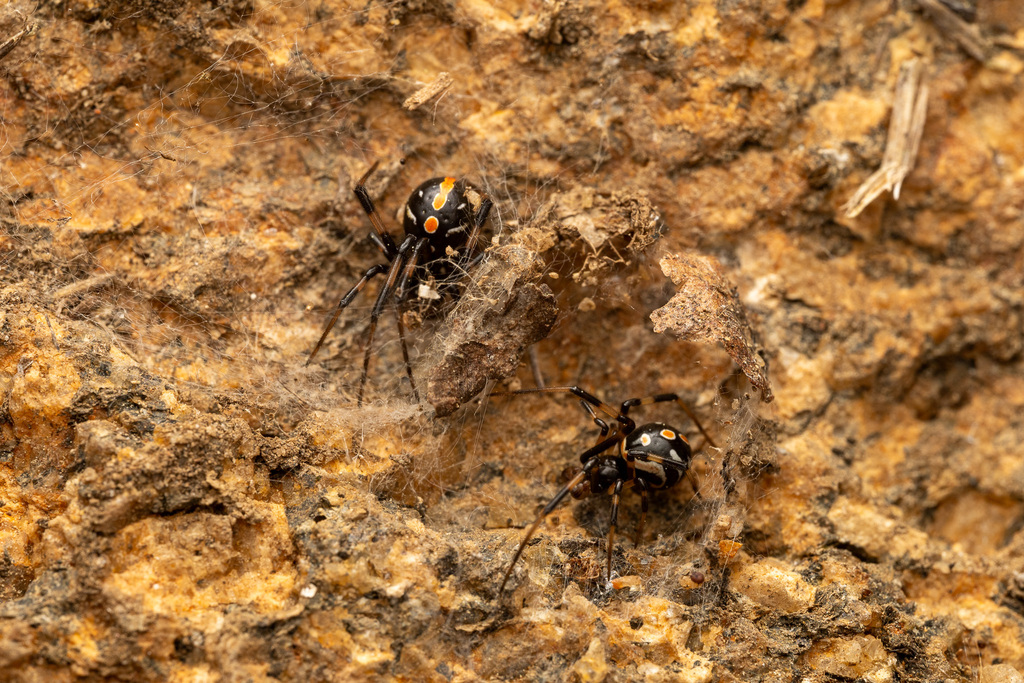
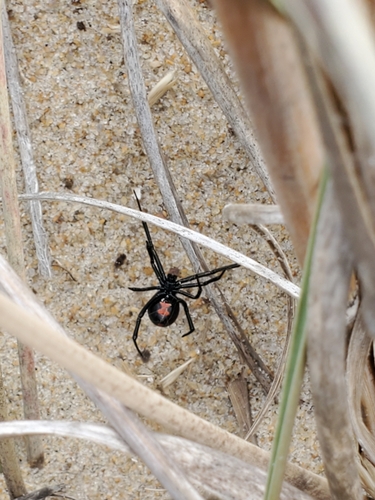
Females are shiny black with a bright red hourglass on the underside of a very round abdomen, and may have a red or orange patch above the spinnerets. They live mainly in the southeastern United States, extending north to Ohio and west to Texas, and are also found in Mexico and the Hawaiian Islands.
Source: Wikipedia, UF/IFAS, Penn State Extension
How to recognize it
Female Southern black widows are glossy black with a red hourglass on the belly’s underside.
Source: Wikipedia, UF/IFAS, Penn State Extension
Size
Adult females measure 8 to 13 mm in body length, while males are 3 to 6 mm. A gravid female’s abdomen can exceed 1.25 cm in diameter.
Source: Wikipedia
Is it a pest in the house?
Their three-dimensional cobwebs are strong and can be found in garages, barns and other dark corners of homes. Females guard their egg sacs in summer, which is when most bites to humans occur. They can help control pest insects such as fire ants and harvester ants.
Source: Wikipedia, Penn State Extension, UF/IFAS
Does it bite or sting?
Only mature females have fangs large enough to bite humans, and their chelicerae are about 1 mm long. The bite is usually painful but rarely fatal to healthy people. Bites are most likely when a female is protecting an egg sac.
Source: Wikipedia, Penn State Extension, UF/IFAS
Where it lives
They are commonly found in undisturbed places such as under stones, in woodpiles, vacant rodent holes, barns, garages, and outdoor privies.
Source: Penn State Extension
What it eats
They catch insects, woodlice, centipedes, millipedes and other spiders in their tangled cobwebs.
Source: Wikipedia
Life cycle
A female can lay four to nine egg sacs each summer, each containing 100 to 400 eggs. Maturing to breeding age takes two to four months, usually six to nine months total.
Source: Wikipedia
When you see it
They are most common in the southeastern United States from Ohio west to Texas, and have also been established in Hawaii.
Source: Wikipedia
Where it comes from
The species is native to North America, especially the southeastern United States.
Source: Wikipedia
Lookalikes
The northern black widow (L. variolus) overlaps in range with the Southern black widow.
Source: Wikipedia, Penn State Extension
Where it is found in the US
Recorded in 35 of 51 states and DC. Most records: Texas, Oklahoma, North Carolina, Virginia, Arkansas, Florida, Alabama, Georgia.
Darker = more records. Counts are museum and citizen-science records, not population size.
Source: GBIF
Status: native in United States. Source: iNaturalist
Months it is reported in the US
Source: GBIF
More photos
Questions people ask
How can I identify a Southern black widow?
Look for a shiny black spider with a bright red hourglass on the underside of its round abdomen; many also have a red or orange spot above the spinnerets.
Source: Wikipedia, UF/IFAS, Penn State Extension
Where are Southern black widows most likely to be found?
They live mainly in the southeastern United States, extending north to Ohio and west to Texas, and can also be found in Mexico and Hawaii.
Source: Wikipedia
Do Southern black widows bite humans?
Only adult females can bite, and the bite usually causes pain but is rarely fatal to healthy people.
Source: Wikipedia, UF/IFAS, Penn State Extension
Same family (Theridiidae)



Sources
- Wikipedia: https://en.wikipedia.org/wiki/Latrodectus_mactans
- UF/IFAS: https://edis.ifas.ufl.edu/publication/IN1000
- Penn State Extension: https://extension.psu.edu/southern-black-widow-spider
Look it up elsewhere: GBIF · iNaturalist · BugGuide · ITIS · Wikipedia
Text written 2026-10-23 from the sources above and checked sentence by sentence against them. Data fetched 2026-10-23.