 Bug FAQ
Chinese Red-headed Centipede
Scolopendra mutilans · Order: Scolopendromorpha · Family: Scolopendridae
Source: Wikipedia


The Chinese red-headed centipede grows to about 20 cm (8 in) long. It is a predator that kills prey by injecting venom. Its bite delivers a peptide toxin that activates TRPV1, producing a burning sensation.
Source: Wikipedia
How to recognize it
Also called the Chinese red head, this centipede is from East Asia, with its type locality in Japan.
Source: Wikipedia
Size
Adults average about 20 cm (8 in) in length.
Source: Wikipedia
Does it bite or sting?
The venom contains a peptide toxin (RhTx) that activates TRPV1, causing a localized burning pain. Crude venom is toxic to mice and can cause platelet aggregation.
Source: Wikipedia
What it eats
It hunts and kills prey by injecting venom.
Source: Wikipedia
Life cycle
Females guard their eggs, wrapping their bodies around the clutch until they hatch.
Source: Wikipedia
Where it comes from
It is native to East Asia, specifically Japan.
Source: Wikipedia
Lookalikes
It differs from S. subspinipes in the spination pattern of the prefemur on the ventral legs.
Source: Wikipedia
Questions people ask
How large does the Chinese red-headed centipede get?
Adults average about 20 cm (8 in) long.
Source: Wikipedia
Does it bite humans?
Yes, its bite delivers a toxin that activates TRPV1, causing a burning pain.
Source: Wikipedia
How do the females care for their eggs?
Females wrap their bodies around the egg clutch and guard it until the eggs hatch.
Source: Wikipedia
Same family (Scolopendridae)
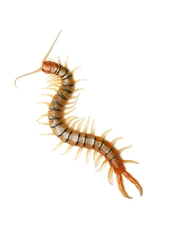 Common Desert CentipedeScolopendra polymorphaCan bite
 Giant Desert CentipedeScolopendra herosCan bite
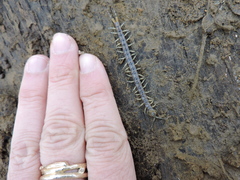 Eastern Bark CentipedeHemiscolopendra marginata
 Mediterranean Banded CentipedeScolopendra cingulataCan bite
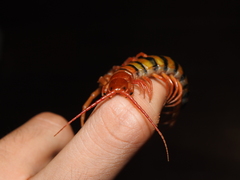 Red-headed CentipedeScolopendra morsitansCan bite
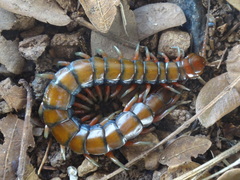 Pacific Giant CentipedeScolopendra subspinipesVenomous
Sources
- Wikipedia: https://en.wikipedia.org/wiki/Chinese_red-headed_centipede
Look it up elsewhere: GBIF · iNaturalist · BugGuide · Wikipedia
Text written 2026-10-23 from the sources above and checked sentence by sentence against them. Data fetched 2026-10-22.