 Bug FAQ
Red-headed Centipede
Scolopendra morsitans · Order: Scolopendromorpha · Family: Scolopendridae
Also called: Redhead Centipede, Tansanian blue ringleg, Tanzanian Blue Ringleg
Source: Wikipedia
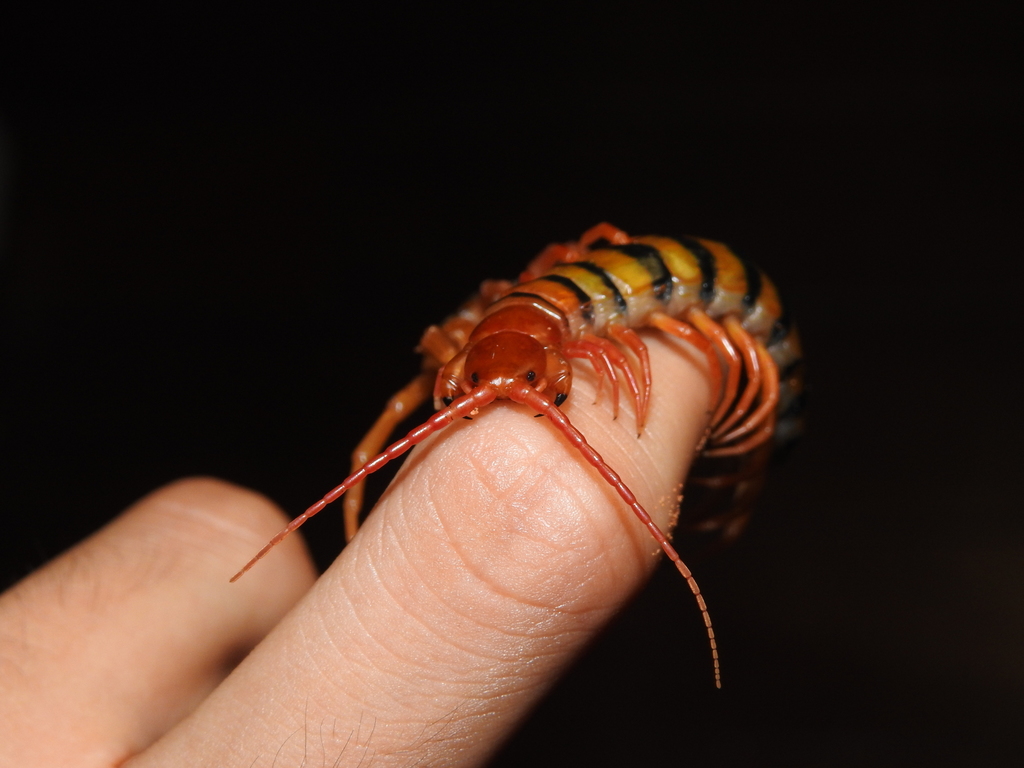
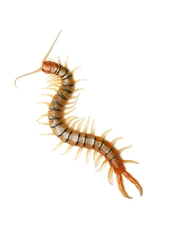
Adults have a bright red head and a brownish, striated body, with relatively thick ultimate legs. They are nocturnal predators that hunt other arthropods and small vertebrates using neurotoxic venom and strong jaws.
Source: Wikipedia
How to recognize it
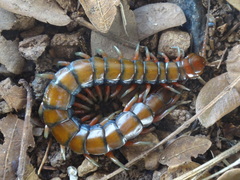
Adults show a bright red head, brownish body with distinct segment striations, and thick rear (ultimate) legs.
Source: Wikipedia
Size
Adults can reach up to about 127 mm (5 in) in length, though many are smaller, around 100 mm (4 in).
Source: Wikipedia
Is it a pest in the house?
The centipede is highly invasive and found on all inhabited continents.
Source: Wikipedia
Does it bite or sting?
Their neurotoxic venom can rapidly paralyse prey and, in human bites, causes redness, swelling and sometimes severe pain.
Source: Wikipedia
Where it lives
They prefer warm ground habitats, hiding under leaves, bark and other substrate.
Source: Wikipedia
What it eats
They are aggressive nocturnal hunters that eat other arthropods and small vertebrates, using neurotoxic venom and strong jaws to subdue prey.
Source: Wikipedia
Life cycle
The species is the type species of the genus Scolopendra, designated in the 1950s. Field observations note their relatively thick ultimate legs compared with other Scolopendra species.
Source: Wikipedia
When you see it
They hunt primarily at night. In north-western Thailand they have dark heads and legs, while in north-eastern Thailand and Cambodia they show bright red heads and legs.
Source: Wikipedia
Where it comes from
The species has a cosmopolitan, highly invasive distribution across all major continents.
Source: Wikipedia
Lookalikes
Do not confuse S. morsitans with S. heros, S. subspines, or Ethmostigmus trignopdus, which have similar common names.
Source: Wikipedia
Where it is found in the US
Recorded in 3 of 51 states and DC. Most records: Hawaii, Massachusetts, California.
Darker = more records. Counts are museum and citizen-science records, not population size.
Source: GBIF
Months it is reported in the US
Source: GBIF
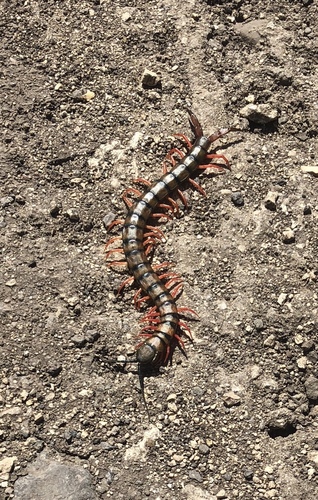
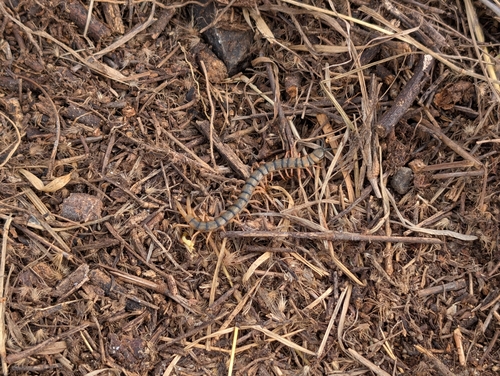
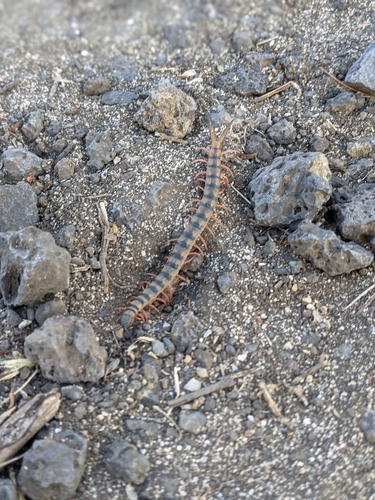
More photos

Questions people ask
How can I identify a red-headed centipede?
Look for a bright red head, brownish striped body and thick ultimate legs.
Source: Wikipedia
Where are they likely to be found?
In warm ground habitats under leaves, bark or other debris, and they are widespread across all continents.
Source: Wikipedia
Same family (Scolopendridae)



Sources
- Wikipedia: https://en.wikipedia.org/wiki/Scolopendra_morsitans
Look it up elsewhere: GBIF · iNaturalist · BugGuide · ITIS · Wikipedia
Text written 2026-10-23 from the sources above and checked sentence by sentence against them. Data fetched 2026-10-22.