 Bug FAQ
Common Desert Centipede
Scolopendra polymorpha · Order: Scolopendromorpha · Family: Scolopendridae
Also called: Desert Tiger Centipede, Giant Sonoran Centipede, Multicolored Centipede, Tiger Centipede
Source: UC IPM

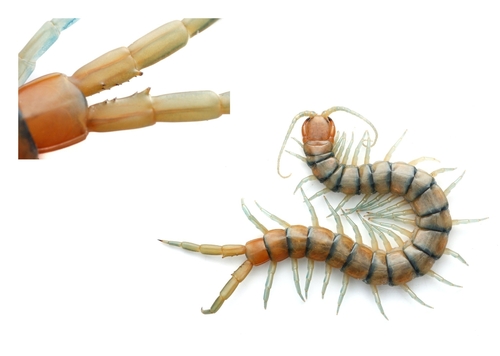
Adult desert centipedes are 10 to 18 cm long and have a flattened body with one pair of legs per segment. They show many colour forms, often brown with a dark stripe on each side, and are called tiger-striped or multicoloured centipedes. They live in dry grasslands, deserts and forests of the southwestern United States and northern Mexico.
How to recognize it
Their colour varies widely, giving them names like multicoloured or tiger-striped centipede. The body is brownish, over an inch long, with a dark lateral stripe on each segment.
Size
Adults reach 4 to 7 inches (10 to 18 cm) in length.
Source: Wikipedia
Does it bite or sting?
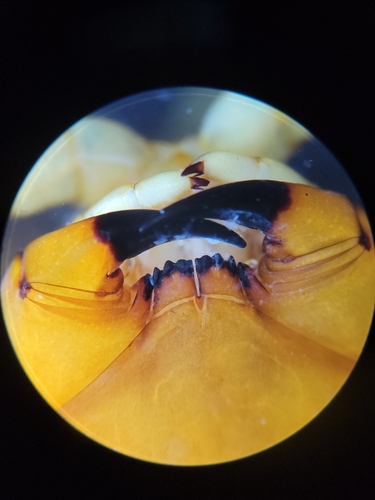
When provoked, they may bite, causing a painful wound with swelling, colour change and numbness. Their venom is considered medically relevant because it can cause muscle damage in laboratory animals.
How to get rid of it
Centipedes rarely need control unless they become a nuisance inside homes. Pesticides are seldom justified for centipede control.
Source: UC IPM
Where it lives
They inhabit dry grasslands, forests and desert areas.
Source: Wikipedia
What it eats
Their venom can damage muscle tissue in prey, affecting cellular structures and respiration.
Source: Wikipedia
Life cycle
After using its venom, the centipede cannot fully replenish it within the first 48 hours.
Source: Wikipedia
Where it comes from
They are native to the deserts of the southwestern U.S. (California, Arizona, New Mexico, Texas) and northern Mexico (Sonora, Chihuahua).
Source: Wikipedia
Lookalikes
Garden symphylans are much smaller (under ¼ in) and white, while millipedes are longer and can be confused with soil beetles.
Source: UC IPM
Where it is found in the US
Recorded in 15 of 51 states and DC. Most records: California, Arizona, New Mexico, Texas, Colorado, Nevada, Kansas, Utah.
Darker = more records. Counts are museum and citizen-science records, not population size.
Source: GBIF
Status: native in North America; native in United States. Source: iNaturalist
Months it is reported in the US
Source: GBIF
More photos

Questions people ask
Do they bite?
Yes, when disturbed they can bite, causing painful swelling, discoloration and numbness.
Source: UC IPM
Where are they found?
They live in dry grasslands, deserts and forests of the southwestern United States and northern Mexico.
Source: Wikipedia
Do I need to use pesticides to get rid of them?
Usually no; they seldom need control unless they become a nuisance, and pesticides are rarely justified.
Source: UC IPM
Same family (Scolopendridae)
 Giant Desert CentipedeScolopendra herosCan bite
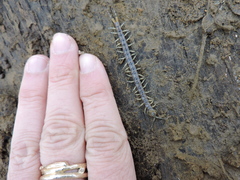 Eastern Bark CentipedeHemiscolopendra marginata
 Mediterranean Banded CentipedeScolopendra cingulataCan bite
 Chinese Red-headed CentipedeScolopendra mutilansCan bite
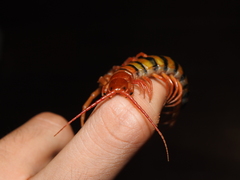 Red-headed CentipedeScolopendra morsitansCan bite
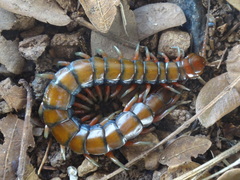 Pacific Giant CentipedeScolopendra subspinipesVenomous
Sources
- UC IPM: https://ipm.ucanr.edu/home-and-landscape/centipedes-and-millipedes/
- Wikipedia: https://en.wikipedia.org/wiki/Scolopendra_polymorpha
Look it up elsewhere: GBIF · iNaturalist · BugGuide · ITIS · Wikipedia
Text written 2026-10-22 from the sources above and checked sentence by sentence against them. Data fetched 2026-10-22.