 Bug FAQ
Vietnamese Centipede
Scolopendra dehaani · Order: Scolopendromorpha · Family: Scolopendridae
Also called: Malaysian Cherry Red Centipede

The giant Vietnamese centipede can grow to 25 cm or more in length. It hunts insects, spiders, vinegaroons and occasionally small vertebrates such as snakes and tree frogs.
Source: Wikipedia
How to recognize it
The centipede’s back plates are brown-orange and its sides are yellow. Four colour morphs are dichromatic and one is monochromatic, all generally reddish, brown or orange.
Source: Wikipedia
Where it lives
It can hunt in trees and has been observed foraging arboreally during the day.
Source: Wikipedia
What it eats
Its diet includes insects, spiders, vinegaroons and occasionally small snakes, tree frogs and other vertebrates.
Source: Wikipedia
Life cycle
Adults typically live five to six years.
Source: Wikipedia
Questions people ask
What does this centipede eat?
It eats insects, spiders, vinegaroons and sometimes small snakes or tree frogs.
Source: Wikipedia
Same family (Scolopendridae)
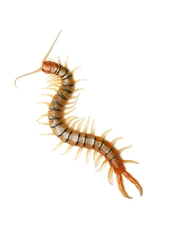 Common Desert CentipedeScolopendra polymorphaCan bite
 Giant Desert CentipedeScolopendra herosCan bite
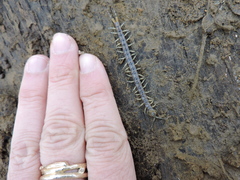 Eastern Bark CentipedeHemiscolopendra marginata
 Mediterranean Banded CentipedeScolopendra cingulataCan bite
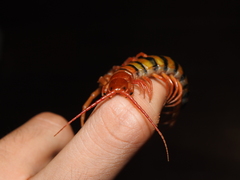 Red-headed CentipedeScolopendra morsitansCan bite
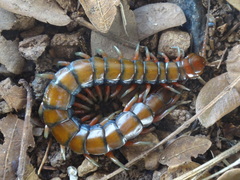 Pacific Giant CentipedeScolopendra subspinipesVenomous
Sources
- Wikipedia: https://en.wikipedia.org/wiki/Scolopendra_dehaani
Look it up elsewhere: GBIF · iNaturalist · BugGuide · ITIS · Wikipedia
Text written 2026-10-23 from the sources above and checked sentence by sentence against them. Data fetched 2026-10-23.