 Bug FAQ
Common Brimstone
Gonepteryx rhamni · Order: Lepidoptera · Family: Pieridae
Also called: Brimstone, The Brimstone
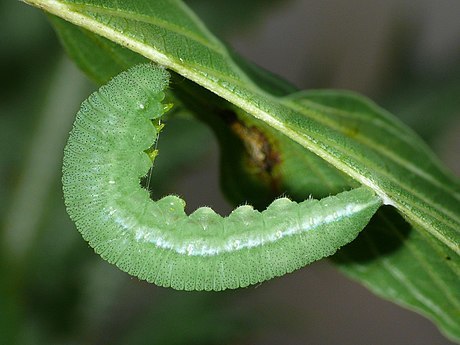
The common brimstone is a medium-sized butterfly with a wingspan of about 60 to 74 mm. Males have bright yellow, iridescent wings while females are greener and non-iridescent, and they can blend in with leaves while hibernating. It lives across Europe, Asia and North Africa, breeds in wetlands, hibernates in woodlands, and feeds on buckthorn as a caterpillar and various flowers as an adult.
Source: Wikipedia
How to recognize it
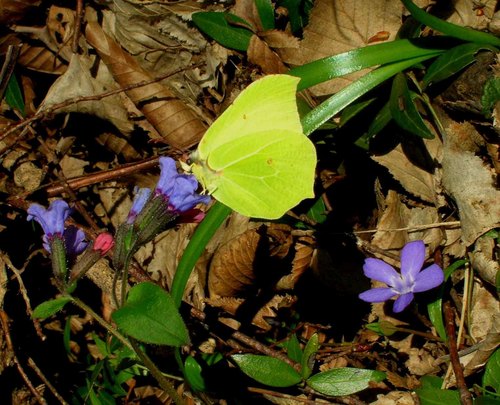
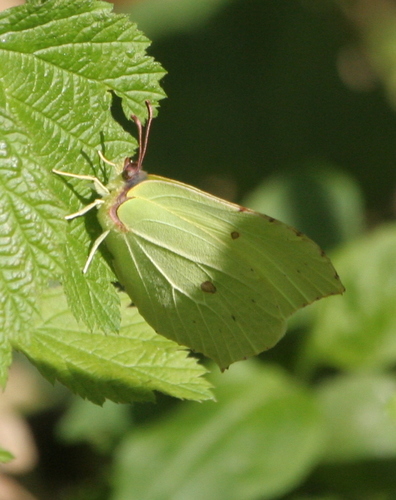
Males have yellow, iridescent wings; females have greenish-white, non-iridescent wings. The wing pattern resembles leaves, helping them stay hidden while hibernating.
Source: Wikipedia
Size
Wingspan ranges from 60 to 74 mm (2.4 to 2.9 in).
Source: Wikipedia
Where it lives
Breeds in wetlands where host plants like alder buckthorn are abundant. Adults hibernate in woodlands, using evergreen foliage and holly for shelter.
Source: Wikipedia
What it eats
Caterpillars feed only on alder buckthorn and common buckthorn. Adults sip nectar from many flowers such as knapweed and scabious.
Source: Wikipedia
Life cycle
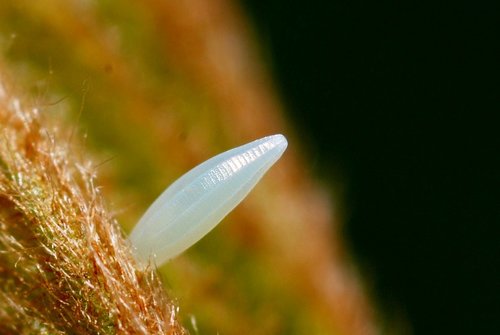
Adults live about 10 months to a year, one of the longest for butterflies. The species is univoltine, producing one generation each year.
Source: Wikipedia
When you see it
In spring they return to wetlands to mate and lay eggs when host plants are ready. They move to suitable hibernation sites in late summer and fall, then back to breeding grounds in spring.
Source: Wikipedia
Where it comes from
Found throughout the Palearctic region, including Europe, Asia and North Africa.
Source: Wikipedia
Lookalikes
Do not confuse this butterfly with the brimstone moth Opisthograptis luteolata.
Source: Wikipedia
Where it is found in the US
Recorded in 1 of 51 states and DC. Most records: Ohio.
Darker = more records. Counts are museum and citizen-science records, not population size.
Source: GBIF
More photos

Questions people ask
Are they a pest for gardens or crops?
The larvae feed only on buckthorn species, not on garden crops.
Source: Wikipedia
Same family (Pieridae)



Sources
- Wikipedia: https://en.wikipedia.org/wiki/Gonepteryx_rhamni
Look it up elsewhere: GBIF · iNaturalist · BugGuide · Wikipedia
Text written 2026-10-22 from the sources above and checked sentence by sentence against them. Data fetched 2026-10-22.