 Bug FAQ
Green-veined White
Pieris napi · Order: Lepidoptera · Family: Pieridae
Also called: Mustard White, Sharp-veined White, Weined White

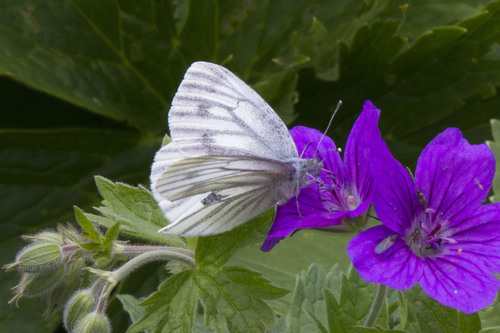
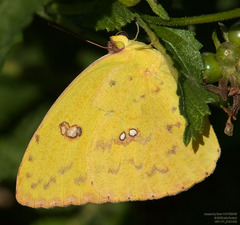
The Green-veined White butterfly has pale yellow hindwing undersides with black-scaled veins that look green, and females show two spots on each forewing while males have one. It lives in damp, grassy spots with some shade such as forest edges, hedgerows, meadows and river valleys, from sea level up to high mountains across Europe, Asia and North America.
Source: Wikipedia
How to recognize it
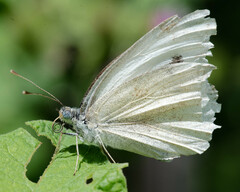
Underside hindwings are pale yellow with black-scaled veins that give a greenish tint. Females have two spots on each forewing; males have only one.
Source: Wikipedia
What it eats
Eggs are laid singly on many plants such as hedge mustard, garlic mustard, cuckooflower, water-cress, charlock, large bitter-cress, wild cabbage and wild radish. Caterpillars usually feed on leaves, while the similar orange tip caterpillar feeds on flowers and seed pods, so they rarely compete.
Source: Wikipedia
Life cycle
Overwinters as a pupa like other Pieris species.
Source: Wikipedia
When you see it
In Great Britain, early-season (April-June) butterflies have grey-tinged veins, while the second flight in late July-August shows stronger black markings.
Source: Wikipedia
Where it is found in the US
Recorded in 25 of 51 states and DC. Most records: California, Utah, Colorado, Alaska, New Mexico, New Hampshire, Arizona, Montana.
Darker = more records. Counts are museum and citizen-science records, not population size.
Source: GBIF
Months it is reported in the US
Source: GBIF
More photos
Questions people ask
Are they a garden pest?
They are rarely a pest because their larvae feed on a wide range of wild mustard-family plants, not cultivated crops.
Source: Wikipedia
Same family (Pieridae)


Sources
- Wikipedia: https://en.wikipedia.org/wiki/Green-veined_white
Look it up elsewhere: GBIF · iNaturalist · BugGuide · ITIS · Wikipedia
Text written 2026-10-22 from the sources above and checked sentence by sentence against them. Data fetched 2026-10-22.