 Bug FAQ
Common Buckeye
Junonia coenia · Order: Lepidoptera · Family: Nymphalidae
Also called: Northern Buckeye

The common buckeye is a medium-sized butterfly with brown, orange, black, white, blue and magenta markings and distinctive eyespots on its wings. It lives in sunny open areas such as fields, dunes and scrub up to about 1,300 m altitude and feeds as a caterpillar on various plantains and other herbs, while adults visit yellow flowers that have not been altered by other insects. Its life cycle includes a J-shaped hanging pupation on a silk pad and a brown, prickly chrysalis, and it can be confused with similar species like the painted lady or the gray buckeye.
Source: Wikipedia
How to recognize it
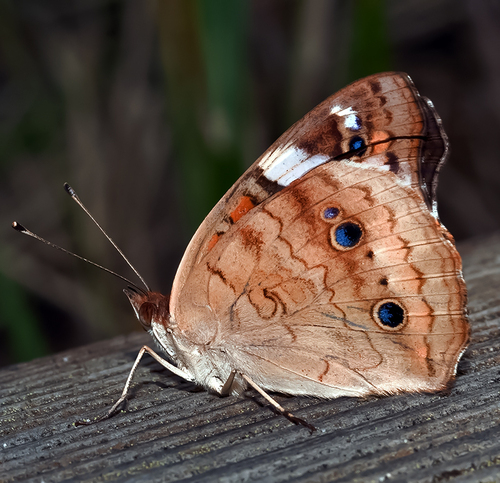
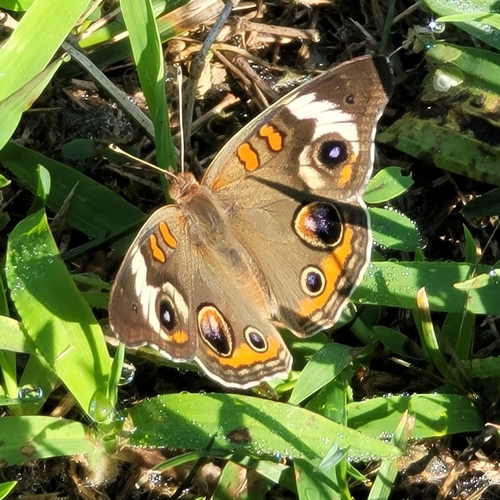
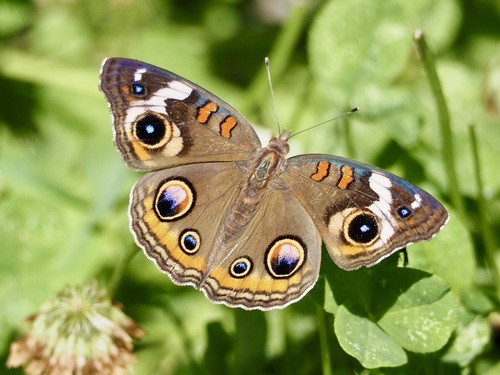
The butterfly is mostly brown with orange, black, white, blue and magenta patches, and its forewings have orange bars, a white band, and two eyespots with bluish centers and orange borders.
Source: Wikipedia
Size
Its wings carry two eyespots about 2 to 2.5 inches (5 to 6.5 cm) across.
Source: Wikipedia
Where it lives
It prefers sunny fields, dunes and scrub, often up to 1,300 m elevation.
Source: Wikipedia
What it eats
Caterpillars eat a range of plants such as narrowleaf and common plantain, blue toadflax, false foxglove, Mexican petunia, firecracker plant and cudweed. Adults sip nectar from yellow flowers that have not been altered by prior insect visits.
Source: Wikipedia
Life cycle
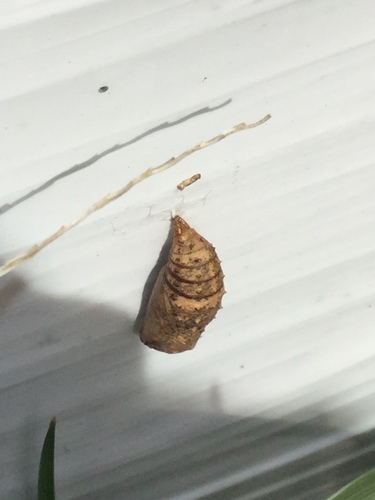
Caterpillars spin a silk pad, attach themselves, and hang in a J-shape for a day before shedding to become a chrysalis. The chrysalis is brown with beige markings and a prickly texture.
Source: Wikipedia
Where it comes from
Native to North America. Its genus first arose in Africa.
Source: iNaturalist, Wikipedia
Lookalikes
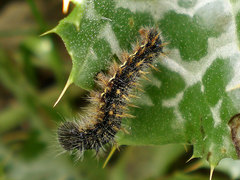
Other butterflies that look similar as caterpillars include the painted lady, Glanville fritillary and red admiral. The gray buckeye (Junonia grisea) west of the Rockies was once considered a subspecies of this butterfly.
Source: Wikipedia
Where it is found in the US
Recorded in 49 of 51 states and DC. Most records: Texas, Florida, Illinois, Virginia, North Carolina, Maryland, Georgia, South Carolina.
Darker = more records. Counts are museum and citizen-science records, not population size.
Source: GBIF
Status: native in North America; native in United States. Source: iNaturalist
Months it is reported in the US
Source: GBIF
More photos
Same family (Nymphalidae)





Sources
- Wikipedia: https://en.wikipedia.org/wiki/Junonia_coenia
- iNaturalist: https://www.inaturalist.org/taxa/48505
Look it up elsewhere: GBIF · iNaturalist · BugGuide · ITIS · Wikipedia
Text written 2026-10-22 from the sources above and checked sentence by sentence against them. Data fetched 2026-10-22.