 Bug FAQ
Common Drone Fly
Eristalis tenax · Order: Diptera · Family: Syrphidae
Also called: Bee Mimicking Hover Fly, Drone Fly
Source: Wikipedia
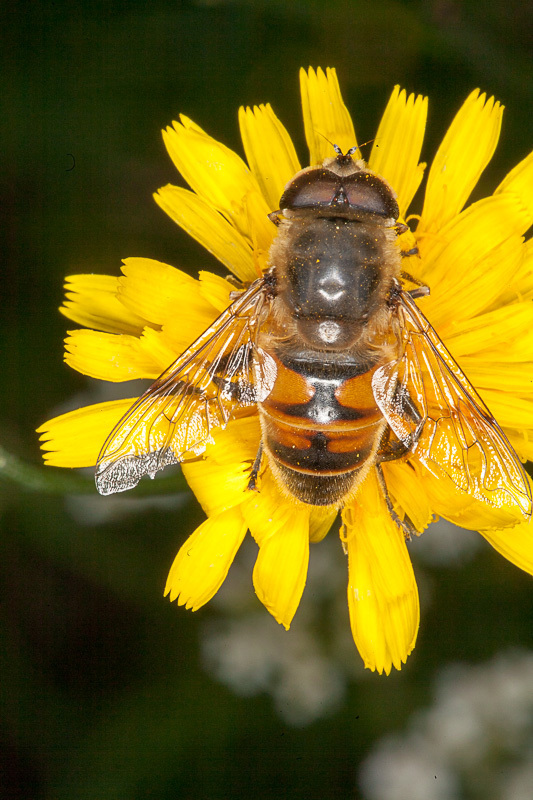
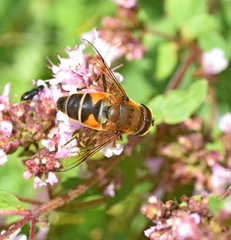
It is a small hoverfly with wing length about 10-13 mm and a wingspan near 15 mm. The abdomen ranges from dark brown to orange, the hind tibiae are dark and thickened, and dark setae sit just above the antenna bases. It lives near polluted water such as drainage ditches and manure pools, and adults feed on flower nectar and pollen, especially in late summer and autumn.
Source: Wikipedia
How to recognize it
Abdomen colour varies from dark brown to orange. Hind tibiae are black or brown and thickened in the middle. Dark setae are present just above the antenna bases.
Source: Wikipedia
Size
Wing length averages 9.75 to 13 mm; wingspan about 15 mm.
Source: Wikipedia
Is it a pest in the house?
Males may enter barns and basements while defending territories.
Source: Wikipedia
Does it bite or sting?
The adult that emerges is harmless.
Source: Wikipedia
Where it lives
Found in gardens and fields across Europe and Australia. Larvae live in polluted water such as drainage ditches, manure pools, and sewage.
Source: Wikipedia
What it eats
Adults feed mainly on flower nectar and pollen, and will sip water if offered.
Source: Wikipedia
Life cycle
Eggs are laid on surface water and develop through three larval stages before leaving the water to pupate.
Source: Wikipedia
When you see it
Adults are common on flowers in late summer and autumn; males defend territories in summer.
Source: Wikipedia
Where it comes from
A cosmopolitan, migratory species present on all continents except Antarctica.
Source: Wikipedia
Lookalikes
It resembles a drone honey bee, gaining some protection by mimicking a stinging insect.
Source: Wikipedia
Where it is found in the US
Recorded in 50 of 51 states and DC. Most records: California, New York, Vermont, Washington, Maine, Pennsylvania, Massachusetts, Ohio.
Darker = more records. Counts are museum and citizen-science records, not population size.
Source: GBIF
Status: introduced in North America; introduced in United States; introduced in Canada. Source: iNaturalist
Months it is reported in the US
Source: GBIF
More photos

Questions people ask
Do they bite or sting?
No, the adult common drone fly does not bite or sting people.
Source: Wikipedia
Why do they sometimes get into my barn or basement?
Males defend territories such as flowerbeds or bushes and may wander into barns and basements while doing so.
Source: Wikipedia
What do the larvae look like?
The larvae are rat-tailed maggots that live in polluted water and are saprophagous.
Source: Wikipedia
Same family (Syrphidae)





Sources
- Wikipedia: https://en.wikipedia.org/wiki/Eristalis_tenax
Look it up elsewhere: GBIF · iNaturalist · BugGuide · ITIS · Wikipedia
Text written 2026-10-23 from the sources above and checked sentence by sentence against them. Data fetched 2026-10-22.