 Bug FAQ
Yellow-haired Sun Fly
Myathropa florea · Order: Diptera · Family: Syrphidae
Also called: Batman Hoverfly

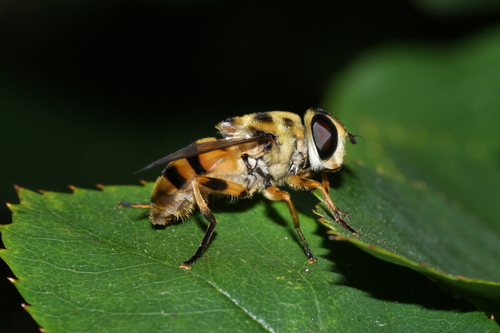
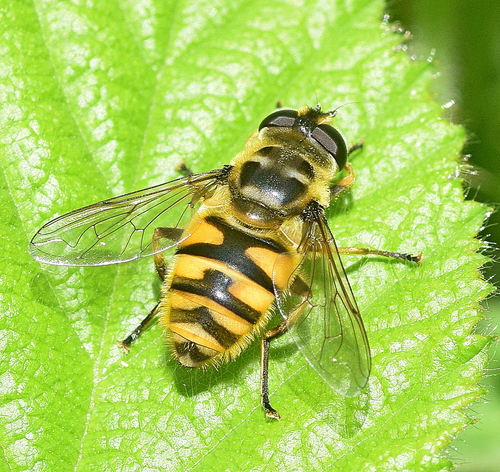
The yellow-haired sun fly is a small hoverfly with a wing length of about 7 to 12 mm and distinctive yellow and black markings on its thorax and abdomen. It lives in deciduous woodlands, farms, parks and gardens across most of Europe and flies from May to October, visiting many kinds of flowers.
Source: Wikipedia
How to recognize it
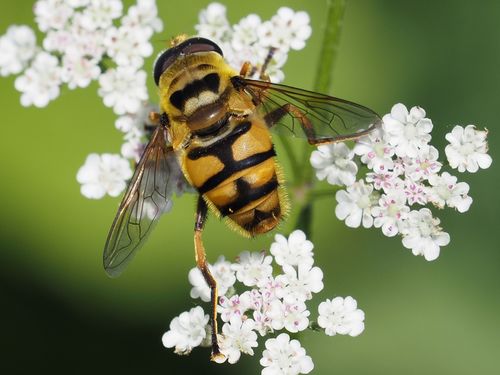
The thorax has two light yellow bands broken by a black central spot and a skull-shaped black pattern, while the abdomen is black with yellow markings.
Source: Wikipedia
Size
Wing length ranges from 7 to 12 mm (about 0.3 to 0.5 in).
Source: Wikipedia
What it eats
Adults feed on a wide range of flowers such as umbellifers, hawthorn, honeysuckle, rhododendron and many others. Larvae live in water-logged detritus, feeding on bacteria in shallow rot holes of tree stumps.
Source: Wikipedia
When you see it
Adults are seen on flowers from May through September, with the overall flight period extending to October.
Source: Wikipedia
Where it is found in the US
Recorded in 5 of 51 states and DC. Most records: California, Oregon, Washington, Idaho, Colorado.
Darker = more records. Counts are museum and citizen-science records, not population size.
Source: GBIF
Status: introduced in North America; introduced in United States. Source: iNaturalist
Months it is reported in the US
Source: GBIF
More photos

Questions people ask
Are they a pest for gardens or crops?
They are not reported to damage plants; they mainly visit flowers for nectar.
Source: Wikipedia
Same family (Syrphidae)





Sources
- Wikipedia: https://en.wikipedia.org/wiki/Myathropa_florea
Look it up elsewhere: GBIF · iNaturalist · BugGuide · Wikipedia
Text written 2026-10-22 from the sources above and checked sentence by sentence against them. Data fetched 2026-10-22.