 Bug FAQ
Thick-legged Hover Fly
Syritta pipiens · Order: Diptera · Family: Syrphidae
Also called: Common Compost Fly, Hover Fly
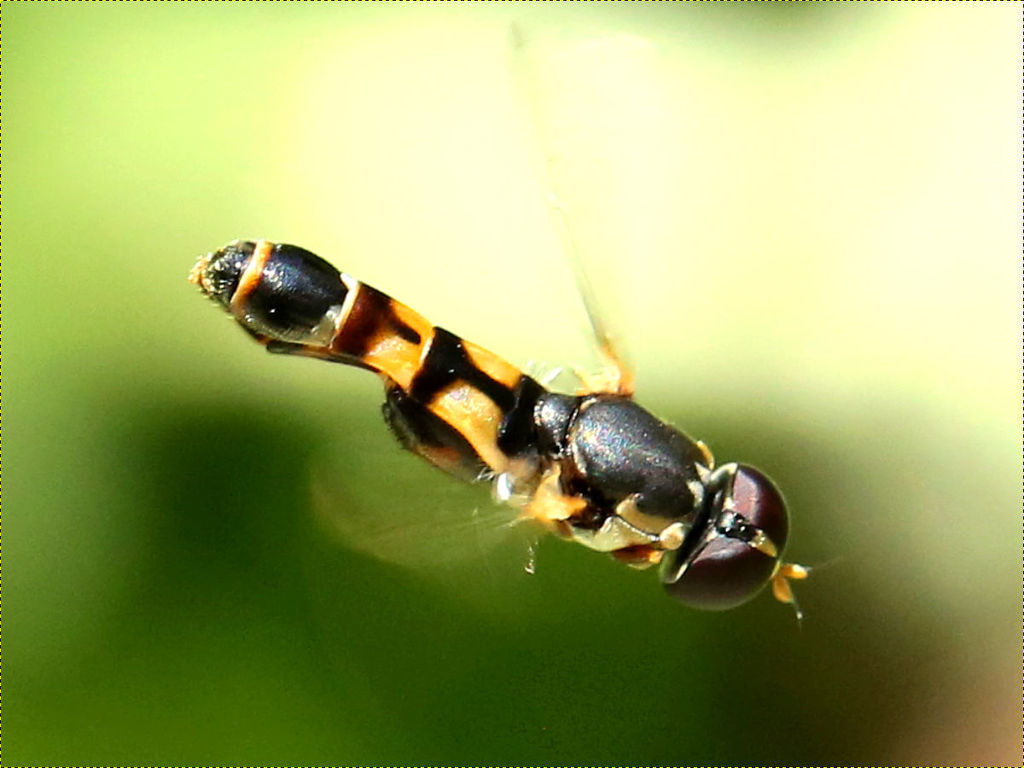
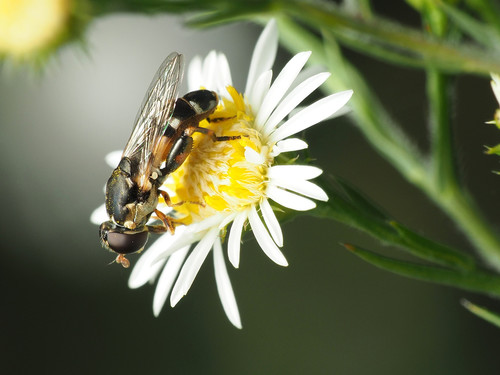
Adult flies are small, 6.5 to 9 mm long, with broad femora and two white wedge-shaped spots on the thorax behind the head. They live in gardens, farms and urban parks where flowers are present, while larvae develop in wet, decaying organic matter such as compost and manure. They are native to Europe but now occur across Eurasia and North America, flying from spring to autumn in most regions.
Source: Wikipedia
How to recognize it
Females have similar markings and a bluish-black ocellar triangle with a metallic sheen.
Source: Wikipedia
Size
Wing length is 4.25 to 7 mm and body length is 6.5 to 9 mm. Larvae are about 10 mm long, 2.75 mm wide and 2 mm high.
Source: Wikipedia
Is it a pest in the house?
They recycle plant and animal debris, pollinate many common plants and serve as bio-indicators of environmental health.
Source: Wikipedia
Where it lives
Adults are common in human-made habitats like farms, gardens and urban parks where flowers grow. Larvae live in wet wetlands near lakes, ponds, rivers or ditches, and in moist rotting material such as compost and manure.
Source: Wikipedia
What it eats
Larvae feed on decaying organic matter. Adults visit flowers of water-willow, white vervain, American pokeweed and candyleaf for nectar.
Source: Wikipedia
Life cycle
The life cycle includes egg, larva, puparium and adult stages. Larvae develop in moist, rotting organic material such as manure, compost and decaying vegetable waste.
Source: Wikipedia
When you see it
In Ontario they are active from mid-April to mid-October; in Europe they fly from March to November and may be present year-round in southern areas.
Source: Wikipedia
Where it comes from
Originally European, the species now ranges across Eurasia and North America.
Source: Wikipedia
Lookalikes
The name comes from their characteristically broad femora.
Source: Wikipedia
Where it is found in the US
Recorded in 50 of 51 states and DC. Most records: California, New York, Massachusetts, Pennsylvania, Washington, Maine, Oregon, Vermont.
Darker = more records. Counts are museum and citizen-science records, not population size.
Source: GBIF
Status: introduced in North America; introduced in United States; introduced in Canada. Source: iNaturalist
Months it is reported in the US
Source: GBIF
More photos
Questions people ask
Where can I find them?
Look for them on flowers in gardens, farms and parks, and their larvae in moist compost, manure or wet organic matter near water.
Source: Wikipedia
When are they active?
They are active from early spring to late autumn, depending on the region.
Source: Wikipedia
Same family (Syrphidae)





Sources
- Wikipedia: https://en.wikipedia.org/wiki/Syritta_pipiens
Look it up elsewhere: GBIF · iNaturalist · BugGuide · ITIS · Wikipedia
Text written 2026-10-22 from the sources above and checked sentence by sentence against them. Data fetched 2026-10-22.