 Bug FAQ
Common Eastern Velvet Ant
Dasymutilla occidentalis · Order: Hymenoptera · Family: Mutillidae
Also called: Cow Ant, Cow Killer Velvet Ant, Eastern Red Velvet Ant
Source: Wikipedia, citybugs.tamu.edu, extension.msstate.edu, arthropod.uark.edu
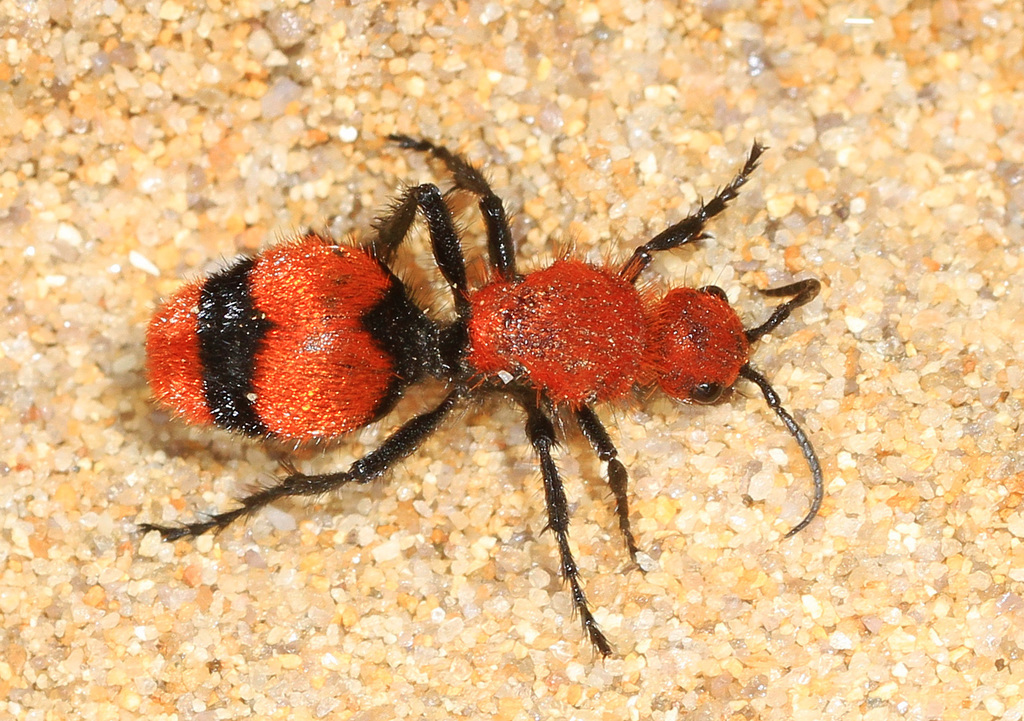
The eastern velvet ant is a wingless female wasp about 1.9 cm long, covered in dense red and black velvety hairs. It is most noticeable in summer when females wander on the ground looking for nests of cicada-killer and other large ground-nesting wasps to parasitize.
Source: Wikipedia, citybugs.tamu.edu, extension.msstate.edu, arthropod.uark.edu
How to recognize it
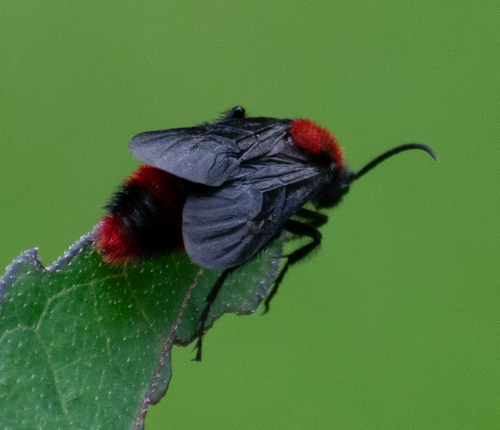
Adults have black bodies with bright orange-red markings on the thorax and abdomen, a warning coloration.
Source: Wikipedia, extension.msstate.edu, arthropod.uark.edu
Size
Females can reach about 1.9 cm (0.75 in) in length, roughly an inch long.
Source: Wikipedia, extension.msstate.edu, arthropod.uark.edu
Is it a pest in the house?
People are most likely to be stung when walking barefoot in areas where females are active on the ground.
Source: citybugs.tamu.edu, extension.msstate.edu
Does it bite or sting?
The sting is rated 3 out of 4 on the Schmidt pain index and is described as more painful than a bee or red wasp sting. The painful reputation has earned it the nickname “cow killer.”
Source: Wikipedia, citybugs.tamu.edu, extension.msstate.edu, arthropod.uark.edu
How to get rid of it
Control options are limited; educate children not to handle them and wear shoes in infested areas. They rarely sting unless stepped on or mishandled.
Source: citybugs.tamu.edu, extension.msstate.edu
What it eats
Females locate nests of cicada-killer and horse-guard wasps, lay an egg on a host larva, and their hatching grub eats the host.
Source: Wikipedia
Life cycle
Velvet ants live solitary lives; females mate once and then search for host nests to lay eggs. The developing larva pupates in about 23 days.
Source: Wikipedia
When you see it
Adults are most commonly seen during the summer months.
Source: Wikipedia
Where it comes from
The species occurs in the United States from Connecticut west to Kansas and south from Florida to Texas.
Source: Wikipedia
Lookalikes
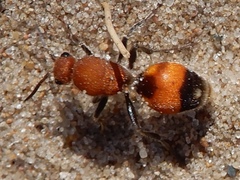
Females look like large, wingless ants, while males have translucent wings and lack a stinger. Despite the name, velvet ants are actually wasps in the family Mutillidae.
Source: Wikipedia, citybugs.tamu.edu, extension.msstate.edu, arthropod.uark.edu
Where it is found in the US
Recorded in 41 of 51 states and DC. Most records: Texas, Florida, North Carolina, Georgia, Virginia, Tennessee, South Carolina, Alabama.
Darker = more records. Counts are museum and citizen-science records, not population size.
Source: GBIF
Status: native in North America; native in United States. Source: iNaturalist
Months it is reported in the US
Source: GBIF
More photos
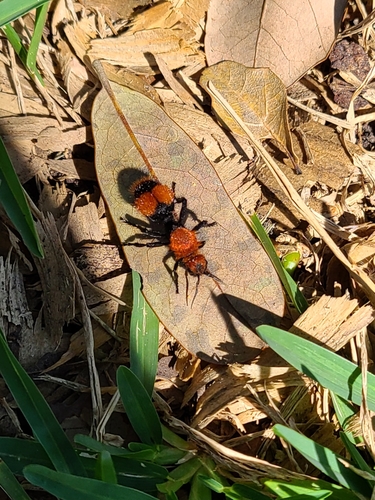
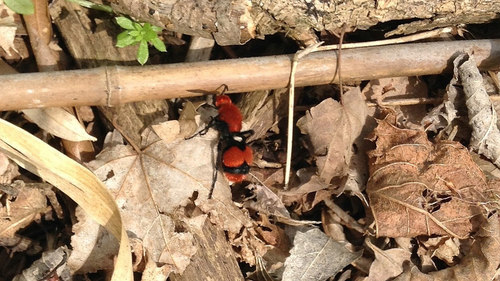
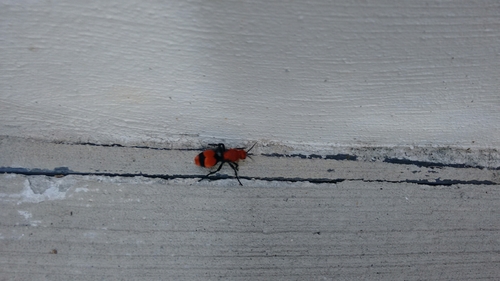
Questions people ask
How can I avoid getting stung by an eastern velvet ant?
Wear proper footwear and avoid handling the insects; they usually only sting when stepped on or mishandled.
Source: citybugs.tamu.edu, extension.msstate.edu
What does the eastern velvet ant look like?
It is a wingless, ant-like female about an inch long, black with bright red or orange markings and covered in velvety hairs.
Source: Wikipedia, citybugs.tamu.edu, extension.msstate.edu, arthropod.uark.edu
When are eastern velvet ants active?
Adults are most commonly seen in the summer months, moving on the ground searching for host nests.
Source: Wikipedia, extension.msstate.edu
Do eastern velvet ants damage my garden?
They do not feed on plants; they parasitize other ground-nesting wasps, so they are not a garden pest.
Source: Wikipedia
Same family (Mutillidae)


Sources
- Wikipedia: https://en.wikipedia.org/wiki/Dasymutilla_occidentalis
- citybugs.tamu.edu: https://citybugs.tamu.edu/factsheets/biting-stinging/wasps/ent-3004
- extension.msstate.edu: https://extension.msstate.edu/newsletters/bugs-eye-view/2019/eastern-velvet-ant-vol-5-no-22
- arthropod.uark.edu: https://arthropod.uark.edu/?p=27766
Look it up elsewhere: GBIF · iNaturalist · BugGuide · ITIS · Wikipedia
Text written 2026-10-23 from the sources above and checked sentence by sentence against them. Data fetched 2026-10-23.