 Bug FAQ
Dasymutilla vestita
Dasymutilla vestita · Order: Hymenoptera · Family: Mutillidae
Source: Wikipedia

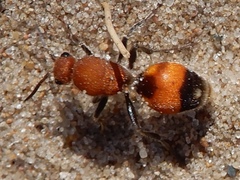
Adults are about 9.5 mm long and show bright red bodies with black legs, a narrow mid-section, eyes and antennae when viewed from above. Females are wingless, look like large hairy ants, and spend most of their lives searching the ground for host nests to lay eggs. They occur in western North America, from western Canada through the western United States into dry regions of Mexico.
Source: Wikipedia
How to recognize it
The insect is strikingly red with black legs, a narrow mid-section, eyes and antennae visible from above. A tight constriction separates the hind part (metasoma) from the middle part (mesosoma).
Source: Wikipedia
Size
Body length is about 9.5 mm.
Source: Wikipedia
Does it bite or sting?
Females can sting painfully, earning the nickname “cow killers,” though the venom is less toxic than honeybee venom.
Source: Wikipedia
Where it lives
In the southwestern USA it signals pinyon-juniper woodlands where trees are stressed by drought and beetles. It has been photographed in an overgrazed, eroding field at roughly 1,900 m elevation in central Mexico.
Source: Wikipedia
What it eats
Males visit flowers and feed there, while females search the ground for host nests to lay eggs.
Source: Wikipedia
Life cycle
The larva consumes the host pupa, kills it, then pupates and emerges as an adult. Finding a suitable host for eggs is a difficult task for the female.
Source: Wikipedia
Where it comes from
In Canada it is found in Alberta and Saskatchewan. In the USA it ranges across the western states east to Arkansas and Texas. In Mexico it lives in the dry northern, eastern and central areas down to Oaxaca, but not the Yucatán.
Source: Wikipedia
Lookalikes
Wingless females resemble large, hairy ants; winged males look like typical wasps.
Source: Wikipedia
Where it is found in the US
Recorded in 18 of 51 states and DC. Most records: New Mexico, Colorado, Utah, Arizona, Texas, Wyoming, Idaho, Nevada.
Darker = more records. Counts are museum and citizen-science records, not population size.
Source: GBIF
Status: native in North America; native in Canada; native in United States. Source: iNaturalist
Months it is reported in the US
Source: GBIF
More photos


Questions people ask
Do they sting people?
Yes, the female can deliver a painful sting, but the venom is milder than that of a honeybee.
Source: Wikipedia
What do they look like?
They are about 9.5 mm long, bright red on top with black legs, a narrow black mid-section, eyes and antennae, and females are wingless.
Source: Wikipedia
Same family (Mutillidae)


Sources
- Wikipedia: https://en.wikipedia.org/wiki/Dasymutilla_vestita
Look it up elsewhere: GBIF · iNaturalist · BugGuide · Wikipedia
Text written 2026-10-22 from the sources above and checked sentence by sentence against them. Data fetched 2026-10-22.